

Calmer waters: Biden's prospective foreign policy
The new president's foreign policy will differ from Trump's in style, language and tone more than in substance.
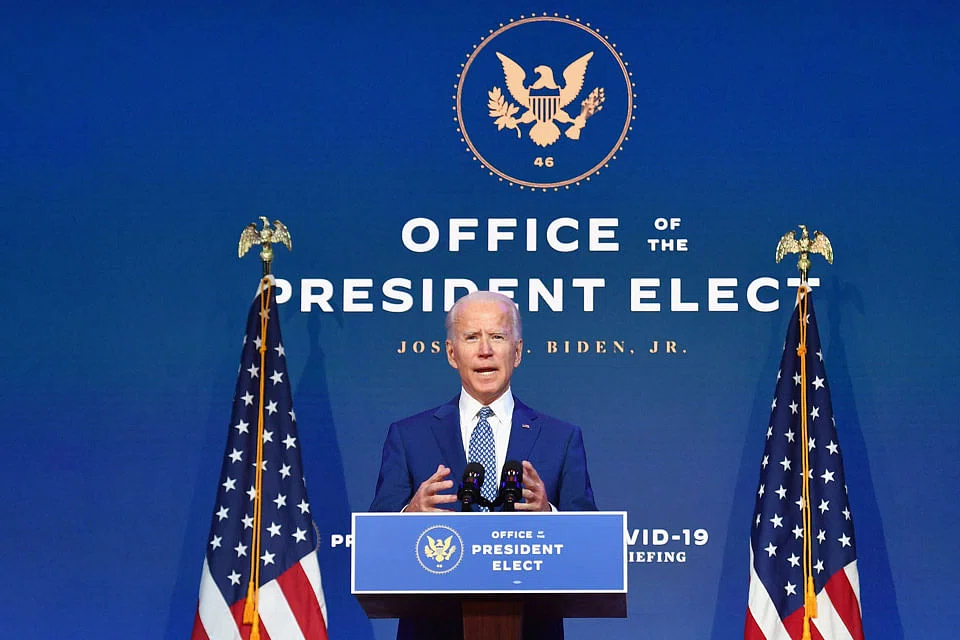
THANK goodness! That will be the reaction of political leaders in most, but by no means all, countries around the world to Joe Biden's victory in the US presidential elections - as well as that of most of their citizens.
This does not mean, however, that the new president will turn Donald Trump's foreign policy on its head overnight. On some major issues, there will be more continuity than change in the foreign policy of the new administration. On others, though, Mr Biden will set a new direction.
The most radical change will be one of style, tone and language. US foreign policy under President Biden will be more consistent, stable and calculable. It will not be made by presidential tweets.
US policy will be conducted by experienced, professional diplomats, under the oversight of a president who, having long served on the Senate Committee on Foreign Relations, twice as its chairman, has an infinitely deeper knowledge of international affairs than his predecessor.
At the level of rhetoric at least, the US will once again become a champion of liberal-democratic values.
Irrespective of policy content or substance, this change will be important. As the international balance of power continues to shift, as it will, from the West (led by the US) to the East (above all China), the capacity of the US to influence world politics will depend increasingly on how closely and effectively it can cooperate with like-minded states around the world.
Mr Biden and his team will strive to restore the international reputation and image of the US - which Mr Trump's unilateralist policy of 'America First' has so much tarnished.
A RETURN TO MULTILATERALISM
Compared with Mr Trump, Mr Biden's approach to foreign policy will therefore be much more multilateral.
The new president and his foreign policy team will invest heavily in repairing the damage done by Mr Trump to the alliances of the US and to relations with its historical partners around the world.
It is certain to be much less friendly than Mr Trump towards Russia. It will not raise question marks over the survival of the North Atlantic Treaty Organization ( Nato) and it will not seek to undermine the European Union as did Mr Trump with his support for Brexit.
Thus British Prime Minister Boris Johnson will likely have to abandon any hopes he might have had to negotiate a trade agreement with the US that could in any way compensate for the UK's withdrawal from or more limited access to the EU's internal market.
In the same vein, Mr Biden's administration will bring the US back into several international organisations and accords from which the Trump administration withdrew.
The US will rejoin the World Health Organization (WHO) and the Paris climate accord, even if progress in the US in reducing greenhouse gas emissions may still be limited by the balance of power in Congress. Similarly, there is a reasonable prospect that the Iran nuclear agreement will be resuscitated.
In some issue areas, in contrast, there will be considerable continuity between Mr Biden's and Mr Trump's foreign policies.
Like Mr Trump, reflecting most Americans' fatigue concerning military intervention abroad, Mr Biden will be extremely hesitant about involving the US in any potentially open-ended overseas military engagements. Syria, Yemen, Libya, Nagorno-Karabakh - regional conflicts of this kind will continue to burn in the face of relative US indifference.
Under the pressure here too of a sceptical American public, Mr Biden will similarly be cautious in his attitude towards any new trade liberalisation agreements. He will avoid the kind of knee-jerk trade protectionism that was one of Mr Trump's trademarks, but re-globalisation will not be the aim of his foreign trade policy either.
US-CHINA RELATIONS
For the world economy and international political relations, the US's most important bilateral relationship will be with China.
The rapid post-Cold War shift in the balance of power towards China - the only 'peer competitor' of the US on the world stage - inevitably generates major tensions between Washington and Beijing.
The two contemporary Great Powers will be pitted against each other on issues of trade and technology (5G telecommunications), security (freedom of navigation in maritime Asia, Taiwan) and human rights (Hong Kong and the Uyghur population in Xinjiang).
History suggests that power shifts of this kind culminate more often than not in war between declining and rising powers.
Thankfully, especially given that we live in an age when war could become nuclear, history is not destiny.
Keeping Sino-American relations on an even keel will nevertheless require considerable diplomatic will and skill on both sides.
Increasingly, the US will be able to balance growing Chinese power only by mobilising the support of traditional allies in Europe and Asia, many of whom Mr Trump - to a greater or lesser extent - alienated. Mending fences, notably with these partners, will be one of Mr Biden's major foreign policy priorities.
Pulled in opposite directions, these countries, especially those that are close to and economically strongly dependent on China, may find the task of navigating a path that keeps them on good terms with both superpowers increasingly difficult.
Some of the most intractable issues that will affect relations between the US and its allies during Mr Biden's presidency will likely concern their respective ties with China.
Mr Biden's main priorities as president will be domestic. His foreign policy will be subordinate to these. Substantively, he will not transform Donald Trump's foreign policy beyond recognition. But - and this matters enormously - his approach to foreign policy will be very different.
Leaders of authoritarian states and populist 'illiberal democratic' states around the world will regret Mr Trump's defeat.
They will no longer enjoy the same political following wind that they have had from Washington the last four years.
The rest of us, in contrast, are entitled to feel relieved that the US has stepped back from the brink and to hope that under Mr Biden, both in terms of domestic politics and foreign policy, the US - and with it the wider world - will reach calmer waters.
How long this period will last is an open question. It is not implausible that Mr Biden's successor will be... Donald Trump.
Decoding Asia newsletter: your guide to navigating Asia in a new global order. Sign up here to get Decoding Asia newsletter. Delivered to your inbox. Free.
Share with us your feedback on BT's products and services
TRENDING NOW
Ex-Sembcorp Marine CEO Wong Weng Sun acquitted of charges in Brazil corruption case

Can Mark Shaw bring Singapore back to Orchard Road and the movies?

He built the Vingroup empire. Now South-east Asia’s richest man is handing some key roles to his sons

Prudential announces regional leadership changes, including for Singapore, Indonesia

