Can the India-China border skirmishes spur Indian economic growth?
A state of "no war and no peace" may help generate economic growth. Throughout history, preparations for war have spurred technological invention.
THE hand-to-hand combat between Indian and Chinese border troops, which is unlikely to escalate into a limited border war, has been bad for regional harmony. But it has had no impact on companies and consumers of both countries that have benefited right through their skirmishes.
Chinese investment stakes in India are enormous. The Brookings Institute of Washington DC estimated that Chinese companies' total investment in India crossed US$26 billion in March this year. Chinese individual investors and companies have been ramping up their foreign portfolio investments (FPI) despite the border stand-off in 2017. The inflow of FPI from China into Indian-listed companies rose sharply during the quarter that ended on March 31, 2020, due largely to the purchase of a 1.01 per cent stake in HDFC Limited by the People's Bank of China, according to the online source nseinfobase.com belonging to the Prime Database Group.
Besides HDFC Ltd, the Indian-listed companies where FPIs from China have taken over 1 per cent stake are Avanti Feeds (8.77 per cent), Kingfa Science & Technology (6.32 per cent), and Kiri Industries (2.29 per cent). Chinese companies are major investors in more than half of the 30 unicorns (startups worth at least US$1 billion) in India. Alibaba and Tencent are investors in more than 10 of these unicorns such as Zomato, Paytm, Byju, Ola Cabs, and BigBasket, among others.
The inflow of these investments confirms the conventional wisdom that war, or the lack of peace, helps to spur economies. Clifford Thies and Christopher Baum explain in an article in the Cato Journal that, on the one hand, war may increase gross domestic product (GDP) per capita by reducing unemployment and by moving people into wartime production. On the other hand, war may lower GDP per capita by reducing labour and productivity as a result of the destruction of physical and human capital.
The Indo-China border stand-off stops short of war. A state of "no war and no peace" may help generate economic growth. Historians have presented much evidence to show that preparations for war have spurred technological invention. The need to finance wars has pushed governments to help develop monetary and financial institutions, which enabled the rise of the West.
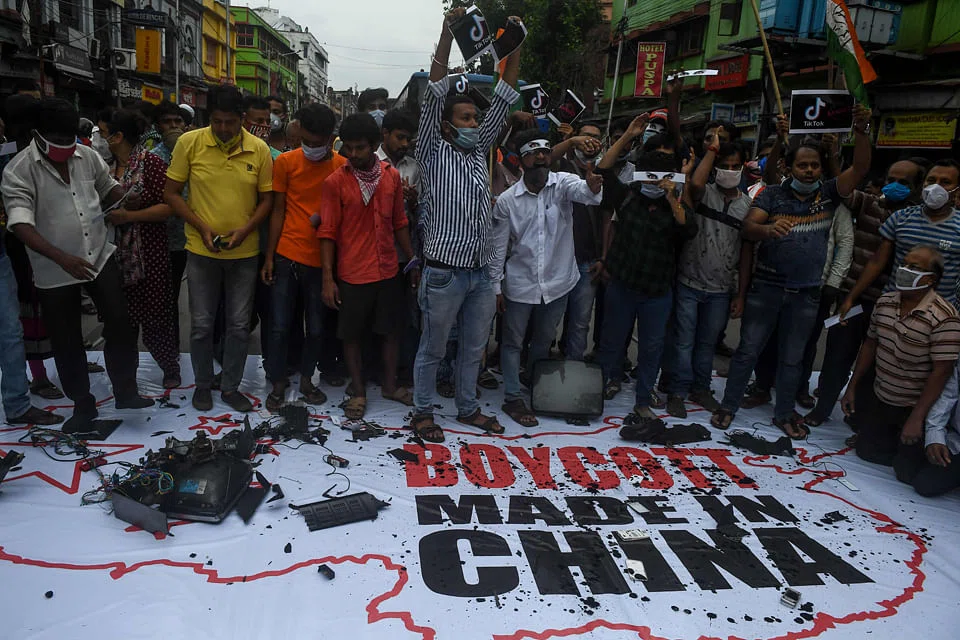
But as war clouds loom over the Sino-Indian border, there are rising calls to boycott Chinese products. The Indian government banned 59 Chinese apps on June 29, such as TikTok and WeChat, declaring that "they are engaged in activities which are prejudicial to sovereignty and integrity of India, defence of India, the security of the state and public order". India has also cancelled the participation of Chinese companies in government infrastructure projects and tenders floated by state-run companies. None of these measures affect the massive volume of existing Chinese foreign direct investment (FDI) and FPI in India.
Indian analysts believe that the Indian ban was a response to China's aggression at the Line of Actual Control in Ladakh where 20 Indian soldiers and an undisclosed number of Chinese People's Liberation Army troops were killed in violent hand-to-hand combat on June 15-16.
At a time of the coronavirus pandemic, Indian trade protectionism and boycott will hurt Indian consumers and companies more than it would hurt China. Indian consumers would suffer, for instance, if Chinese home appliances were replaced by more expensive Japanese products. A ban on Chinese products would badly impact Indian retailers who have already built up large stocks and may be unable to sell them. A ban would severely impact Indian manufacturers that depend on supplies of Chinese raw materials and goods such as electrical machinery, fertilisers, optical and photographic equipment, and organic chemicals which are used to produce final goods.
The dominance of China in global trade means that India will lose much more than China if the two countries stopped trading. It is estimated that China would lose only 3 per cent of its exports and less than 1 per cent of its imports, while India may lose 5 per cent of its exports and 14 per cent of its imports.
Such conventional reliance on trading data masks the real loser, China, which would have to exit from the fastest growing emerging market in the world, India, that is expected to rebound with 6.6 per cent economic growth in 2020-2021 after zero growth this year, according to the ratings agency Moody's. Chinese departure would also lead to loss of economic hegemony over India - something Beijing can ill afford because it would be an enormous setback to its desire for global dominance.
At any rate, India has embarked on a massive military build-up which will continue for decades in order to close the large weapons gap with China. Some of the higher Indian economic growth will result from defence spending and emergency orders placed by the Indian military for weapons. Such armaments-driven economic growth has occurred in many conflicts across the world.
The analyst Tyler Cowen argued back in 2014 that the lack of major wars, or the persistence of peace, may be hurting economic growth. He probably still stands by his thesis because, as he explained: "The world just hasn't had that much warfare lately, at least not by historical standards. Some of the recent headlines about Iraq or South Sudan make our world sound like a very bloody place, but today's casualties pale in light of the tens of millions of people killed in the two world wars in the first half of the 20th century. Even the Vietnam War had many more deaths than any recent war involving an affluent country."
Mr Cowen argued: "The greater peacefulness of the world may make the attainment of higher rates of economic growth less urgent and thus less likely. This view does not claim that fighting wars improves economies, as of course the actual conflict brings death and destruction. The claim is also distinct from the Keynesian argument that preparing for war lifts government spending and puts people to work. Rather, the very possibility of war focuses the attention of governments on getting some basic decisions right - whether investing in science or simply liberalising the economy. Such focus ends up improving a nation's longer-run prospects."
It was during a time of war that innovations such as nuclear power, the computer and the modern aircraft were given a push by the United States, which was eager to defeat the Axis powers and, later, to win the Cold War, Mr Cowen argued. The Internet was originally designed to help the US withstand a nuclear exchange, and Silicon Valley had its origins with military contracting, not today's entrepreneurial social media startups, Mr Cowen believes.
So, in this context, the Indian ban on Chinese apps is just cosmetic because all the major Chinese investments are already in place in India and they will not be disturbed. The popular Indian calls to boycott Chinese goods are expected to fade away after the border tensions simmer down. Then, a period of higher economic growth may follow.