

China and Taiwan: What role for the Kuomintang?
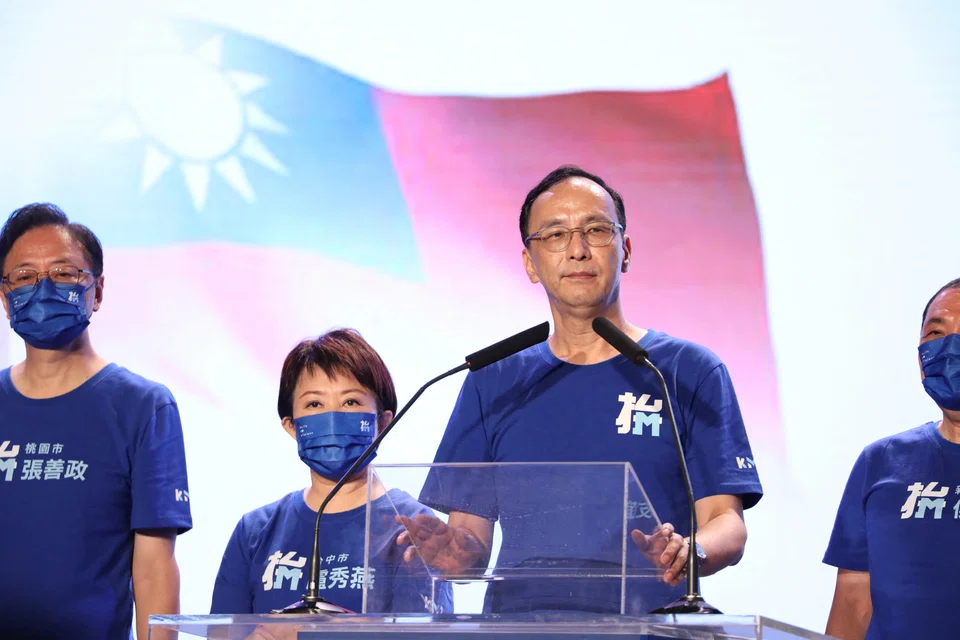
JUST after China’s People’s Liberation Army sent ballistic missiles flying over Taiwan and effectively blockaded the island’s ports in a ferocious show of force following a visit by United States Speaker of the House of Representatives Nancy Pelosi, the vice-chairman of Taiwan’s opposition Kuomintang (KMT) party, Andrew Hsia, began a 17-day visit to the mainland with cries of “traitor” ringing in his ears.
Upon his return, KMT chairman Eric Chu had one word to describe Hsia, who had met mainland officials responsible for dealing with Taiwan: “Brave.”
This is an apt description, though perhaps not the only one. The KMT knew that Taiwan’s governing Democratic Progressive Party (DPP) would cast the trip as a betrayal of Taiwan: cosying up to the mainland at the very time when Beijing was threatening the continued existence of the island as a political entity.
Hsia explained that his trip was to assist Taiwan businesspeople and their families resident in the mainland, numbering perhaps two million of Taiwan’s 23 million people. Many of them are supporters of the KMT. No doubt the local elections in Taiwan, scheduled for November, figured in his calculations. Doing well in these elections of mayors and county leaders across the island would give the KMT a decided boost in the presidential election in 2024.
After Hsia’s return to Taiwan, the KMT gave an account of what had transpired during his meeting with senior Communist officials. These included the mainland’s top Taiwan negotiator, Zhang Zhijun, who chairs the semi-official Association for Relations Across the Taiwan Strait, and Chen Yuanfeng, deputy director of the Taiwan Affairs Office of China’s State Council.
According to the KMT, Hsia had conveyed to Chinese officials the Taiwan community’s concerns over Beijing’s military drills around the island and told them that the exercises were not helpful to peaceful development.
The vast majority of Taiwanese, Hsia explained, were worried about the drills. Mainland officials defended the military exercises as necessary to uphold China’s sovereignty and territorial integrity.
Other issues discussed were recent cases of job scams and telecoms fraud in Cambodia involving residents from both sides of the strait, and the restoration of direct flights between Taiwan’s offshore islands and the mainland, which were suspended because of the pandemic.
Chu, the KMT chairman, emphasised the importance of keeping lines of communication with the mainland open to prevent conflict. The ability to engage in dialogue with the mainland is a definite plus for the party, since Beijing will not talk to the ruling DPP.
Some KMT leaders, however, feel that its identification as a “China-friendly” party hinders its election prospects in Taiwan.
Two years ago, when Johnny Chiang ran for the KMT party chairmanship, he told the media that he was considering abandoning the “one China” position – often referred to as the “1992 consensus”. After Chiang won, he was cold-shouldered by China.
But when Eric Chu regained the party chairmanship the following year, after reaffirming support for the “1992 consensus”, he received a congratulatory message from Communist party leader Xi Jinping, and the two parties were on speaking terms again.
As long as there is a viable political party in Taiwan not opposed to unification with the mainland, it would be difficult for Beijing to argue that all possibilities for “peaceful reunification” have been exhausted and that the only option it has left is to use force.
Chu clearly understands this. He is eyeing the presidential election in 2024 and, for that reason, went to Washington in June to open a representative office for the KMT.
Speaking at the Brookings Institution, Chu said the KMT – often derided for being “China-friendly” – will remain “pro-US forever.” He emphasised his party’s desire to seek “principled dialogue” with Beijing to avoid conflict.
As for the controversial “1992 consensus”, it resulted from a deadlocked meeting in Hong Kong in which the two sides agreed there was only one China but could not agree whether that was the “People’s Republic of China” on the mainland or the “Republic of China” on Taiwan.
Asked about this, Chu described it as a “no-consensus consensus” – that is, one that had no real content but was useful as a foundation for maintaining cross-strait interaction.
For Taiwan to continue to thrive, it is necessary for it to get along with the mainland. A state of hostility between the two sides of the strait is intrinsically unnatural and dangerous. If the KMT did not exist, it would be necessary in Taiwan’s fraught situation to invent it, if only for the purpose of maintaining a channel of communication between the two sides.
The writer is a Hong Kong-based commentator.
TRENDING NOW

First Resources blames El Nino, outside fires for Kalimantan hotspots amid haze scrutiny
High Court rules against Julius Baer’s Singapore trust arm in US$50 million family trust dispute
Singapore key exports jump by higher-than-expected 68.4% in September, led by non-electronics
MSCI proposes downgrading Indonesia to standalone market status

