

Cleaning out the oil barrel
Singapore’s oil refining sector has navigated decades of disruptions. Low-carbon fuel is its next battleground in managing energy transition.
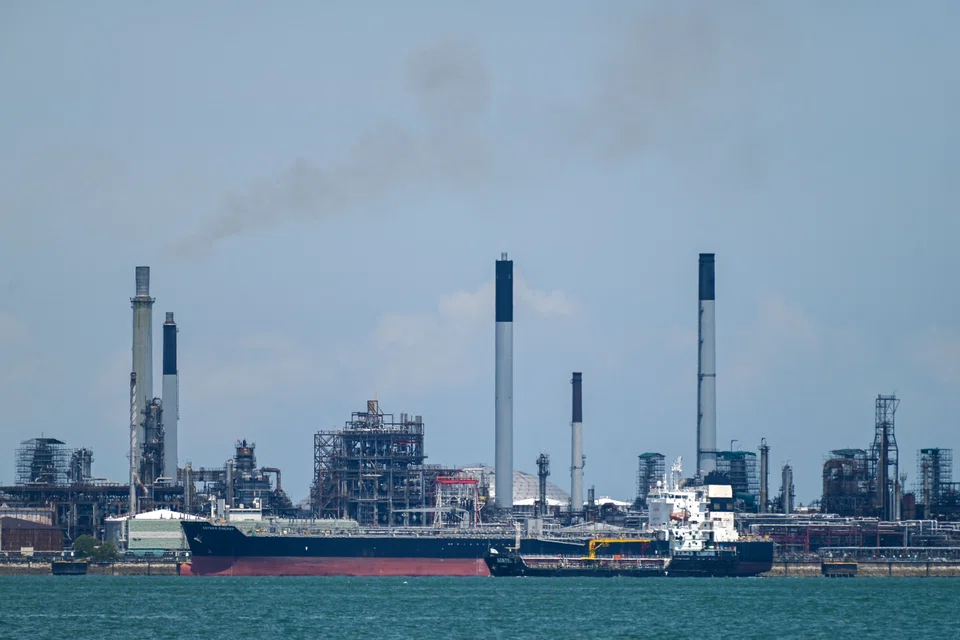
SINGAPORE’S petroleum sector occupies a pre-eminent position in the history of energy and oil.
As early as the 19th century, Singapore’s deep-water port, positioned strategically along key trade routes to Asia, was being used as a storage hub for petroleum fuels.
Singapore has hosted the predecessor of nearly every major global oil company that has ever stored, traded, produced or processed petroleum fuels, such as M Samuel & Co, which later became Shell Transport and Trading, and Rockefeller’s Standard Oil, which would later evolve into companies like Caltex, Texaco, Esso, Mobil, BP, ExxonMobil and Chevron.
Besides the so-called “7 sisters” of oil, other companies included Van Ommeren, which has links to tea and coffee trading with the Dutch East India Company and later became Netherlands-based Royak Vopak, the world’s largest oil storage company.
Singapore’s first oil refinery was officially opened in 1961 on Pulau Bukom. By the 1980s, petroleum refining drew in more investment from oil companies that were wary of the nationalisation of assets in the Middle East. Until then, oil refineries were typically built in countries that produced crude oil.
The industry was shifting towards the consumer of fuels and Singapore soon became “Houston East”, referring to the oil refining hub in the US. Over the years, it pooled the combined capabilities of Geneva’s commodity trading houses, London’s financial institutions, and the shipping and storage hubs of Europe’s Amsterdam-Rotterdam-Antwerp in a single location in Asia.
Oil refining in Singapore has always evolved along with geopolitical and economic turbulence.
In the 1980s, large volumes of Iranian crude were processed in Singapore due to the Iran-Iraq war that prevented Tehran from using Middle East refineries. While American investment in Singapore-based fuel supply chains was strategic, many other Asian countries relied on gasoline, diesel and jet fuel supply from Singapore in the early days of developing their own domestic refining capabilities.
Malaysia’s Petronas, Indonesia’s Pertamina and China’s state oil companies used to contract Singapore’s refining capacity to process their crudes when their domestic oil production boomed but they lacked investments to build new refineries.
Responding to changing priorities
The contracted oil processing business model was unique to Singapore’s oil refineries. Besides the commercial ingenuity, the petroleum hub was also able to evolve its refining technology to meet rapidly changing fuel specifications, allowing regional countries to introduce clean fuel norms faster than their domestic fuel supply chains could keep up.
Countries like Indonesia, China and Australia were able to implement rapid changes in fuel efficiency, low-sulfur regulations and removal of harmful pollutants like lead at a rapid pace without having to reinvent the wheel, or even build new refineries.
As carbon emissions become a growing concern, low-carbon fuels are set to become the next battleground for oil refineries, not just to compete but also as a survival strategy, amid growing concerns about stranded assets and proposed trade policies like cross-border carbon taxes.
It is also another litmus test for Singapore’s refining sector. It is true that the current global energy crisis is focused on energy security and there is limited appetite for higher fuel prices with the added costs of decarbonisation.
But despite the turmoil, long-term energy transition strategies are still gradually playing out. Few, if any, new refineries are likely to be built, and another refining hub like Singapore is unlikely to emerge again. For existing hubs, the outcomes of a long-term decarbonisation strategy to lower the carbon intensity of refined products will become key to being competitive.
Measuring carbon intensity
So how do Asian refiners lower their carbon intensity?
Carbon Intensity is the measure of how much CO2 and the CO2 equivalent of other greenhouse gases (GHG) are emitted per unit of production, and it is how organisations can assess the total footprint and impact of their operations.
First of all, it’s worth noting that a portion of emissions is calculated, rather than measured.
When crude oil or a mineral is processed, it tends to have a defined carbon footprint that can be standardised for that industrial process.
However, with emissions, whether CO2, methane, or any other GHG, they become harder to track once they have been released into the atmosphere. There are also multiple sources of emissions in any given process, so while sensors can be used, the scale of measuring emissions can also be a challenge, particularly if there are leakages.
There are a growing number of tools to mitigate this problem of tracking actual emissions such as the use of satellite data. Satellites can see where oil and gas facilities are flaring, and identify leaks or gases like methane and other fugitive emissions.
For Singapore’s refineries, the key sources of carbon emissions are processes like the flaring of industrial gases, generation of heat and steam in the crude distillation process that is heated using either natural gas or fuel oil, and the source of electricity, all of which require a decarbonisation strategy.
Other key factors that influence a refinery’s carbon intensity are a refinery’s configuration and complexity level, what types of crude oil are used as raw material, and what types of petroleum products are produced.
For example, heavy sour grades of crude oil (from places like Venezuela) require more processing, and fuels like gasoline also require more processing, and hence have a higher carbon intensity.
Standardising carbon intensity measurements will allow refiners to invest in emissions reduction activities, such as carbon capture utilisation and storage, enabling them to switch to cleaner fuels within the plant, reducing venting/flaring and leaks; and then determining the volume and cost of carbon credits needed to offset their footprint.
The cheapest ton of CO2 is likely to become the one you do not emit. What is clear is that low-carbon differentiated fuels will become a benchmark for the competitiveness of oil refineries in Asia.
The writers are from S&P Global Commodity Insights. Eric Yep is LNG and energy transition lead editor and Deb Ryan is head of low carbon commodities.
The 38th Asia-Pacific Petroleum Conference (APPEC) is taking place in-person at the Raffles City Convention Centre from Sep 26 to 28.






