

Clinton's campaign gathers pace
Hers is a favoured name in the field, but will the scandals trip her up? And can she excite voters?
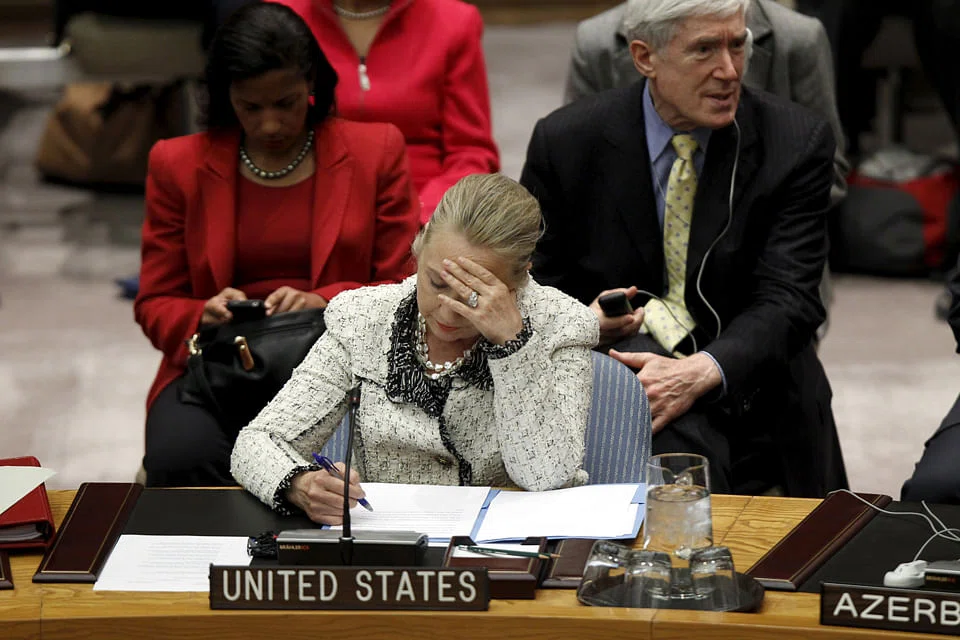
IF one were to conduct an informal poll among members of the Washington press corps on which major presidential candidates they would like to see occupying the White House after 2016, it won't be surprising if the majority of the journalists - regardless of their own political orientation - would pick Hillary Clinton as their choice.
Want to know why? Consider that since the former Secretary of State announced her candidacy last month, a day hasn't passed by without a new revelation that ties the former First Lady to an alleged political or financial scandal, to another this "gate" or that "gate".
To put it in simple terms, if you are a journalist covering Washington and hoping that your stories would be splashed on the front page of the newspaper or lead the television newscast and then dominate the conversation on the Internet, you are quite confident that with a Clinton in the White House, there is never going to be a slow day, with one "gate" following the other, perhaps putting you on track for the coveted Pulitzer Prize.
Ironically, the way some of her political advisors see it, the fact that she has been bested by a series of real or phony scandals at the launch of her campaign for the presidency may actually be good news. The media will chew these stories non-stop and eventually bore everyone to death, so by the time the real campaign starts next year, no one will remember them.
Instead, the public will be focusing on the presumptive Democratic presidential nominee's plans to, say, reform the American prison system.
But those expectations could prove to be a form of wishful thinking, if Mrs Clinton and her aides continue failing to give straight answers to some of the major accusations directed against her, and especially if her political rivals decide to exploit the perception that she has done something wrong, or, even worse, if they could prove that through her conduct, she may have violated ethical standards and perhaps have even broken the law.
The first allegation about her misconduct came under the heading of "Servergate" (or "e-mailgate") and relate to her use of a private e-mail server while performing her duties as Secretary of State, which critics see as an attempt to evade oversight. They contend that she shouldn't have conducted public business on a private server, and then destroy around 30,000 e-mails (which she described as involving private affairs such as her daughter's wedding) and then provide the rest in boxes of paper records.
It is difficult to use a "gate" for a headline about the second alleged scandal. She and her husband, former President Bill Clinton, have been criticised for allowing their family's charitable foundation, the Clinton Foundation, to accept donations from foreign governments, which critics say could pave the way for those governments to influence her during her time in government or as a presidential candidate.
The response from the Clintons to these stories has been clear and concise: They have done nothing illegal, which follows their handling of the many scandals that engulfed the administration of President Bill Clinton. Say what you want about him - that he befriended a few unsavoury characters and slept with his young intern in the White House - but, hey, he never violated the law. It explains why Congress didn't impeach him and why voters re-elected him for a second term.
It is true that no one has been able to prove that Mrs Clinton has broken the law - although some of her actions in both cases seem to fall into a legal grey area.
But the 24-hour news cycle and the social media have created pressure on candidate Clinton to respond to related reports, about aides who were under investigation, about how slowly she disclosed her e-mails and how quickly she purged other e-mails, about the astronomical speaking fees that she and her husband have received, about their political and financial ties to the wealthy contributors to the foundation as well as to her election campaign.
The end result could be compared to a possible death of an election campaign by small cuts. As she responds to one allegation, another one pops up, producing a never-ending vicious circle.
And one of the problems has been that the Democratic candidate has refrained from responding to most of the allegations. In fact, she hasn't held a major press conference for several weeks. Instead, she has been stating in between her meetings with chosen groups of citizens: "I want those e-mails out" and "I am proud of the work that the Clinton Foundation has done". The message seems to be: "That's it, dear media! Get over it. And have a nice day."
It's not clear whether this media strategy will work in the long run, but at this stage of the campaign, it seems that despite the battering she has endured in recent weeks, her support among Democrats remains strong. A recent Wall Street Journal/NBC News poll found out that 76 per cent of Democrats viewed her favourably.
At the same time, when it comes to the general public, only a quarter of registered voters said they viewed her as honest and straightforward. But interestingly enough, about half of Americans surveyed also said that she had the knowledge and experience to handle the presidency. That means that many of those who regard her as being dishonest, still think that she could be an effective president.
Moreover, the same poll also indicated that if the election had taken place this month, she would have beaten her major potential Republican presidential rivals, including former Florida Governor Jeb Bush, Senator Marco Rubio, Senator Rand Paul and Wisconsin Governor Scott Walker. The poll also found, however, that her margin of victory would have been between 2 per cent and 5 per cent.
This suggests that even before the Democratic primaries have taken place and despite the scandals and allegations, Mrs Clinton is heading towards the general elections with a certain momentum. Some would even argue that since she is not facing any major challenge from another Democratic candidate in the primaries, she may now be in a position to fashion a centrist political message that would also appeal to Independent voters and even to some Republicans.
In fact, all she has to do is to embrace the kind of centrist political agenda that helped her husband win two presidential races, for example, by expressing support for the proposed Trans-Pacific Partnership (TPP) accord that she helped craft when she was secretary of state. One recalls that promoting global free trade was central to her husband's popular and successful economic policies in the 1990s.
But since announcing her candidacy, she has refrained from endorsing the TPP, which seems to move her in the direction of the members of the progressive wing of her party, who oppose the trade deal.
In fact, she and her advisors have launched what amounts to a political rebranding campaign of her candidacy, marketing her now less as a centrist Democrat and more as a progressive, left-leaning candidate.
Hence, candidate Clinton's current emphasis is on dealing with the growing social-economic inequality in the country, calling for providing a path to citizenship for illegal immigrants, expressing support for same-sex-marriage and committing herself to taking action to combat racial and sexual discrimination.
This new strategy seems to be based on the assumption that she could win the general election in 2016 by counting on the same electoral coalition that helped President Barack Obama get elected and re-elected - African American and Latino voters, single women, young voters and urban professionals - without having to draw more support from white voters, who now tend to vote by a large majority for the Republican presidential candidate.
But no one really knows whether Mrs Clinton - who unlike President Obama and her husband, is not an exciting candidate - will succeed in re-energising these voters and whether they will buy her in her new role against Wall Street, where some of her best friends and financial supporters work.
TRENDING NOW

South-east Asia has lost Nvidia’s best salesman

Demand, tech capabilities position Apac and AI as Skyscanner’s next growth frontiers: CEO Bryan Batista

Peter Kwee’s Ridley Park bungalow on the market with S$100 million asking price

Beyond the greenback, Vietnam’s big borrowers turn to Asian-currency bonds

