As competition intensifies, Hong Leong Finance should consider a sale

THANKS to rising interest rates, Singapore’s lenders are doing well. DBS Group , OCBC Bank and UOB Group posted strong growth in net interest margins (NIMs) and net profit in 2022.
Singapore’s largest finance company, locally-listed Hong Leong Finance (HLF), has seen similarly good numbers. Net profit came to S$131 million for 2022, up 54 per cent from 2021, helped by loan growth and higher asset yields. NIM grew 41 basis points between 2021 and 2022 to 1.82 per cent.
Compared with its pre-pandemic numbers in 2019, HLF’s net profit for 2022 was up 27 per cent. Net asset value (NAV) per share rose by 6 per cent from S$4.28 at end-2019 to S$4.55 at end-2022.
HLF’s shareholders have much to cheer: The board has recommended a final dividend of 13.25 Singapore cents per share. If shareholders approve the final dividend at HLF’s annual general meeting on Apr 27, the total dividend for 2022 will be 42 per cent higher than in 2021.
Yet, investors appear to value HLF much more conservatively than they do the three locally-listed banks. Based on share prices as at Apr 12, 2023, the three banks traded at premiums to end-2022 NAV of between 11 per cent and 53 per cent. HLF traded at a discount to its end-2022 NAV of 45 per cent.
Over 2022, the share prices of DBS, OCBC and UOB rose by between 4 per cent and 14 per cent. HLF’s share price was flat.
Unlocking value
As a shareholder of HLF, I would like to urge HLF’s board of directors to explore ways to boost HLF’s share price. The best solution may be to sell HLF to another financial group.
Perhaps one of the three local banks might be keen to buy HLF at its book value – or more. The upside to HLF’s share price from a sale would be over S$2 per share.
For comparison, the deal struck in early 2022 for UOB to buy Citigroup’s consumer banking businesses in Indonesia, Malaysia, Thailand and Vietnam was priced at 1.2 times net assets.
If HLF’s shareholders swap their shares in the finance company for shares in DBS, OCBC or UOB, they will own shares in entities with higher trading liquidity, richer valuations and possibly brighter growth prospects.
Challenges
Looking ahead, HLF could struggle to secure a competitive advantage.
Over 2018 to 2022, HLF’s net profit growth of 11 per cent lagged that of Singapore’s largest lender DBS (47 per cent).
The finance company’s platform may lack the scale and regional reach of the local banking trio.
UOB, the smallest of the three banks by asset size, had total assets of S$504 billion and customer loans of S$315 billion as at end-2022. HLF’s total assets were S$14.3 billion, including net loan assets of S$11.7 billion, as at end-2022.
HLF has a long track record serving small and medium-sized enterprises (SMEs). But the local banks have strong regional footprints and are also keen to serve SMEs. They are likely able to serve these institutions with regional aspirations more effectively.
While HLF rolls out new digital initiatives, the banks, armed with larger budgets to invest in technology, may also be better positioned for digital transformation.
According to its latest annual report, DBS leverages artificial intelligence and machine learning to send 45 million hyper-personalised nudges each month to SME customers across the region, with suggestions on how to make their money work harder.
HLF faces a tough fight for talent. Talented individuals may prefer the stronger platforms and growth prospects of the local banks.
Moreover, competition for talent and business could intensify as the groups awarded digital bank licences here try to grow their operations in a saturated Singapore market.
Exit timing
The timing may be fairly opportune for a sale. Like the banks, HLF is benefiting from rising interest rates. The three-month compounded Singapore Overnight Rate Average was about 3.6 per cent per annum on Apr 11, 2023, up over 340 basis points from the start of 2022.
The going could get much tougher for lenders should a weaker economy lead to interest rates falling, worsening credit quality and slowing loan growth.
Also, investors who are working with a higher cost of equity could lean even more towards leaders among financial stocks.
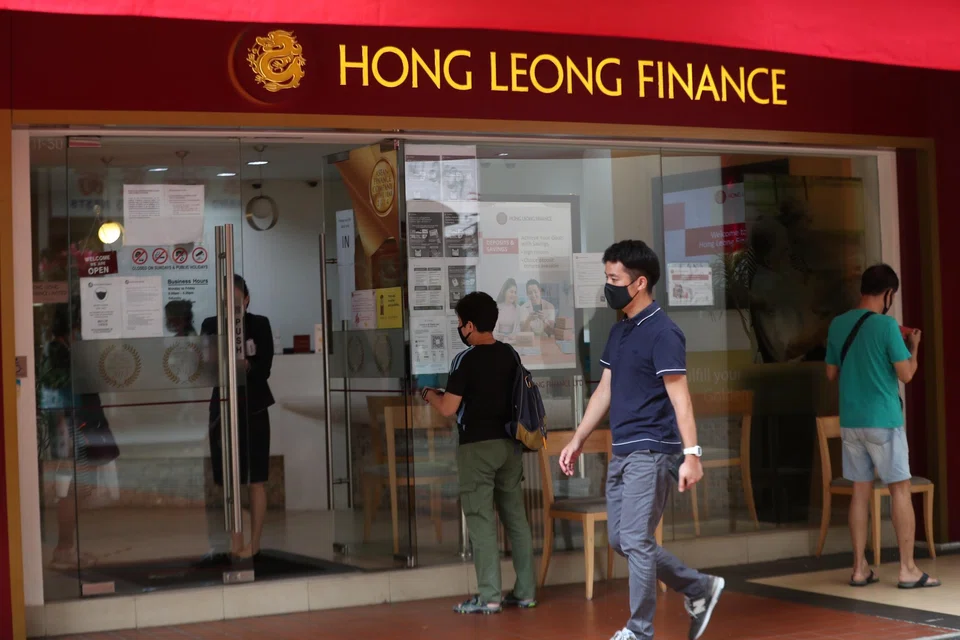
Founded in 1961, HLF’s takes deposits and savings from the public and provides financing solutions and services, specialising in SMEs.
HLF has 28 branches in Singapore. It is part of the Hong Leong Group Singapore, which is helmed by tycoon Kwek Leng Beng. Aged 82, Kwek is HLF’s executive chairman – a position he has held for over 38 years.
As a finance company competing with large and well-funded banks, HLF has had to be nimble and customer-centric.
Still, an honest assessment of the competitive landscape may lead HLF’s board to conclude that HLF lacks a competitive edge.
In its latest annual report, Kwek affirmed HLF is resolute in building a resilient customer-centric organisation. But HLF’s customers may be better served by HLF being part of a larger financial group.
Equally, HLF’s shareholders stand to profit should the finance company join the likes of Keppel Tat Lee Bank and Overseas Union Bank in yielding its independence.
Perhaps Kwek can call time on his tenure at HLF, by engineering a sale of the firm for a juicy price to a group that will bring HLF to greater heights.