COP26: Is Boris Johnson up to first big post-Brexit test?
It's around three months before a landmark climate summit and the UK is rather under-prepared, but all may not be lost if there is now a concerted UK campaign of leadership.
 Add BT as a preferred source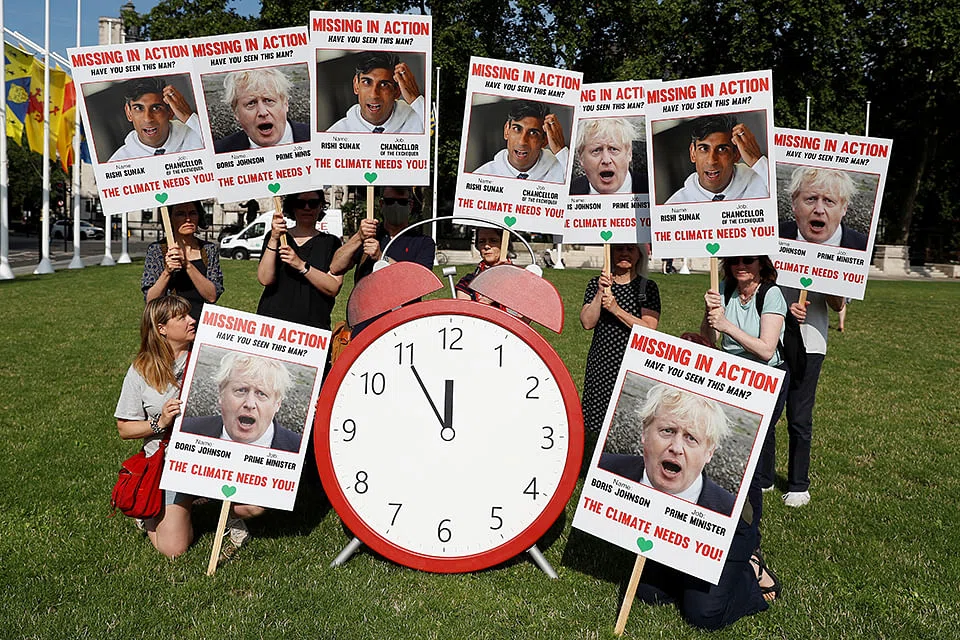
DeeperDive is a beta AI feature. Refer to full articles for the facts.
LESS than 100 days from the landmark COP26 climate summit, concerns are growing about UK preparedness for hosting the event as a landmark UN report released on Monday gives the world its strongest warning yet on the perils of global warming.
Monday's report from the Intergovernmental Panel on Climate Change pulls no punches in warning of "code red for humanity" in the words of UN Secretary-General Antonio Guterres. The study argues that "there is no time for delay and no room for excuses. . . to avert catastrophe".
The damning findings will pile the pressure on the UK-hosted COP26 climate event which is the jewel in the crown in a super year of sustainability events in 2021 including the UN Biodiversity, UN Food Systems, and UN Nutrition for Growth Summits. What makes this a potential 'once in a generation period too is that the presidency of COP26 is shared between the Italian and UK governments which are also the chairs of the 2021 G-20 and G-7 respectively.
Taken together, this presents an unparalleled opportunity to create synergies between the summits and to leverage the G-20 and G-7 to increase the chances of successful outcomes at the environmental events.
Yet, there are worries that the UK government is not remotely as prepared as the French were in the build-up to the last big global environmental event: the Paris COP21 summit. To be fair, this is partly because of the pandemic, but the fact remains that France threw the full weight of the state behind the 2015 talks with then-foreign minister Laurent Fabius, who was in the 1980s France's youngest ever prime minister, the most effective ever COP president.
It's a stark contrast from this year's COP chief Alok Sharma, the former UK business secretary. To be sure, Mr Sharma is doing extensive diplomatic legwork, having flown to at least 30 countries over the past seven months.
Navigate Asia in
a new global order
Get the insights delivered to your inbox.
However, even Mr Sharma's allies admit he lacks Mr Fabius's gravitas and global connections. Further up the UK political food chain too, Prime Minister Boris Johnson, Foreign Secretary Dominic Raab and Chancellor Rishi Sunak are not global political 'heavyweights' either, and have all been criticised for failing (yet) to put urgency behind the talks.
Take the example of Mr Johnson whose efforts, such as they are, to meet the challenge of net-zero is falling far short of that needed. All too often, his climate change strategy seems to amount to encouraging everyone to have their own electric car, a solution that is not feasible given that there aren't enough rare earth materials in the world to replace every UK car currently in use, let alone right across the globe.
CLEAR DANGER
The clear danger is that UK under-preparedness not only translates into a weak COP26 outcome, bad as that would be. In addition, it could unravel this year's wider sustainability agenda. The UN Food Systems Summit in September aims to transform the way the world produces and consumes food; the biodiversity agenda takes place in October, while the Nutrition for Growth summit in December will address global malnutrition issues by strengthening the link between food systems, diet, and health.
Yet, with around three months left until COP26, all may not be lost if there is now a concerted UK campaign of leadership. In part, this is because of the sea-change in US leadership, and the fact that the pandemic has underlined that no nation can now deny a globalised world faces interconnected threats which require far-reaching and coordinated action.
But the biggest change factor is US leadership again. Mr Biden's big initiative is the plan to cut by 2030 greenhouse emissions by at least 50 per cent below 2005 levels, approximately doubling the previous US promise, and this is stimulating activity in other nations too.
Mr Biden has been unambiguous that the 2020s are "the decisive decade where we must make decisions that will avoid the worst consequences of the climate crisis" and "try to keep the Earth's temperature to an increase of 1.5 deg Celsius". This clarity about the imperative to act immediately is a potentially transformative change from that of the Trump team.
Last Thursday, Mr Biden announced the latest in a stream of initiatives with an executive order that half of US cars sold by 2030 should be zero-emission vehicles. Transport accounted for some 30 per cent of US greenhouse gas emissions in 2019, and sales of US zero-emission vehicles lag behind those in Europe and China.
The new US commitments are already spurring other large emitters to raise their game. Take the example of Japan which announced in spring a reduction of emissions by 46 per cent in 2030 compared to 2013 levels.
Key emerging markets including Brazil, South Africa and India are also working to strengthen their so-called nationally determined contributions (NDC) pledged at Paris in 2015 to cut emissions. In a joint statement in spring, they said that they had "already set forth climate policies and contributions reflecting their highest possible ambition". For instance, South Africa is consulting on deepening its 2030 emissions cuts by almost a third compared to its 2015 NDC pledge.
So rather than Mr Johnson 'pulling a rabbit out of the hat', the success of November depends on US diplomacy and convincing others to step up to the plate. To persuade large emerging markets to step up their carbon-cutting nations, the industrialised world will also need to step up aid in a context where UN Environment estimates there remains an annual US$70 billion gap for addressing global climate impacts.
PUSHING BEIJING
The single biggest relationship where US diplomacy is needed is China which was key to delivering the Paris deal. Mr Biden is therefore pushing Beijing hard for a new bold commitment to reciprocate the US one given to cut by 2030 US greenhouse emissions by at least 50 per cent below 2005 levels.
If the US and China become broadly aligned on this agenda, the EU would provide a third leg of the stool to get a deal over the line in November. Collectively, the 27-nation European club, plus China and the US account for around one half of global climate emissions and the triumvirate are critical to a positive outcome.
With the result of COP26 in the balance, massive momentum is therefore needed in the weeks ahead. It is Mr Biden, not Mr Johnson, who can potentially provide this by convincing more key countries to reduce emissions faster and deeper in what is now a race against time.
- The writer is an associate at LSE IDEAS at the London School of Economics
Decoding Asia newsletter: your guide to navigating Asia in a new global order. Sign up here to get Decoding Asia newsletter. Delivered to your inbox. Free.
Share with us your feedback on BT's products and services