

Dissecting the global financial crisis
Martin Wolf offers a masterly post-mortem of the Great Recession and after
DURING an interview with me in June 2007 (published in BT on July 7), Timothy Geithner, then chief of the New York Fed, which regulates Wall Street banks, didn't seem to have a clue that a financial crisis was around the corner. Responding to a question on whether so-called financial innovations such as collateralised debt obligations (CDOs) may be dangerous because of their complexity and opaqueness, he said: "The combined effect of these innovations probably makes crises less probable."
He also suggested that "it's very unlikely that we'll face again the sort of circumstances that led to the opportunity for collective action that LTCM presented", referring to the bailout of the troubled hedge fund Long Term Capital Management in 1998. In other words, all seemed well and good.
A little over a month after Mr Geithner spoke, the early contours of the global financial crisis came into view. In early August 2007, faced with a wave of redemptions, BNP Paribas announced it could no longer refund investors in three of its investment funds. On Aug 9, the European Central Bank (ECB) was forced to inject 95.8 billion euros (S$155.2 billion) into the markets to calm jittery investors. On Sept 13, the British mortgage bank Northern Rock suffered the first big depositor run since the 19th century. A string of other financial disasters were to follow, one after the other, all the way into 2009.
Few saw it coming. Policymakers were not among them, not even then Fed chairman Ben Bernanke, who infamously declared in testimony to the US Congress in March 2007 that "the impact on the broader economy and financial markets of the problems in the subprime (mortgage) market seems likely to be contained".
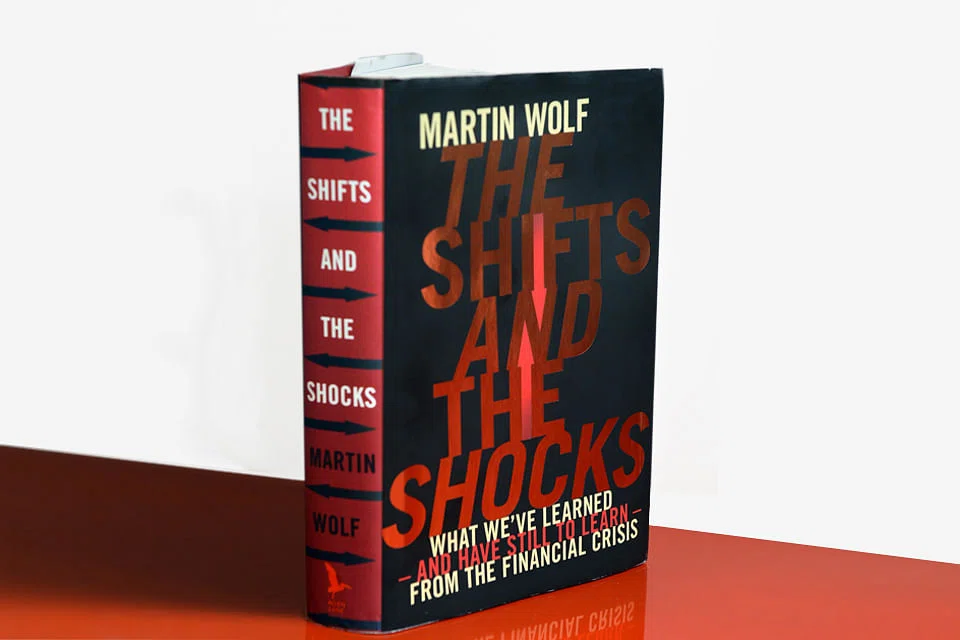
The failure of policymaking, both in terms of intellectual understanding and policy action, is one of the themes in Martin Wolf's latest book, The Shifts and the Shocks - one of the most detailed examinations yet of the whys and hows of the global financial crisis.
Mr Wolf - associate editor and chief economics commentator at Financial Times, and probably one of the most influential economic journalists of our time - suggests that the pre-crisis economic orthodoxy, which relied on inflation-targeting by central banks and light-touch financial regulation, proved utterly misguided. Regulators were also naive to assume that the financial system was as stable (and its participants as honest) as they thought.
Added to these "sins of omission" were "sins of commission", he says. One was the zero-risk weighting of sovereign debt, which came back to haunt the eurozone. The risk management models of banks (based on risk-weighted assets) were also fantastical. The models showed, for instance, that UK banks' assets became progressively safer from 2004 to 2008; worse, regulators believed these models. Another sin of commission was the enthusiastic promotion of home ownership, which helped fuel housing bubbles.
One of Mr Wolf's theses is that the crisis was not a singular event, but (like an earthquake) the culmination of deep subterranean shifts in the broader economy.
He identifies two shifts in particular. One was the shift of the financial system from stability to fragility over 25 years. The main causes were financial deregulation in the 1980s and 1990s; the globalisation of finance, which vastly increased the size of bank balance sheets; financial innovation; and the rise of leverage, which was partly embedded in the new financial instruments but was also a by-product of the homebuying spree of the 1990s and beyond.
The other major shift was the emergence of two macro megatrends since the 1990s: a global savings glut, aided by a huge reserve buildup by Asian countries after the 1997 Asian crisis and the burgeoning surpluses of oil exporters. A second, related shift was growing current account imbalances.
There were a couple of other seismic shifts that Mr Wolf does not cover, though he has written about them before. One was the shift from wages to profits in the 1990s. The share of wages in GDP in advanced countries fell on average from 73 per cent in 1980 to 64 per cent in 2007, while the share of profits rose commensurately. The other was the huge expansion of the financial sector's profits relative to the rest of the corporate sector. At its peak in 2004, the financial sector alone accounted for about 40 per cent of all US corporate profits, compared to 10 per cent in 1984. The finance sector's share of GDP is currently just 6.4 per cent.
In an interview with BT, Mr Wolf concedes that these shifts deserved more attention than he gave them in his book. He suggests that the most plausible explanation for the shift from wages to profits was the "enormous effective increase in the world's labour supply", especially after China and India became more integrated into the world economy during the 1990s. Their combined labour forces - China in manufacturing and India in services - had the effect of depressing the price of labour relative to capital in rich countries. Income inequality also grew and since the rich don't spend much of their excess income, many rich countries became demand-deficient. Mr Wolf points out that credit expansion "was one vehicle to get the poor to spend more". This, together with high leverage (associated with property buying) may explain some of the financial sector's oversized profits.
All these shifts together created the conditions for the global financial crisis.
Mr Wolf debunks the oft-cited view that the decision by the US government to permit the collapse of the investment bank Lehman Brothers in September 2008 triggered the crisis. "The crisis did not occur because of Lehman," he says. "The whole system was extremely stretched; some sort of break was inevitable. There was an immense amount of rot in the financial sector - many institutions were going to go down: RBS, UBS, Citi, AIG. The business model of the broker-dealers was broken."
As to what might have happened had Lehman been rescued, Mr Wolf speculates that perhaps the panic would not have been as intense as it was. "We would have had a long period of chronic malaise. There may not have been a recession, but the subsequent growth might also have been weaker." But the collapse of Lehman and the ensuing panic may have also had a salutary effect, he adds: "The determination to clean up the financial sector only happened when the panic became so severe that you couldn't ignore it. It's arguable that the Lehman collapse was a catalyst for both the panic and the clean-up."
Nor did the Lehman collapse cause the eurozone crisis, which had its origins in the divergences between the economies of the 18-nation area, the mispricing of sovereign risk, the buildup of asset bubbles in some countries, the relentless pursuit of fiscal austerity and, perhaps most of all, the straitjacket imposed by the common currency, the euro.
"The euro has been a disaster," writes Mr Wolf at the start of his sobering chapter on the eurozone. "No other word will do." He notes that although it was intended to strengthen solidarity, bring prosperity and weaken Germany's economic domination of Europe, it "has achieved precisely the opposite". By creating a monetary union before creating a political union, Europe ended up putting the cart before the horse.
Mr Wolf offers a neat analogy: "Think of the eurozone as a polygamous monetary marriage entered into by people who should have known better, in haste and with insufficient forethought, without any mechanism for divorce."
The eurozone crisis was temporarily quelled, thanks largely to the ECB's programme of Outright Monetary Transactions (OMT) launched in August 2012, under which it pledged to buy troubled countries' sovereign bonds in secondary markets - which successfully caused the yields of these countries to fall and provided them breathing space.
Mr Wolf suggests that the OMT was actually "a bluff, but an astonishingly successful one". The OMT programme was in theory unlimited, but in practice conditional: countries have to adhere to an agreed reform programme beforehand, and if they do not, ECB support can be withdrawn. The continued German backing for the OMT is also in doubt, given that the programme has been judged to be in violation of the German Constitution.
Thus there is actually no solid central bank backstop for the eurozone debtors, which remain vulnerable, especially given that the eurozone is flirting with deflation, which will increase the real value of debt.
So what is the way forward?
There are three options, according to Mr Wolf. The worst is a "disorderly exit" - which might happen if a debtor country refuses to go along with a programme in return for additional financing. It issues a new currency, imposes exchange controls and defaults on its euro-denominated debts. The situation could quickly slide into chaos, with a wave of bankruptcies, looting and rioting, maybe a coup or even a civil war.
An "orderly breakup" - which sounds nice in theory - is a "contradiction in terms", according to Mr Wolf. The redenomination of euro contracts into national currency contracts would be unacceptable to citizens of harder- currency economies - who would also have to contend with soaring currency values and sinking economies.
The best bet for the eurozone would be to try to turn the "bad marriage" into a good one. A number of radical policies would be needed here. First, ECB to more aggressively ease monetary policy, adopting an inflation target of 3-4 per cent (instead of 2 per cent); second, fiscal reflation by Germany to get its current account surplus down, which would help troubled countries cut their deficits. Some debt restructuring would also be needed for those (such as Greece) whose debts are simply too large to service. Finally there would need to be some eurozone-wide reforms such as a proper banking union with central regulation and supervision (which is in process) and a fiscal union which would ease fiscal transfers within the eurozone and provide a collective backstop for the banking union.
Mr Wolf is also in favour of Eurobonds - that is bonds for which eurozone countries would be jointly and severally liable. Apart from creating a huge and liquid bond market, Eurobonds would provide the ideal collateral for the ECB and make it easier for it to engage in unconventional policies like quantitative easing (QE). If a part of existing national debts are converted to Eurobonds, the remaining debt would also be easier to restructure. Finally, the ECB needs more powers, including the ability to finance governments directly.
Alas, not much of Mr Wolf's proposed agenda is on the cards at the moment. As he acknowledges, there are deep differences between economies, cultures and politics, as well as much mutual distrust. Germany (which dominates the eurozone) remains fixated on keeping inflation low. Neither is it ready to accept many of the other reforms essential to growth - not large-scale quantitative easing, nor Eurobonds nor fiscal reflation nor debt restructuring nor yet a proper banking union.
As to what will actually happen, Mr Wolf's most optimistic scenario is that the eurozone muddles through: monetary policy becomes easier, confidence gradually improves, ad-hoc assistance is provided to countries that need it, and slowly but surely, consumption and growth pick up. A return to crisis is also possible - if deflation gets worse, real debt levels continue to rise, markets start to panic again and long-term bond yields go up. The OMT gets triggered, but countries don't agree to accept its tough conditions, leading to a political backlash.
There is one further possibility which Mr Wolf sketches out in our interview: in desperation, the eurozone debtor countries "capture" the ECB and force it to buy their bonds as well as pursue a really vigorous programme of quantitative easing. Then Germany decides to leave the eurozone - which in fact may be the least painful option. Either way, it's a grim prognosis, and the eurozone's much vaunted resilience could face many tests yet.
Apologists for the eurozone's current policies make much of this resilience, but the fact that so much of the pain in Europe was avoidable does not get the attention it deserves. This comes through intellectually in Mr Wolf's account, but he might have driven home the point harder had he elaborated on just how huge the costs have been, not only in foregone output but also in human terms - the chronically high unemployment rates, particularly among youths in Spain and Greece; the fraying of social cohesion, and more.
But he does go beyond the costs of the financial crises: he reminds us that they can change belief systems and be a force against globalisation; crises create angry and anxious people, and "angry and anxious people are not open to the world". They can also undermine confidence in elites, and ultimately even in democratic legitimacy. Putting things right and preventing future crises will "require more radicalism than most recognise", he says. Policymakers usually don't like radical remedies. But as Mr Wolf's book makes clear, that is what the doctor has ordered for the global economy.
TRENDING NOW

Can a first-time homebuyer couple earning S$18,000 a month afford a new EC unit?

He built the Vingroup empire. Now South-east Asia’s richest man is handing some key roles to his sons
Asia needs new energy security architecture

Chagee, Mixue and Luckin won the market. Sustaining their edge is the harder part

