The edge in the global advanced manufacturing race
Sustainable manufacturing will unlock new growth opportunities for Singapore and future-proof local businesses
SINGAPORE’S leaders have time and again emphasised the importance for the country to become more productive and competitive, noting that there is little that the nation can do to influence rising costs. That rings true not least for Singapore manufacturers, who, in the wake of the pandemic, are now ramping up capabilities in advanced manufacturing to secure the next stage of growth.
Singapore was ranked the world’s second most innovative economy in the 2021 Bloomberg Innovation Index, which scores economies on factors such as manufacturing capability, research and development spending, and concentration of high-tech public companies. Manufacturing is a catalyst to increase productivity, transform industries and revitalise workforces. In Singapore, the government has its sights set on a visionary and ambitious plan to grow the nation’s manufacturing sector by 50 per cent by 2030.
Considering that manufacturing drives over one-fifth of Singapore’s gross domestic product (GDP), the multiplier effect this will bring to the economy over the next few years will be significant. But the growth trajectory is not without its challenges.
In light of this, sustainable manufacturing has emerged as a growth area that can help manufacturers gain a long-term competitive advantage.
Sustainability – the advanced manufacturing differentiator
Beyond just measuring productivity, the ability to drive innovation, sustainability, and inclusion to create value for customers, employees, society, and the environment will become increasingly important in the race for advanced manufacturing leadership, according to the World Economic Forum.
To succeed, manufacturers must outperform on the ability to innovate and develop higher-value products and services with quality and at scale. And governments across the world are recognising that. The United States has its sights set on advancing the technological leadership of small and large manufacturers to build global competitiveness and long-term resilience, while China has committed to a major upgrade of manufacturing capabilities by 2025 by focusing on 8 key areas of high-tech manufacturing.
For Singapore, as a capital and skills-intensive country, advanced manufacturing and sustainable manufacturing present a major opportunity for it to stand out from other manufacturing hubs, allowing the economy to tap its strong tech talent pool while requiring far less land and labour. This genuine point differentiation is an area that the city is already making good progress on.
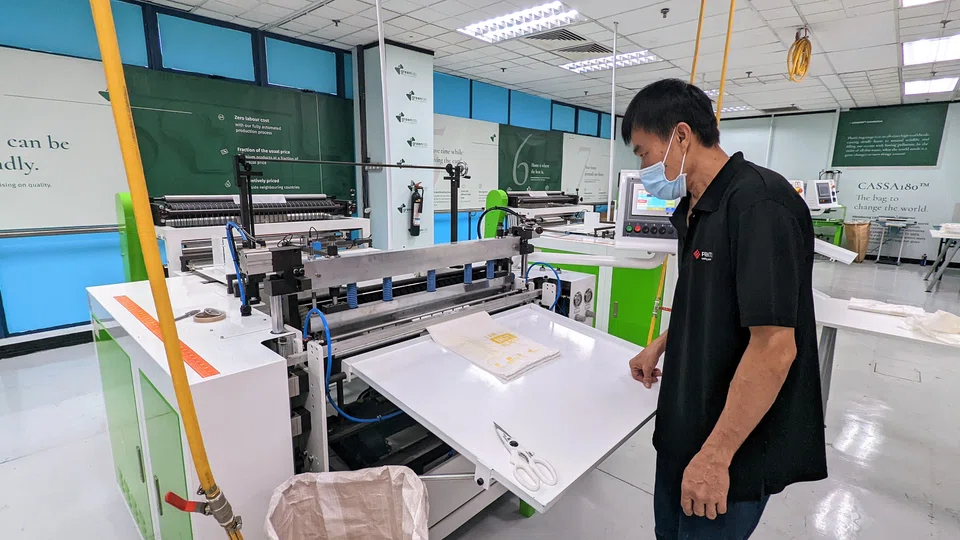
Sustainable manufacturing has also been identified as a key contributor to the government’s Green Plan 2030 goals. In May this year, Singapore’s first eco-solutions manufacturing plant was officially opened, providing sustainable products for food and beverage companies in Singapore but also targeting businesses across Asean.
This is just one of many initiatives promoting the city’s capabilities in developing sustainable packaging, decarbonisation, waste upcycling, and water treatment solutions, among others. SkillsFuture Singapore has also partnered with industry-leading companies to upskill manufacturing talents in areas such as sustainable manufacturing, green procurement, and equip small and medium sized businesses with the skills to embrace digital transformation.
Leveraging technology to drive Singapore’s manufacturing competitiveness
Singapore is already well established as a leading manufacturing hub, but we must not rest on our laurels. Since 2018, the government has committed S$3.2 billion towards research and development for advanced manufacturing and engineering, with the aim of building up the innovation capacity of companies embarking on Industry 4.0.
Singapore’s strong innovation ecosystem positions the country well to develop new solutions in the green economy, such as in low-carbon hydrogen and carbon capture, utilisation and storage. Strong public-private partnerships have emerged over the years such as the Green Compass initiative, which was launched in 2021 to help businesses in Singapore understand how to apply industry 4.0 solutions in their sustainability efforts.
However, the pivot to becoming a leader in sustainable manufacturing requires not just investments in Industry 4.0 technologies, but also skill sets and agile mindsets to deploy these technologies. In these aspects, Singapore is well poised to tap its strong pool of tech talents to innovate and up-level manufacturing capabilities. Besides moving workers from repetitive tasks to higher-value production, manufacturers have the opportunity to create roles that are attractive to the next-generation workforce.
The sustainability imperative is growing in importance. With technologies such as advanced analytics, machine learning, and automation, manufacturers can easily detect, diagnose, and predict product quality across manufacturing lines, thereby improving product quality while reducing energy use, material waste, and carbon emissions.
Sustainable manufacturing’s impact on people and planet
If the pandemic taught us any lessons beyond the urgency to transform healthcare systems around the world, it is that global supply chains must become more sustainable. And manufacturers are at the core of this global challenge.
Increasingly, sustainability is becoming a critical driver in business decision-making, and there is pressure for manufacturers to implement more sustainable practices into their ecosystems. The faster, easier, and lighter we manufacture, the less waste we produce, the less energy we use. And the more we recycle, the more circular our economy becomes.
When done right, sustainable manufacturing has the potential to uplift the manufacturing sector, contribute to economic revitalisation, and reduce societal inequalities. Sustainable manufacturing will contribute to a better Singapore, and on a larger scale, ultimately towards a better planet.
The writer is managing director of HP, Greater Asia.