

The end of Pax Americana in the Middle East
Winding down of US involvement in region preceded Trump - and will outlast him
Washington
THERE are 1,001 reasons to disapprove of the current White House occupant and one could probably author a long volume explaining why he is not fit to hold the most powerful job in the world.
But you do have to give President Donald Trump credit on one issue: More than most of the politicians, pundits and pollsters, the 45th US president can feel the political pulse of the American people.
The most dramatic case at point: He had felt in his gut that he could and would become the Republican presidential nominee and then defeat his Democratic rival, at a time when almost all the political pros had concluded that that was just plain crazy. There was no way someone with no policy background, who was so unpresidential, would be elected to the office once held by George Washington and Abraham Lincoln.
And when I mentioned the "American people" earlier, I do not have in mind government officials, columnists, think-tankers and the other major players in Washington, but the Average Joe in small-town America who does not read The New York Times or follow closely the latest civil war in this "-stan" or that "-stan".
So here is what Mr Trump ended up figuring out last week when he was speaking on the phone to Turkish President Recep Erdogan: The American people are opposed to getting entangled in a new war in the Middle East and will punish me if I order US soldiers to intervene in another bloody civil war in a distant province in that part of the world.
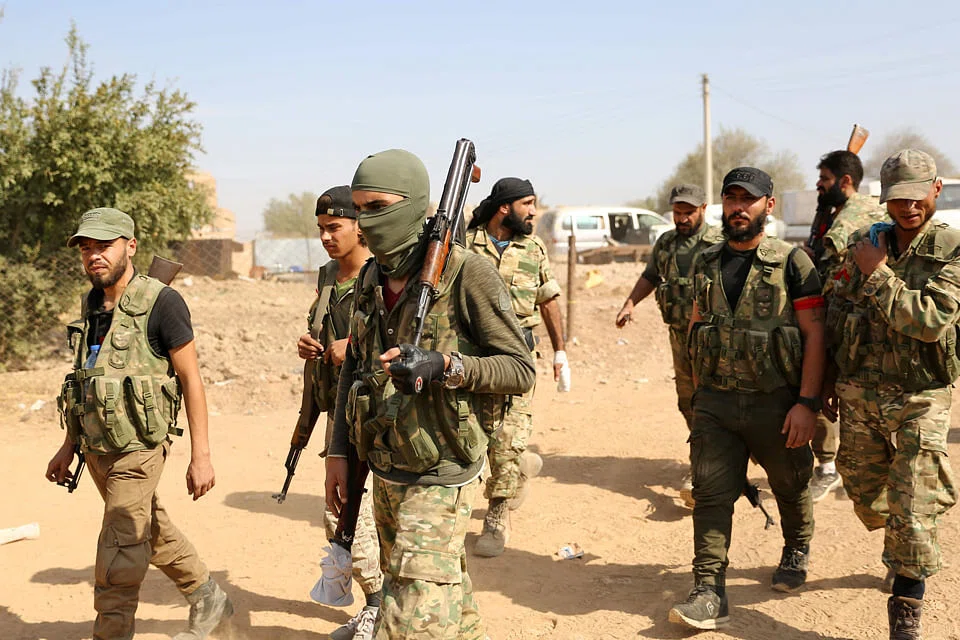
His top national security advisers, officials at the State Department in the Pentagon, the mainstream media and the many foreign policy experts insisted that he should not give the green light to the Turkish strongman to deploy his troops in a northern area of Syria which has been held by Kurdish fighters, and in the process withdraw the remaining American forces that have been working with the Kurds.
They made their plea based on both moral and policy considerations. The Americans should not abandon the Kurdish forces who served as their allies in the fight against ISIS; that withdrawing American troops from Syria would only serve the interests of US adversaries, including Syrian President Bashar Assad who has been classified a "war criminal" by Washington; the anti-American Iranian regime; and Russia, a leading global rival, warning that a decision to pull out American troops from Syria would result in ethnic cleansing, if not a bloodbath.
PUBLIC BACKLASH
Those warnings made sense and in some cases proved correct. But then Mr Trump (not unlike his predecessor in office, Barack Obama) could imagine what would happen if a small contingent of 50 to 100 US soldiers found themselves in the middle of a war between the Turkish military and the Kurdish guerrillas.
Protecting the Kurdish fighters might have made the pundits, the think-tankers and other members of the foreign policy establishment feel good. But when the bags carrying the bodies of American soldiers started arriving in the United States and Mr Trump was being forced to send more troops to fight in Syria, a 24/7 bombardment of this kind of images would have produced a public backlash. Pictures of dead Kurdish fighters would not have that effect.
Against the backdrop of the hysteria that engulfed Washington following Mr Trump's decision to partly disengage from Syria and all the talk about "betraying" the Kurds, let us put a few things in perspective. First, there has never been a strategic alliance between the US and the Kurdish forces fighting the Syrian regime and seeking autonomy in northern Syria.
The Obama administration initiated, and the Trump administration maintained, a tactical partnership with some of the Kurdish forces as part of an effort to defeat the ISIS groups who were occupying parts of Syria and Iraq.
But the Americans have never backed a plan to create a Kurdish autonomous zone in Syria and has showed no sign of employing the US military to help the Kurds and other Syrians oust Mr Assad from power, although the Americans have backed and provided support for years to a Kurdish autonomous area in Iraq.
On the other hand, the US has an historic strategic alliance with Turkey, an important nation that lies between the Middle East and Europe, that goes back to the end of World War II when the Turks, who now control one of the world's largest militaries, joined the North Atlantic Treaty Organization (Nato).
At the same time, the Turks have been fighting for years with radical Kurdish guerrillas in southern Turkey who call for the secession of the Kurds in the area and who also maintain close ties with the Kurds fighting in northern Syria.
Mr Erdogan may be an authoritarian leader, but his concerns over the security threat that the Kurds in northern Syria pose to Turkey are well-founded and shared by most of his countrymen. From that perspective, northern Syria is located on Turkey's strategic sphere of influence, and the Turks have the right and the obligation to protect their national security there, and respond in probably the same way that the US would have if anti-American guerrillas took over parts of Mexico, which is part of the US' own sphere of influence.
It is true that every decision to go to war, to make peace, or to return troops home, could pose moral dilemmas, since they involve issues of life and death.
There is no doubt that the decisions by Great Britain after World War II to wind up its imperial project in the Indian subcontinent and later to end its presence in Palestine, were followed by years of conflict between Hindus and Muslims, Jews and Arabs, not unlike the bloody consequences of American withdrawal from Vietnam when its military interventions there ended.
PUBLIC SENTIMENT
But those moves by Britain and the US reflected the sentiments of the British and American people who did not want to continue paying the high costs in lives and funds involved in controlling far-away lands whose national, tribal and religious conflicts could not be resolved through remote control from London or Washington.
Would anyone argue today that the Brits should have kept their jewel in the crown and continued to rule over the Promised Land, or that the Americans should have remained in Vietnam, in order to prevent all the bloodbaths that followed?
Mr Trump should be criticised for his erratic management of what amounts to his "foreign policy" and indeed the latest Middle East crisis could have been handled differently.
But that does not change the fact that the era of Pax America in the Middle East is over and that the United States has begun a process of gradual disengagement from the region, and that regional and global powers would have to adjust to that reality.
Anyone who assumed that ending the endless US wars in the Middle East was all "about Trump" should have watched the Democratic presidential nomination debate on Tuesday, when current Democratic frontrunner, Senator Elizabeth Warren from Massachusetts, called for the US to "get out" of the Middle East.
"I think that we ought to get out of the Middle East," Ms Warren said during a discussion of Mr Trump's decision to pull troops out of Syria. "I don't think we should have troops in the Middle East."
She may have been able to manage the US withdrawal from Syria in a more elegant way - but it would have happened even if Mickey Mouse was sitting in the Oval Office.
TRENDING NOW

Indonesia’s coal tycoon Low Tuck Kwong replaced as Bayan Resources president-director

OCBC names Ang Eng Siong as global corporate banking head in rejig of wholesale banking business

Consider lowering homeownership barriers for some non-resident foreigners

DBS opens flagship investment strategy to retail investors with new fund

