
COMMENTARY

Future of Singapore’s social compact rests on the shoulders of the people

The government cannot breathe life into a social compact, it is the people who do when they believe and are committed to it.
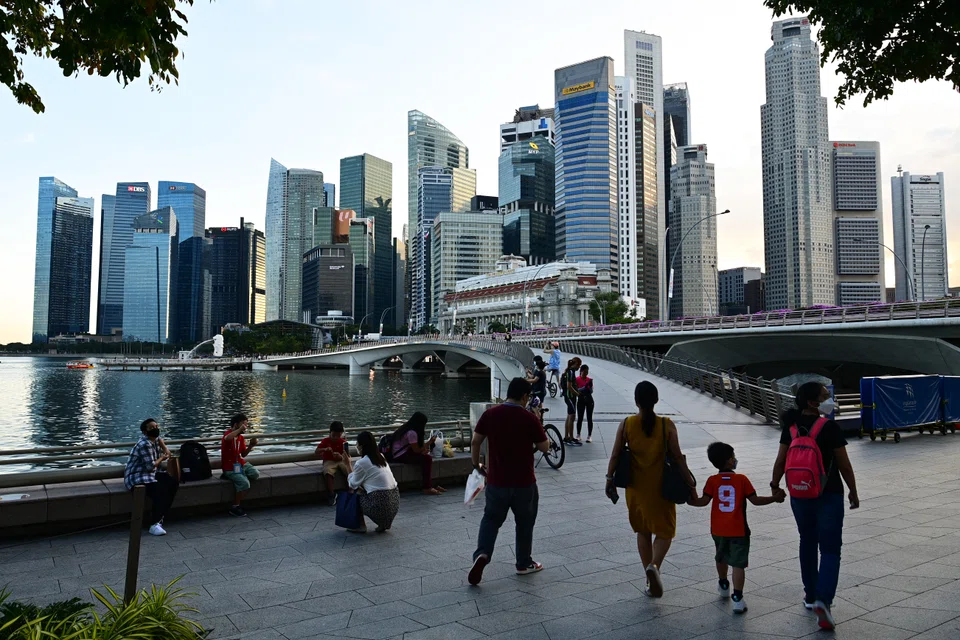
    • People walking towards the Jubilee Bridge. All societies are governed by social compacts, whether implicit or explicit. In articulating the relationship between the state and the people, a social compact is, in essence, the substance of state-society relations.
    • People walking towards the Jubilee Bridge. All societies are governed by social compacts, whether implicit or explicit. In articulating the relationship between the state and the people, a social compact is, in essence, the substance of state-society relations. The Straits Times
    Published Mon, Aug 8, 2022 · 05:50 AM

    LAUNCHED in June this year, Forward Singapore is an ongoing initiative led by Deputy Prime Minister Lawrence Wong and his fourth generation (4G) leadership team to review and refresh Singapore’s social compact, and set out a roadmap for the next decade and beyond.

    In some respects, Forward Singapore is not very different from previous national conversations and consultations, which were not just feedback exercises but also serious efforts at consensus building on key issues of the day. What is different this time, however, appears to be the attempt to specifically engage Singaporeans on 4 defined big issues - how our economy is run and whether the system benefits all or just a few; our system of meritocracy; our system of social support, and on our solidarity.

    These are issues that are fundamentally concerned with fairness, fair play and justice in our society. They speak directly to Singaporeans on post-material aspirations: What is it that defines us and what does it mean to be Singaporean. All societies are governed by social compacts, whether implicit or explicit. In articulating the relationship between the state and the people, a social compact is, in essence, the substance of state-society relations.

    At the National Day Rally in 2001, then-prime minister Goh Chok Tong described the social compact as “an understanding among all Singaporeans, and between the government and people (which) will ensure that we stay a cohesive nation even as economic competition intensifies and the income gap widens”.

    Founding prime minister Lee Kuan Yew observed in 2007 that Singapore’s social compact was central in Singapore’s transformation from an “improbable nation” to a “first world oasis” despite lacking the “ingredients of a nation”.

    Put simply, the social compact is a means of and an end towards the productive and purposeful organisation of society. It is a powerful source of the people’s affective and cognitive ties with the state, government, and fellow citizens.

    Unsurprisingly, Singapore’s social compact must be continually forged anew to retain its raison d’etre and appeal, in tandem with the fast-changing complexion of society locally and internationally.

    Performance legitimacy, premised on the government’s delivering sustained economic growth with equity, begets trust in the government. Today, the management of success in Singapore has brought with it new challenges.

    At that National Day Rally 21 years ago, Goh outlined 3 key principles of the social compact. First, the government would heavily subsidise public housing, education and healthcare, making them affordable to all. Second, the government would distribute Budget surpluses during good performing years through asset-enhancement schemes and rebates. Third, the government would pay specific attention to the needs of the lower-income group.

    In 2003, Lee Hsien Loong - then deputy prime minister - underscored the close, if inevitable, linkage between the social compact and the economy. He noted that governments need to “rethink their social compacts and the protection that the state can offer citizens”. He reiterated the government’s pledge to protect those marginalised by globalisation.

    He also emphasised the necessity of economic restructuring if Singapore was to maximise the resources it had to deal with the variegated consequences of globalisation.

    Accordingly, the economy needs to be regularly restructured at the macro-level. At the micro-level, job redesign, skills upgrading, and wage restructuring must be pursued relentlessly. These tasks required the tripartite cooperation of employers, employees’ unions, and the government.

    In 2006, as prime minister, Lee endorsed a revitalised social compact as a priority for his newly elected government: “It is essential for us to tilt the balance in favour of lower-income Singaporeans, because globalisation is going to strain our social compact”.

    The concern is not only with enlarging the economic pie; it is also how the enlarged pie is to be shared, without incurring political costs and generating disequilibrium to a system that greatly values stability, consensus, and order in the economic and socio-political realms.

    Consequently, the tenor of public policies has shifted from sharing the nation’s wealth equally to sharing it equitably. This entails that the poor and vulnerable receive relatively more assistance and support from the state. The government rolled out the Progress Package that year, its most comprehensive surplus sharing initiative to date.

    In 2007, the Workfare Income Supplement Scheme was introduced as a new pillar of Singapore’s social compact. Targeted primarily at low-wage Singaporeans, Workfare sought to deal with structural poverty through wage supplements to low-income citizens - while requiring them to remain employed - and incentivising employers to hire them.

    With the upcoming changing of the guard in political leadership and amid persistent concerns over social mobility, the imperative is clear: Keeping income inequality to a minimum and according special consideration to the needs of the lower-income group. The global Covid-19 pandemic has made this task of closing the societal gaps even more urgent.

    Singapore has weathered difficult periods relatively well because the government has been able to harness the mass action and cooperative spirit of Singaporeans. There is the need to ensure that the social compact continues to be relevant and fit for purpose.

    To sustain Singapore’s social compact, a fundamental mindset change is needed. As Singapore matures, however, economic efficiency and material interests alone cannot form the foundation of the bond between the state, government and society.

    Free-market capitalism, through its single-minded emphasis on the pursuit of private economic gain, alone cannot produce the social capital, social institutions, and values that are needed for society to cohere and to generate a shared narrative and purpose.

    The social compact can leaven the economic imperative with civic action to help assuage the economic anxiety and fear that globalisation poses to broad segments of society. Fundamental to the sustenance of the social compact is trust – among Singaporeans, and between the government of the day, the state, and Singaporeans. To achieve this, the social compact needs to dovetail with a vision of Singapore society as one characterised by a dense interlocking web of social networks and adequate social safety nets.

    However, the social compact cannot be about individualistic, pragmatic contracts premised on quid pro quos (the what’s-in-it-for-me syndrome). It must be a lived reality grounded on social, moral and associational bonds that celebrates the individual citizen as an equal and participating stakeholder in the writing of the Singapore Story. As Wong put it, “we must all, as a society, learn to value the contributions of every worker in every profession or field”.

    This deepening of the sense of mission of Singaporeans, especially the millennials and Gen Zs, can enable them to take ownership for their and Singapore’s future and to realise the vision together.

    Wong has given his 4G leadership team and himself a big task ahead, of which managing expectations, engendering trust, and inspiring hope and confidence would be a major challenge. One person’s sense of justice, fairness and inclusion may well be another person’s sense of injustice, inequality and exclusion.

    Will Singaporeans engage in Forward Singapore with, in Wong’s exhortation, “open minds and big hearts”?

    Forward Singapore is an attempt for the 4G leadership to demonstrate its collective leadership approach and to leave a strong impression on Singaporeans that it is equal to the task of leading Singapore through to the 2030s. It also hopes to defuse the political sensitivity of hot-button issues with new policy initiatives before the next general election which must be held by November 2025. As such, the exercise is inherently political.

    It’s a bold challenge on both levels of process (how the engagement is done) and the outcomes (a fairer, most just Singapore) but one that may well define the 4G team if the refreshed social compact excites and secures the buy-in of Singaporeans, and results in positive outcomes in terms of needed reforms, overdue attitudinal changes, and timely interventions.

    The risk of political and social polarisation in Singapore cannot be discounted. Revitalising the social compact is very much an effort to re-invigorate social solidarity as society becomes more diverse and social mobility slows down. The pandemic has provided a real-time opportunity to re-evaluate how well our social compact has served us.

    In the final analysis, a fair and just society is our individual and collective responsibility. The government cannot breathe life into a social compact, it is the people who do when they believe and are committed to it.

    The writer is an associate professor of law at the Yong Pung How School of Law, Singapore Management University.



