G7 needs more momentum and boldness, post-Ukraine
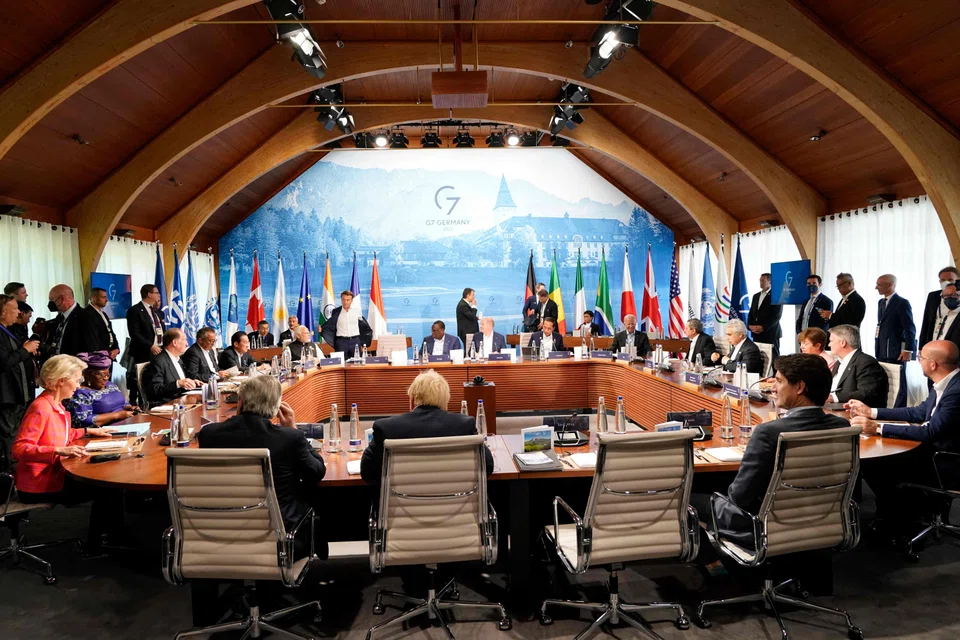
THIS year’s G7 summit concluded on Tuesday in Germany with few big agreements, and the body badly needs more boldness to tackle the growing range of challenges from Russia’s invasion of Ukraine.
Take the example of energy security where there was no strong consensus behind any genuinely new, game-changing initiatives, despite sky-high prices. To be sure, G7 ministers are now looking into a cap on the price of Russian oil and possibly gas too; however, this could take weeks, if not months to finalise, and is far from certain to materialise with the potential “devil in the detail”.
There was also a tension between short-term energy goals, and longer-term climate ambitions. For instance, some leaders sought agreement that “publicly supported” investments in natural gas projects are “necessary” to quell the current energy crisis. Yet this potentially clashes with public commitments made at COP 26 only last year which concerned other leaders.
Even some of the key schemes that were officially launched this week, including a new infrastructure initiative aimed at offering low- and middle-income countries high-quality, transparent investments (a clear response to China’s ‘Belt and Road’ project) are “recycled” from last year’s UK-hosted summit.
In this context, the G7 may appear ill-suited to tackling the overlapping challenges facing the world, from the Ukraine war to the pandemic. This is especially so as the political leadership is weakened from even 12 months ago when the leaders met in the United Kingdom, including UK Prime Minister Boris Johnson, US President Joe Biden, and French President Emmanuel Macron who have all suffered significant political setbacks since then.
Yet, the Western club has often been at its best in turbulent times, and has a strong legacy of working in geopolitical crises. Many forget the body was founded in the 1970s in the aftermath of geopolitical and economic shocks when Washington pulled out of the Gold Standard during the Vietnam conflict. Back then, Richard Nixon also resigned as US president and there was a clear danger of currency wars and wider turmoil.
Even then, the bloc proved fit for purpose, playing a key role in the management of the most important exchange rates. It also brought Japan into the Western policymaking community.
This week, India, Indonesia, Argentina, Senegal and South Africa all joined the G7 leaders to give greater international perspective. Moreover, Ukraine’s President Volodymyr Zelenskyy joined by video, and yet again proved to be a star of the show.
While the G7 was created in the instability of the 1970s to monitor developments in the world economy and assess macroeconomic policies, the Ukraine crisis has once again brought its role as a geopolitical lynchpin to the fore. In recent years, the body has played a significant orchestration role in the West’s policies toward Libya, North Korea and the South China sea too.
The Italian G7 presidency in 2017, for instance, placed strong emphasis on the-then turbulence in North Africa and the Middle East, including Iraq, Libya and Syria. This included a push toward fostering stability in Libya following the collapse of the Gaddafi regime.
Another example was the discussion on the South China Sea during Japan’s presidency in 2016. Then, the G7 warned of “any intimidating coercive or provocative unilateral actions that could alter the status quo and increase tensions” given the territorial disputes over several archipelagos there involving countries such as China, Vietnam, Malaysia and the Philippines.
This prompted strong objections from Beijing, which claims much of the South China Sea, which asserted that that the G7 should focus its time on its founding mandate of global economic cooperation. As this reaction indicates, the G7’s involvement in its geopolitical dialogues has met with significant international criticism from time to time.
Building from this, it is also sometimes asserted, especially by developing countries, that the G7 lacks the legitimacy of the UN to engage in these geopolitical and security issues, and/or is a historical artefact given the rise of new powers, including the BRICS. However, it is not the case that the international security role of the G7 is new.
An early example of the lynchpin function the body has played here was in the 1970s and 1980s when it helped coordinate Western strategy towards the then-Soviet Union. Moreover, following the September 2001 terrorist attacks, the then-G8 (including Russia) assumed a key role in the US-led ‘campaign against terrorism’.
Since the invasion of Ukraine, however, relations are now so poor between the G7 and Russia that Moscow may never be readmitted to the Western club, as constituted as the G8, especially so long as President Vladimir Putin remains in power. Russia joined the summits from 1997 to 2013, but following the annexation of Crimea, Moscow was told it could only rejoin if “it changes course and an environment is once again created in which it is possible for the G8 to hold reasonable discussions”.
Fast forward to 2022, and it is now the Russian-led Ukraine crisis gripping the G7 so the body is once again dominated by geopolitics, despite criticism of its actions in this area. The Western club of Japan, United States, Canada, Germany, France, United Kingdom and Italy have helped spearhead in recent weeks the massive international package of sanctions against Moscow; pledged never to recognise any redrawn boundaries for Ukraine; provided billions in aid and assistance; are currently looking at the reconstruction plans for the nation; and attempting to ameliorate a mounting food and energy security calamity that could make for an exceptionally difficult period to come.
Yet, more is now needed from the Western club as the second half of 2022 dawns.
In the aftermath of Russia’s latest geopolitical gambit, and after the schisms of Donald Trump’s US presidency, now is the right time for the G7 to take an important step back and try to concentrate again on unity, and develop a comprehensive strategy for the big questions facing the West and wider world. And there is no bigger short-term challenge than the impact of the Ukraine crisis, especially coming in the midst of the continuing coronavirus crisis.
Andrew Hammond is an associate at LSE IDEAS at the London School of Economics