

Hong Kong’s commercial property could re-rate downwards

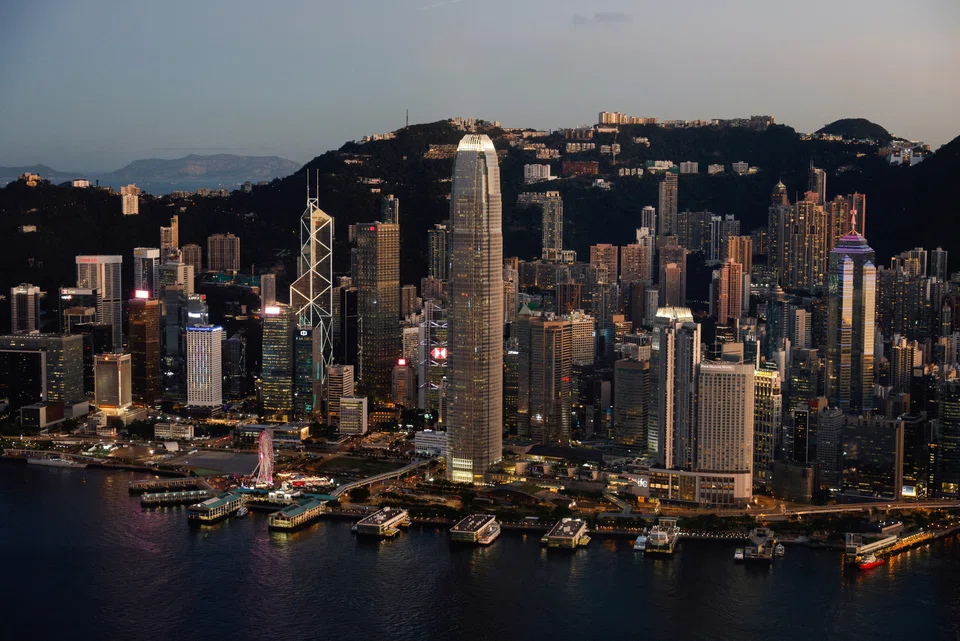
HONG Kong’s gross domestic product fell 4 per cent year-on-year (yoy) in Q1 2022, advance estimates released by the government showed. Retail sales in the territory suffered double-digit declines from a year ago in each of February and March.
Earlier this year, the territory was hit hard by the Omicron-driven wave of the Covid-pandemic, which led to the health system being stretched to its limits and a spike in the number of deaths.
The territory’s pursuit of eliminating Covid with tough border restrictions have led to some people and businesses leaving Hong Kong.
Commercial property landlords in the territory have suffered. Sun Hung Kai Properties’ (SHKP) gross rental income for the 6 months ended Dec 31, 2021, fell to HK$4.5 billion (S$800 million), down 3.8 per cent and 16.4 per cent from the same period in 2020 and 2019 respectively. SHKP owns about 12 million sq ft of retail space across Hong Kong, including IFC Mall in Central, APM in Kwun Tong and New Town Plaza in Shatin.
Investors may be fretting over the prospects for groups exposed to Hong Kong property. As at May 6, 2022, SHKP and Sino Land traded at a discount to their respective end-2021 book value of 55 per cent and 48 per cent respectively. Sino Land is led by Robert Ng, son of the late Singapore property tycoon Ng Teng Fong.
Singapore-listed Hongkong Land, which has been actively repurchasing its shares, traded at a discount to end-2021 net asset value (NAV) of 69 per cent as at May 6, 2022. A key holding of the group is a portfolio of 12 inter-connected commercial buildings in Central, Hong Kong, which provides over 4.8 million sq ft of Grade A office and luxury retail space.
Hong Kong’s positioning
Location is critical in property investment. At a micro level, one seeks to own a commercial asset in a site with good frontage and transport connectivity. At a macro level, one seeks to own a commercial asset in a country or city where growth prospects are strong. While property has helped create many fortunes in Hong Kong, the territory’s commercial property may be at risk of re-rating downwards.
Much uncertainty hovers over demand for office and retail space in the territory. According to Colliers, Grade A office rent in Hong Kong fell 3.6 per cent yoy in 2021 and 14.7 per cent yoy in 2020, and slipped a further 1.3 per cent in Q1 2022 from the previous quarter. Retail rents as of end-2021 are down 19 per cent from January 2020.
In May, Hong Kong allowed non-residents to enter the territory for the first time in over 2 years. Fully-vaccinated visitors entering Hong Kong are subject to a quarantine period of 7 days. Might Hong Kong’s position as a business hub diminish due to tough Covid-related restrictions?
In late April, Hong Kong re-opened gyms, beauty parlours, theme parks and cinemas for the first time in more than 4 months. The group size for dining-in at restaurants has recently been increased, and dining-in hours will be extended later this month.
But, without large inflows of visitors from China - which is still pursuing a Covid-zero strategy - Hong Kong's malls could struggle to regain their lustre. Major brands may be less keen to open big boutiques and showrooms in the territory.
In the investment market, international investors, who are concerned with the territory’s future as a financial hub, may be less bullish in their appetite for and pricing of prime Hong Kong commercial assets.
Chinese buyers may be inactive as some highly-indebted Chinese property groups are focusing on lowering their gearing levels. Meanwhile, some Hong Kong groups and tycoons may diversify their property exposure by buying investment properties in other jurisdictions.
A contrarian MCT
Still, Mapletree Commercial Trust (MCT) is pushing on with its proposed merger with Mapletree North Asia Commercial Trust (MNACT), which has Festival Walk in Hong Kong contributing 54 per cent of its assets under management as at Mar 31, 2022. Located in the upscale residential area of Kowloon Tong, Festival Walk comprises a 7-storey retail mall with a 4-storey office tower and 3 underground car park levels.
The proposed merger involves MCT acquiring all the units of MNACT via a trust scheme of arrangement. The scheme consideration price of S$1.1949 per MNACT unit held reflects MNACT's NAV per unit as at Sep 30, 2021, adjusted to exclude MNACT's distribution per unit for the 6 months to Sep 30, 2021, and to incorporate valuation of the trust's investment properties and joint venture as of Oct 31, 2021.
MNACT’s unit holders were initially offered either new units of MCT or a mix of mainly new units and some cash. An all-cash option was subsequently added. MCT will make a preferential offering of S$2.0039 per unit to fund the additional cash of up to S$2.2 billion required in the cash-only option.
MCT’s unit price fell post announcing the proposed merger. Should MCT just walk away from the deal?
MCT is already a constituent of the benchmark Straits Times Index. Some investors may be happy if the manager continues to focus on its Singapore-only portfolio, which includes premier assets such as Vivo City and Mapletree Business City that will benefit from the development of the Greater Southern Waterfront.
Nonetheless, MCT’s manager wants to scale up and grow overseas via a merger. But, having Hong Kong feature large in the trust’s growth plan seems a contrarian bet.
In MNACT’s financial year ended Mar 31, 2022 (FY22), Festival Walk posted negative average retail rental reversion of 27 per cent. While Festival Walk’s gross revenue and net property income grew yoy in FY22, gross revenue and net property income in FY22 are 20 per cent and 25 per cent lower than in FY19 respectively.
Even if investors are comfortable over the renewal of Festival Walk’s land use right, which expires in 2047, questions loom over the potential decline in values of prime Hong Kong commercial assets.
Will MCT’s unit holders have confidence in Festival Walk and vote for the proposed merger at the extraordinary general meeting on May 23, 2022?
MCT’s unit holders will need to have faith that Hong Kong under its new leader John Lee can prosper. Commercial property owners have to hope that a Hong Kong, which is less international and more Chinese, can be vibrant and relevant.
(The writer holds units in MCT and MNACT)
TRENDING NOW

Two Singapore-listed palm oil firms named in Greenpeace report on Indonesian plantation fires
Singapore Airlines flight returns to San Francisco after ‘unruly’ passenger incident
Singapore looking into which companies responsible for haze-causing fires: PM Wong
Deluge IPO 3.86 times subscribed ahead of SGX debut

