

If we want affordable COEs, islandwide road pricing is the way to go

Dennis Chan
NEW price benchmarks are such a regular feature in these inflationary times that they rarely make a ripple when they come along. However, there is a peculiarity with certain goods that raise the hackles among Singaporeans once an invisible line is crossed.
The first million-dollar HDB resale flat is one example. More recently, it was the S$100,000-mark for a Certificate of Entitlement (COE) in Category A, the one used to register bread-and-butter cars.
The outcry or disquiet – depending on one’s point of view – culminated in a spirited debate in Parliament over rising COE prices and a robust defence of the bidding system by Transport Minister S Iswaran.
In his ministerial statement in Parliament, he said that Singapore must expect the long-term trajectory for COE prices to be upwards, as household incomes continue to rise in the coming years, coupled with the government’s policy of zero-growth in the car population.
That may be true, but I suspect much of the anxiety among car buyers is due to the pace of the price increase. In the last two years, this has been steep and relentless, on the back of a rising drought in vehicle quota (see chart). Between April 2021 and April 2023 (second bidding), cat A COEs rose 109 per cent to S$103,721; cat B COEs, used to register bigger or luxury cars, almost doubled to S$120,889.
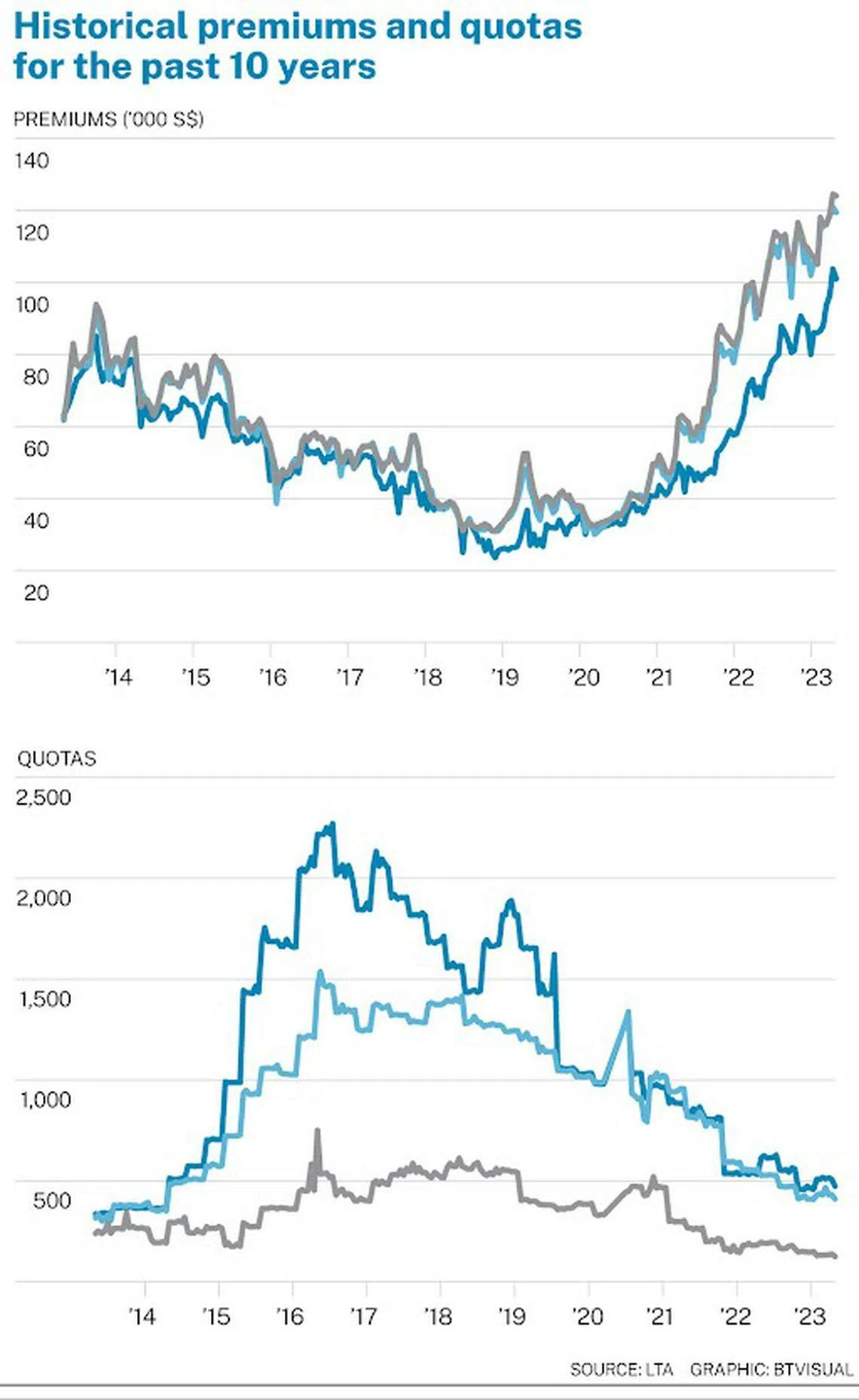
These are the steepest increases in at least the past 20 years, and came on the back of a 43 per cent drop in cat A COEs to 507 pieces and 55 per cent fall in cat B ones to 430 pieces over the same period.
Such drastic changes shocked the market, even one that has gotten used to having the priciest cars in the world. A quick solution is needed to ameliorate the situation, which the Land Transport Authority (LTA) has done by bringing forward deregistrations and redistributing over several quarters about 6,000 non-extendable five-year COEs that are due to expire in the next projected supply peak.
Starting from the bidding exercise that closes on Wednesday (May 17), this move will raise the quota supply by about 24 per cent and 15 per cent, in cat A and cat B, respectively.
In absolute terms, the total quota from May to July will increase from 9,575 to 10,431. That’s about 270 pieces more per month than the February-to-April period that had led to the record-busting prices.
But as Iswaran warned in his statement, the extra COEs from the accelerated deregistration exercise will help to tamp down, but not eliminate, volatility in supply. The long-term upward trend of COE prices due to rising incomes and zero vehicle population growth will not abate, he warned.
He noted that even though the absolute price is higher now, the COE price is relatively lower than the median income because household income has risen.
Academic Raymond Ong wrote in The Straits Times recently that the ratio of COE price to median monthly household income has fallen from 11 to one during the previous COE price peak in 2013, to nine to one today. This may suggest that a car has become more affordable, but it does not take into account upfront car taxes, which have increased over time.
In any case, runaway COE premiums in 2013 were sufficiently alarming for the authorities to impose curbs on car financing (which have since been loosened). And if one were to look further back to 1994, when COEs first breached the S$100,000 mark, the government also took steps to re-examine the system.
More can be done to address spiralling COE prices than the one-off fast-forwarding of car deregistrations. There have been no lack of suggestions from Members of Parliament and market watchers.
At the risk of regurgitating old ideas, I believe the government should think about taxing car owners more on usage and less on ownership.
Let’s have more COEs available but also make it a lot more costly to drive from the first mile. After all, the current policy of zero car population growth is already being undermined by technology.
A few years ago, when the prospect of a fully autonomous vehicle plying the roads was said to be nearing fruition, a banker shared with me over lunch how much he looked forward to this eventuality.
He said his car was underutilised, in that it was mostly used for commuting on weekdays. And on those days, he had to pay for parking in the Central Business District (CBD), which was expensive.
“If I had an autonomous car, my wife and kids can use it while I’m at work. The additional running cost can be offset by my not having to pay for CBD parking,” he said.
It’s a great plan for him, but a horrible idea for Singapore if everyone adopts the same mindset once autonomous cars become ubiquitous. Expect gridlocked traffic, higher energy emissions, perhaps even more accidents when cars are programmed to go round and round.
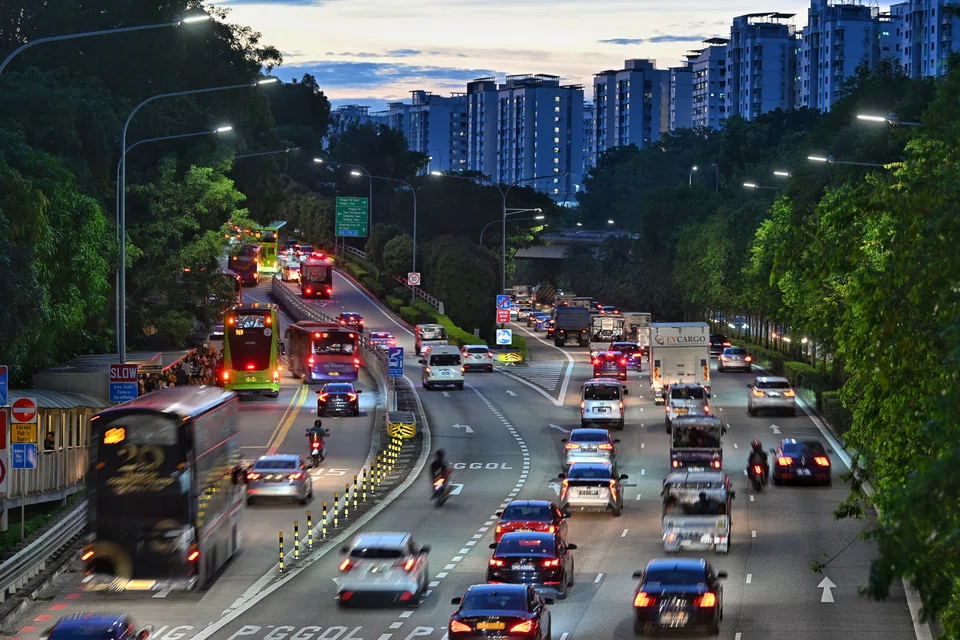
The era of fully autonomous cars plying our roads is not yet a reality, but all the same, it feels like the roads are more congested throughout the day, not just during peak hours.
Ride-hailing and taxis today account for about one million daily journeys, delivered from a fleet of some 70,000 private-hire cars (PHCs) and 14,000 taxis. Meanwhile, the population of not-for-profit private cars is 580,000, and they account for about 4.2 million trips.
While PHCs and taxis may constitute 10 per cent of the car population in Singapore, they make up 20 per cent of the daily trips of all cars. It’s no wonder the roads are busier than before.
The COE as a one-size-fits-all traffic management tool is too blunt, given the technology we have today. On social media platforms, one can easily find drivers offering paid car rides, including inter-border trips. A usage-based road pricing is the most direct way to continue to keep our roads relatively congestion free.
Make drivers pay more for driving, but tax them less upfront when getting a car. If we get the balance right, and people think twice before they turn on their car engine, we can have a “car-lite” society and still leave room for the car population to grow marginally.
Now, I understand our rooted electronic road pricing gantries are unable to tax usage effectively. Such an endeavour requires a global satellite-based system, which the LTA has commissioned.
According to a recent report in The Straits Times, a complete rollout of the project won’t happen before 2025 at the earliest; this is because not only must the infrastructure be built and tested for reliability, existing vehicles will need to be outfitted with a compatible in-vehicle unit.
A big headache in implementing this would be how to charge foreign-registered cars on our roads. And if it’s politically feasible to do so, given the high volume of cross-country vehicular traffic between Singapore and Johor.
But try we must. Private enterprises are tapping technology that has changed and will continue to change our road usage patterns. Likewise, the LTA will need to do the same to keep up.
TRENDING NOW

Once staunchly pro-China, Malaysian Chinese businesses are now distancing themselves from Beijing

Britain’s mansion tax shows the difficulty of targeting wealth

Three hats, one goal: How Ng Kian Swan runs sustainability at NUHS
COE review: The gap between luxury and mass-market cars isn’t the only one worth bridging

