

Is white majority dead? It's risky to misread demographic trends
Non-whites Americans are projected to become the numerical majority by the mid-century, but the waters are muddy from assimilation, intermarriage and bureaucracy.
IN the aftermath of the election of the African-American (in fact, bi-racial) Barack Obama as US president in 2008, political pundits speculated that his victory marked the emergence of a new coalition of non-white American men that, in addition to Blacks, included Hispanics, Asian-Americans, Muslims, feminists and LGBTs.
These groups only needed to band together and help transform American politics. Young people, Blacks, Hispanic and other minorities were leading a revolution!
Then came the presidential win of a manly white man in 2016 over a leading feminist, challenging the notion embraced by many Democrats that they were on the right side of inexorable demographic trends.
To sustain their notion of a "Majority Minority" America, progressives contended that President Donald Trump's victory reflected a political backlash by a declining white majority whose members recognised that they were losing their power to non-white Americans. They were engaged in a rearguard demographic-political fight.
Democrats then predicted that the 2020 presidential election, coming after the national protests in support of racial justice in the summer, would become the real turning point when angry white men would discover that they have lost their power. Some forecast that the Democratic presidential candidate would win by a landslide, and even pick up traditional Republican states like Texas and Arizona with their growing Hispanic populations.
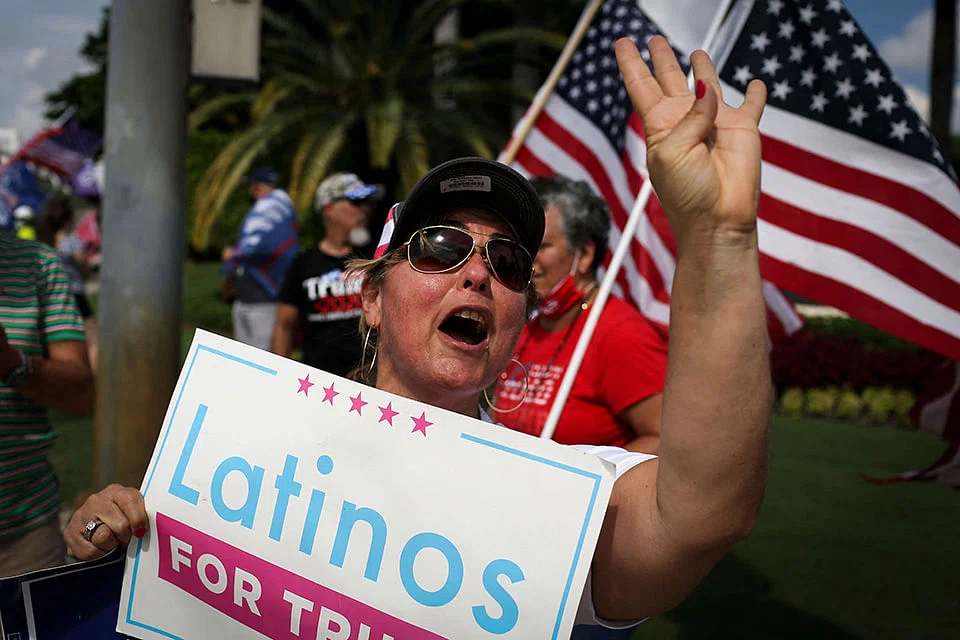
That, as we know, did not happen. President Joe Biden actually won fewer Black votes than Hillary Clinton in 2016, while Candidate Trump - that symbol of White Supremacy - helped Republicans gain more support among Black, Hispanic and Asian-American voters, including in Texas. Hence, President Trump received 36 per cent of the votes of Latinos without a college degree, and President Biden actually won the race from getting more votes from white men.
CENSUS SURVEY
Never mind. Those celebrating the decline of the white majority were buoyed by the results of the 2020 government census survey that showed that the number of whites in America was declining by 8.6 per cent, and that they were projected to lose their numerical majority by the middle of this century.
Progressives would just need to be patient now. In a few years, Blacks, Hispanics and Asian-Americans would become the majority, and ipso facto, the Democrats would be in control.
There are many problems with assuming that changes in the racial and ethnic makeup in the US would by definition stimulate a grand political transformation.
First, much of the discussion of these issues assumes that there are clear definitions of who is "white", or, for that matter, "Hispanic" or "Asian-American". In fact, there has never been such clear definitions.
Many would be surprised to learn that up to the start of the 20th century, Americans (mostly of Anglo and Nordic descent) did not identify southern and eastern Europeans as "whites"; many of them even questioned whether even Irish-Catholics should be regarded as "Americans". And many Americans who were born to mixed-race parents were able to "pass" themselves off as "whites".
Yet the children and grandchildren of Italian and Polish Catholics and eastern Europeans, whose parents arrived a century ago in the last immigration surge, have become Americans. That had to do with what happened after World War II in America, which brought a massive process of assimilation of these groups into society and growing intermarriage between members of these groups.
That explains why while many Americans remain proud of their cultural heritage and ties to the "old country", very few would identify themselves today as "Italian", "Greek" or "Irish" or "Slav". It is very difficult to do that if your grandmother was the daughter of Irish and Italian immigrants and your grandfather was born to a German father and a Slav mother.
This process of assimilation has been one of America's greatest success stories. Consider the following fact: There is a majority of Catholic and Jewish Justices; the US Supreme Court bench even has a Black and a Hispanic, but there is not even one Anglo-Protestant Justice.
This brings us back to the demographic changes of our time, starting with the ethno-racial categories that are being used by the US census, especially when it comes to "Hispanics" and "Asian-Americans" and "African-Americans".
The notion that "Hispanics" or "Latinos" (a category including immigrants from Cuba, Mexico, Puerto Rico, Argentina, Spain, white and blacks, and Sephardic Jews) all belong to a monolithic ethnic-racial group makes no sense at all. Nor is the categorisation of Chinese, Japanese, Koreans, Indian, Pakistanis and immigrants from the Philippines and Vietnam as "Asian-American" based on history and culture.
At the same time, among Black adults, one in eight is an immigrant, a group that grew to almost 4 million in 2018, and includes immigrants from Nigeria who, like immigrants from Cuba and China, do better in terms of income and education than white Americans.
And here are more facts that run contrary to the Majority-Minority myth: Not unlike, say, Italians, Irish and Greeks in the 20th century, about 3 in 10 Americans of Hispanic and Asian origin intermarry, taking usually white spouses.
The result, according to a study by economists Brian Duncan and Stephen Trejo, 35 per cent of third-generation Hispanics of mixed parentage no longer identify as Hispanic; 55 percent of third-generation Asian-Americans of mixed marriage no longer identify as Asian. Some of them identify as "white" and others as "some other race".
According to figures provided by sociologist Richard Alba, Americans of mixed Asian and white descent tend to have more contact with white relatives than with Asian ones. Sixty-two per cent of Asian-whites say they feel "very" accepted by whites, compared with 47 per cent who say the same about Asians.
And when they marry, 72 per cent of Asian-white women and 64 per cent of Asian-white men take white spouses. The US census, however, would categorise them as "non-white".
GROWING INTEGRATION
Indeed, the rising numbers of people from mixed ethno-racial background, a clear sign of growing integration into the mainstream, is not always being registered by society. The US census insists on defining anyone with even one Black parent as African-American. That includes, for example, Vice-President Kamala Harris, a daughter of a Black father and a mother who immigrated from India. Or consider Tiger Woods, who describes himself as "Cablanasian" - of mixed Caucasian, Black and Asian ancestry.
From that perspective, the notion that the US is going to become "less white" suggests that America is going through another successful process of assimilating its immigrants.
Moreover, the political ramifications of this process are, at best, unclear. More likely than not, class, income, education and perhaps gender - not race and ethnicity - are going to determine the political identity of these immigrants and their children.
Hence Asian-Americans with academic degrees, very much like their white counterparts, tend to trend Democratic now. Asian, Hispanic and Black men are more likely to lean Republican than women in these groups. Immigrants from Cuba and Central America have nothing in common in terms of education and economic status and tend therefore to exhibit different voting patterns as do Americans of Japanese and Philippine descent.
And not unlike the immigrants from Italy and Greece in the 20th century, expect them to change their political orientation as they continue to assimilate into American society.






