

It's official: A Sino-US Cold War is on
Policy by China bashers in Washington envisions a long and costly global strategic confrontation involving new international alliances and American sacrifices.
HISTORIANS can point today to the exact starting dates of the Great War and World War II, but would probably disagree when asked to pinpoint the day or even the year that marked the beginning of the Cold War between the United States and the Soviet Union.
In a way, the post-1945 confrontation between the two global superpowers that had defeated Nazi Germany and Imperial Japan evolved gradually after the end of WWII as the US and the USSR could not agree on the shape of the new international system and were drawn into competition over strategic spheres of influence as well as a major clash of ideologies.
Some suggest that the attempts by Moscow to establish communist puppet regimes in Prague and Warsaw followed by Soviet military expansionism into Greece and Turkey, triggering responses by Washington and its Western allies, should be considered as the first moves in the Cold War.
That American strategy, also known as containment, was enunciated in 1947 in the Truman Doctrine, applied a year later in the Marshall Plan for economic recovery of Europe and culminated in the establishment of the North Atlantic Treaty Organization (Nato) in 1948, which led to the formation of the Warsaw Pact by the Soviets and their allies.
By now most of us agree that the Cold War ended when the Berlin Wall collapsed in November 1991 followed by the ensuing breakup of the Soviet Union a year later.
Those dramatic events were greeted by an assertion by a famous philosopher that we had arrived at the End of History marked by the victory of the West that would supposedly ensure that no great powers would challenge the US and its liberal-democratic ideals and thus precluding the possibility of a new Cold War.
But the foreign policy establishment in Washington, dealing with what former American ambassador Chas Freeman described as an "enemy deprivation syndrome", have been warning Americans for years of emerging new global rivals, starting with radical Islam and followed by Russia (or what remained of the Soviet Union), not to mention the Axis of Evil comprising Iran, Iraq (under Saddam Hussein) and North Korea.
Most recently, topping the list of the candidates for a Cold War-like confrontation with the US has been communist China, an emerging superpower, the world's second largest economy with nukes and growing military capacity that, as Washington's Cold Warriors contended, would require expanding defence budgets and military presence abroad, coupled with the declaration of new strategic doctrines and the mobilisation of the American people for a long global battle.
SCAPEGOATING CHINA
While most post-Cold War presidents agreed that Americans needed to prepare themselves for competition with the Chinese, the consensus was that that could take place while at the same time engaging China in the economic and diplomatic spheres.
But in the aftermath of the military fiascos of the wars in Iraq and Afghanistan, and then the 2008 financial crisis and ensuing Great Recession, concerns that the US was losing its hegemonic global status - with economic and political discontent at home - have played into the hands of those in Washington who were intent on scapegoating China for American problems. Chinese power, it was claimed, was supposedly helping to destroy the American manufacturing base, steal American jobs and trying to challenge US military supremacy.
That view seemed to be enjoying wide bipartisan support, with "populists" on the political right and left arguing that for the "globalist elites", China engagement policies were a way to promote their economic interests, and calling for trade wars with the Chinese. At the same time, military hawks have been interpreting each move by Beijing as part of a global strategy to displace the US as the reigning superpower, and have urged Washington to counter that with a new policy of containment vis-a-vis China.
The election of Donald Trump as the new president, a self-proclaimed economic nationalist who pledged to end the engagement policy with China, together with the rise to power in Beijing of President Xi Jinping, a Chinese nationalist intent on asserting his country's global status, helped create the conditions for what is now playing out - a perfect storm in the relationship between the two superpowers.
For a while, it seemed that pressure from Wall Street and advice of some of Mr Trump's allies who support continuing engagement with China would help counter the efforts by China bashers in the Trump administration who advocate an all-out global confrontation with Beijing, and this could persuade the president to avoid an economic war with the Chinese. The conclusion of a Phase-One trade deal between China and the US on the eve of a presidential election seemed to confirm that optimistic view.
But the spread from Wuhan, China, of a global pandemic that have killed many Americans and devastated the nation's economy while threatening the re-election campaign of Mr Trump have allowed the China bashers in the Trump administration - led by Vice-President Mike Pence and Secretary of State Mike Pompeo - to gain the upper hand and to start to bring to an end an era of political and economic engagement with China and perhaps moving the relationship to a point of no return.
Perhaps future historians would point to the recent statements by these and other US officials and the steps they have taken as marking the beginning of Cold War 2.0.
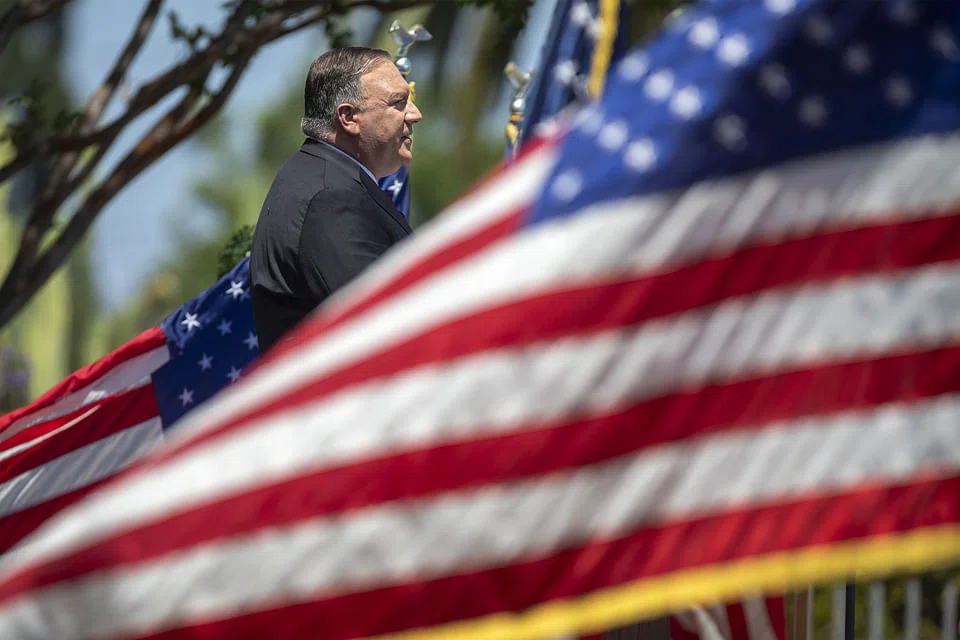
Indeed, Mr Pompeo delivered a blistering attack against China last Thursday that for all practical purposes sounded like a declaration of war against Beijing. He argued that decades of "blind engagement" with China have damaged US economic and strategic interests, and that the current status quo in their relationship only encouraged Chinese aggression abroad and coercion at home and required major changes in US strategy.
"We must admit a hard truth that should guide us in the years and decades to come; that if we want to have a free 21st century and not a Chinese century of which Xi Jinping dreams, the old paradigm of blind engagement with China simply won't get it done," Mr Pompeo said. "We must not continue and must not return to it."
The top American diplomat seemed to be calling for a regime change in Beijing, urging allied countries and the Chinese people to work with the US to transform the party's behaviour, using "more creative and assertive ways" to press the Chinese Communist Party to change its ways, including by forming "a new grouping of like-minded nations, a new alliance of democracies. "If the free world doesn't change, Communist China will surely change us," he declared. Securing the "freedoms from the Chinese Communist Party is the mission of our time" and America was perfectly positioned to lead it.
Richard Grenell, acting director of US national intelligence, told reporters after Mr Pompeo's speech that the US strategy was "to change the behaviour of the Chinese", suggesting that it was "emerging as the Trump doctrine, which is very harsh actions, sanctions and isolation while at the same time always offering a chance to exit if the behaviour changes".
TRUMP DOCTRINE
One problem with this "Trump Doctrine" regarding China is that contrary to the Truman Doctrine that evolved after long and fierce debate in Washington, including in the Congress and the media, the plan to contain China - indeed, to launch a long and costly Cold War against it, that could escalate into a hot war - has been promoted by a few bureaucrats, members of Congress and pundits with no serious public discussion about whether such policies would advance the interests and the welfare of the American people.
The Trump administration has been trying to demonstrate in recent weeks that it does mean business when it comes to its confrontational approach towards China. It announced sanctions on senior Chinese officials over the mass internment of Muslims; stated that China's maritime claims in the South China Sea are illegal; and rescinded the special status of Hong Kong.
Last week, the administration ordered the shutdown of the Chinese consulate in Houston and announced criminal charges against Chinese nationals for lying about their status so as to operate as intelligence agents in the US.
But what Mr Pompeo and other China hawks are proposing goes beyond tough rhetoric and symbolic steps against Beijing. It envisions a long and costly global strategic confrontation that would require the formation of new international alliances a la Nato and could require Americans to sacrifice lives and treasure in wars with China over such problems as Taiwan and Hong Kong, and could make Cold War 1.0 look like a picnic in the park.
It also assumes that it is the responsibility of the US to dictate to the Chinese what kind of political and economic systems they should choose, which was certainly not the reason former president Richard Nixon decided to start re-engaging China. Changing the direction of such a policy requires at the minimum having in place American policymakers who actually know what they are doing.
TRENDING NOW
Things to know about DBS’ incoming chairman Anthony Lim
DBS eyes prime brokerage business as Q3 profit falls 5% on weaker trading income

Royal Group and Sunset Hospitality abandon plans to open Casa Mett hotel off Orchard Road

George Yeo adds 100,000 Wilmar shares at S$2.97 apiece, taking stake to over 1 million shares

