Lessons in strategy from a Sri Lankan port
Hambantota port deal with China addresses issues of commercial viability and military security, offering a template for states keen on Belt and Road projects.
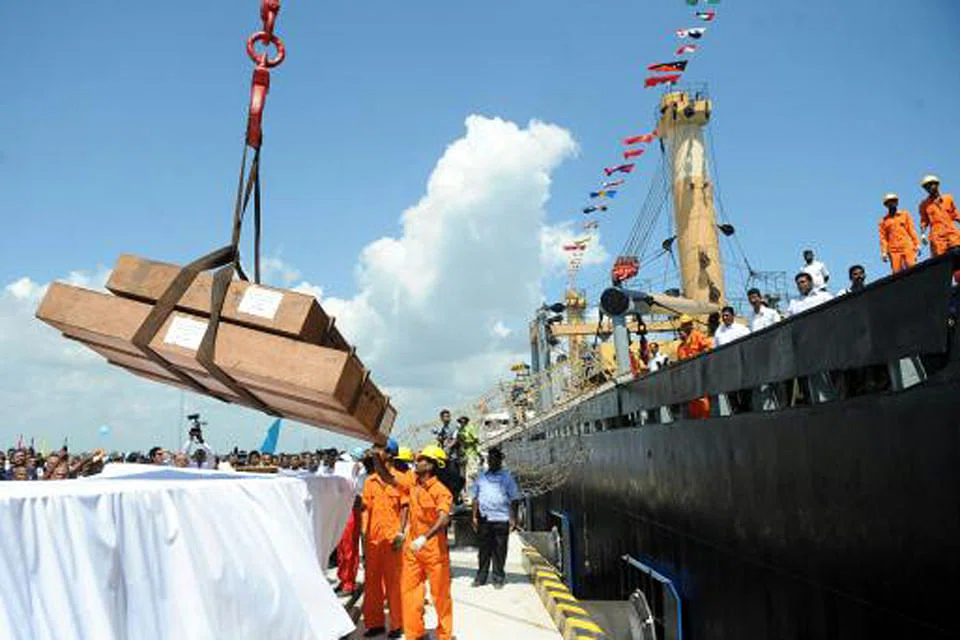
SRI Lanka's Hambantota port has been in the news for several years as a location that arguably underpins Chinese efforts to extend geostrategic influence in the Indian Ocean region. The development of the Chinese funded port has created considerable concerns in Indian strategic circles over its infrastructure enabling deployment of Chinese military resources in the surrounding waters.
The port has also been criticised on economic grounds as a venture that the erstwhile Mahinda Rajapaksa government in Sri Lanka committed to without noting its poor economic feasibility. As a result, Sri Lanka has been unable to recover costs; the port has degenerated into a heavily indebted facility, further burdening an economically distressed Sri Lanka.
The current government in Sri Lanka has renegotiated the operational and financial management of the port with China, to make it a public-private-partnership to change the risk-sharing structure of the port and to also address the security concerns emanating from it.
The port was originally financed by substantive credit from the Export-Import Bank of China. The Sri Lankan government has been struggling to repay the debt, given the low economic use of the port and the low revenues resulting from that.
Under the new agreement, the financial structure has been converted to an equity-based (as opposed to debt-based) financial structure. The state-owned China Merchant Port Holding and the Sri Lanka Port Authority have formed a joint venture with the equity ratio at 85:15.
This models the joint-venture agreement that the two companies have in running the Colombo port terminal operations. The equity arrangement would infuse new funds into the Hambantota port, with China Merchant Port Holding committing to invest more than US$1 billion (S$1.36 billion) into the project.
The new company, Hambantota International Port Group Ltd (HIPG), would focus on commercial operations of the port and the development of infrastructure and cargo handling.
SEPARATION OF ACTIVITIES
The unique part of the new port agreement is in the separation of functions between commercial and non-commercial activities. While the HIPG would focus on the former, Hambantota International Port Service Co Ltd would focus on port security, navigation, anchorage, dredging, pollution control and other port services.
The Sri Lanka Port Authority will be the major equity partner in this joint venture.
By developing the above structure, a couple of concerns about the project have been addressed. The first of these is the reduction of Sri Lanka's debt burden from an uneconomic port by changing the financial risk-sharing pattern; the second is to ensure that China is unable to utilise the port for non-economic, primarily strategic and military purposes, by transferring the oversight of non-economic functions of the port to a corporate entity that has the Sri Lankan company as a majority stakeholder.
The proposed operational structure - separation of functions between the commercial and the strategic, each to be respectively managed by business entities with majority ownership of Chinese investors and local ones - can mark the beginning of a process of project development that might become standardised across upcoming connectivity architectures.
One of the major concerns with China's Belt and Road Initiative (BRI), originally known as the "One Belt One Road" connectivity project, has been the likelihood of the use of the upcoming infrastructure to expand China's geostrategic influence. Chinese investment in these facilities would give it access to critical natural and geographical resources, thereby enabling the expansion of its military presence in the region.
Sri Lanka has been grappling with this concern, which many other countries looking at the BRI also share. The key dilemma for these countries, as it has been with Sri Lanka, is whether access to Chinese funds would entail compromises on sovereign strategic autonomies.
Would the new design of the Hambantota port address the above concern? The answer would be known only after a period of time as the new project model plays out in the port.
However, concerns remain over the "strategic" use of the port, primarily because of its geographical location. Located on Sri Lanka's southern tip, the facility occupies a pivotal position in the geography of the new maritime Silk Road proposed by the BRI. China's interest in retaining control of the port, notwithstanding the fact that it is not central to the busy shipping lanes criss-crossing Sri Lanka and, therefore, incapable of yielding high economic returns, is arguably due to Hambantota's geostrategic importance.
China's perception of this importance also emanates from the fact that it would have access to large chunks of land around the port for industrial development. Concerns over potential compromise on national security arising from this, have been conspicuous in Sri Lanka, manifesting in large-scale public protests.
MANAGERIAL DEXTERITY
It is unclear whether the separation of management of commercial and security functions, as specified in the new design, would assure utilisation of land resources by the Chinese developer in a way that is purely commercial and non-geostrategic. Maintaining virtuous co-existence of commercial and strategic interests would be a challenge for the port authorities and would call for high dexterity in port management between the two new companies.
The message coming out of the new design of the port points to the challenges that various countries will encounter in project development and design as they aim to integrate with the BRI. The Chinese-led initiative has taken off in a fashion that has simultaneously drawn attention to multiple contrasting choices for participating countries - obtaining funds for developing infrastructure, avoiding financial indebtedness and maintaining strategic autonomy.
Sri Lanka has begun experiencing these challenging choices ahead of other countries. The impact of these choices cannot be looked at in isolation from domestic political conditions in individual countries and the regional dynamics.
With respect to South Asia, the domestic political conditions include India's concerns over the BRI's geostrategic effect and the efforts needed to mitigate these. Sri Lanka has experienced this challenge in its effort to balance between China and India. This might only be the beginning for Sri Lanka, as it might be for many others.