

Mitigating climate change impact on businesses
Even with decarbonisation efforts by governments, societies and businesses must adapt to unavoidable changes, address vulnerabilities, and increase resilience.
AS THE world deals with the Covid-19 pandemic, it is easy to forget that there is another crisis on our hands. In remarks at the recent launch of the World Meteorological Organisation's annual State of the Climate Report, United Nations Secretary-General Antonio Guterres issued a reminder that climate change, like Covid-19, is a serious issue that cannot be put on the backburner.
Asia, as the fastest-growing region globally in terms of economic growth and urbanisation, is particularly vulnerable to the impact of climate change. According to Swiss Re Institute's latest research, Asia had 102 natural catastrophes in 2019 - the most of any region. These events accounted for US$66.4 billion in economic losses - again, the highest of any region.
In Singapore, an island-state and regional financial hub, rising sea levels resulting from climate change could leave most of its vital business district and infrastructure under water, crippling the economy. Guarding against sea level rise and other effects of climate change requires planning well in advance, with the government's announcement in Budget 2019 of a S$100 billion war chest to implement protective measures such as sea walls and polders a reflection of this. This year, the government announced even more measures to transit to a low-carbon, low-emissions economy, including plans to make Singapore's transport sector greener by phasing out conventional vehicles in favour of those that run on cleaner energy sources by 2040.
While these are laudable, a long-term low carbon emissions strategy requires a greater range of measures. The National Climate Change Secretariat recognises this and launched a public consultation exercise last year.
There is potential for the manufacturing sector to contribute significantly to reducing emissions, as the sector makes up a fifth of the Singapore economy.
The government's push towards a circular economy could reduce emissions from manufacturing by as much as 40 per cent in 2050, with the greatest opportunities in plastics and metals, according to a report by the Ellen MacArthur Foundation. However, there is a need for appropriate regulation on materials efficiency and recycling. For instance, we need to consider combining the circular model with the limited and expensive use of biomass-feedstock (eg ethylene from algae) in the manufacturing of plastic to reduce harmful emissions. At the same time, recycling efforts can be strengthened. Only 4 per cent of the 908,600 tonnes of plastics disposed of in 2018 were recycled, according to NEA figures. Incinerating almost all of Singapore's non-recyclable waste exacerbates the carbon emission problem.
POLICY LEVERS
Decarbonisation is largely technically feasible with existing technologies, although some of these still need policy and innovation support to reach commercial readiness. Policy levers to accelerate the decarbonisation of manufacturing could include tightening of carbon-intensity mandates on industrial processes as well as adequate carbon pricing differentiated by sector and applied to downstream consumer products.
In recent years, the Singapore government has shifted towards the use of natural gas, the combustion of which produces much lower global warming emissions. Nevertheless, natural gas is still a fossil fuel. In the long term, the replacement of natural gas with synthetic gas from renewable energy is something Singapore will have to think about if we are to decrease absolute emissions.
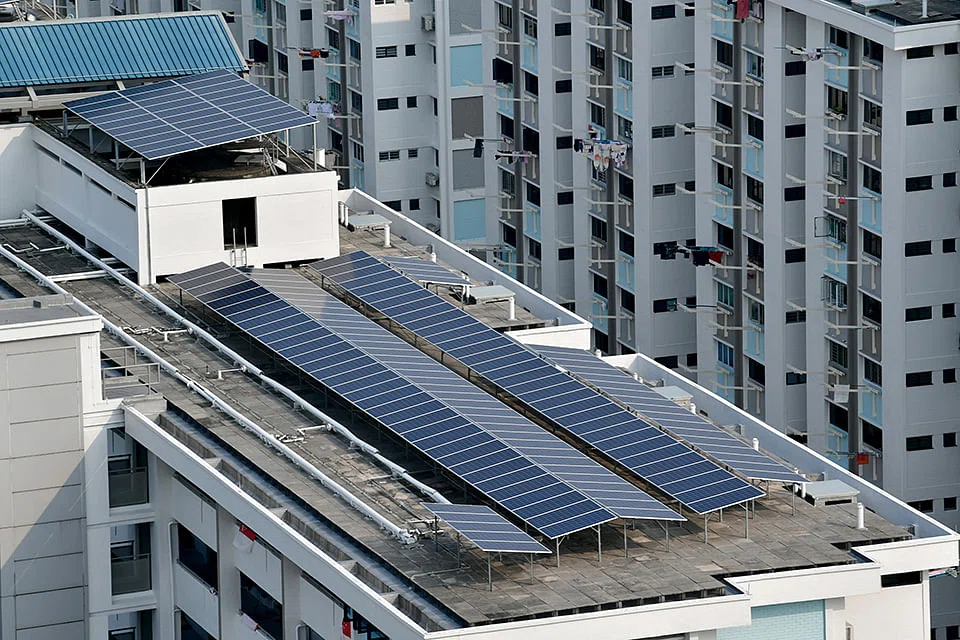
While space constraints pose a challenge in the use of alternative energy sources such as large-scale wind farms, the government is exploring innovative ways to generate electricity while reducing carbon emissions and maximising real estate in the process. With solar energy making up less than 1 per cent of Singapore's energy demand, plans are underfoot to leverage vertical space, including the rooftops of HDB apartment blocks, public sector buildings, and private industrial and commercial buildings, to increase solar power generation.
Building construction is another aspect where decarbonisation efforts can be reinforced. Materials efficiency and circularity need to be improved in a way that reduces over-specification of materials and facilitates end-of-life dismantling, sorting and recycling of materials, similar to what is required in the manufacturing sector.
Timber, as an alternative to steel and cement, could also play a major role. The new sports hall at the Nanyang Technological University is an example of timber's emerging use in construction, with benefits including a reduction in lifecycle emissions and its function as an effective carbon sink. A constraint, however, is the supply of timber currently available and potential reforestation rates.
Even if the best efforts of governments and enterprise pay off, the most optimistic climate change scenario still require that societies and businesses adapt to unavoidable changes, address vulnerabilities, and increase resilience.
Some physical risks that are fairly certain over the coming decades are sea water warming and land ice melting, causing sea level rise with severe local impacts. Very likely, disturbance in the water cycle will lead to increasing water scarcity as well as more frequent and/or longer droughts, leading to conflicts in water use and wildfire risk. While there is uncertainty about rainfall patterns, there is a lot of science suggesting greater severity, frequency and/or clustering of events.
Companies need to ensure that they remain resilient even if such events, which can significantly hurt cashflow and bottomline, occur. While traditional indemnity-based insurance is one form of protection that enhances business resilience, it is not always the most efficient, as assets in the global economy are increasingly shifting from the tangible to the intangible.
Globalisation and interconnected supply chains are another exposure that can result in financial damage, even to economies that are not directly impacted by changing weather patterns and natural perils such as typhoons or wildfires. Therefore, there is a not insignificant degree of vulnerability that Singapore businesses have in relation to climate change. They will need to think about complementing their traditional insurance programmes, which protect primarily physical assets, with more innovative solutions to avoid potentially painful protection gaps. Parametric or index-based insurance solutions are fairly new but have already proven to be an effective complement in protecting such pure financial or supply chain exposures.
Costly disruptions
Examples include import-dependent trading businesses where drought, frost or typhoons in other parts of the world could destroy seasonal harvests and thereby disrupt supply chains, causing costly disruptions to trading operations. A case study was the European heatwave and drought of 2018, where low water levels on the Rhine River made large parts of it unnavigable. This caused production to come to a halt in places, disrupted supply chains and increased manufacturing costs in the industrial heartland of Europe, resulting in hundreds of millions of losses to German companies.
Parametric insurance can offer protection in such instances where financial loss is involved but where there isn't physical damage, as it relies on a measurable and objective index like temperature, rainfall or windspeed to be triggered.
In the case of Singapore, for example, businesses can opt for parametric insurance to guard against the financial impact of a severe haze event, a phenomenon significantly influenced by changing weather patterns and drought in neighbouring countries.
Even as governments and businesses work together to limit global warming to 1.5°C (or at least well below 2.0°C) to avoid the worst impacts of climate change, the reality is that some consequences of climate change seem unavoidable. A business' ability to mitigate the financial fallout from events such as torrential rain, storm surges and floods has a significant impact on its survival post-disaster. Strengthening business resilience and reducing volatility can no longer be an afterthought, and a holistic risk transfer and insurance strategy should be part of it.
TRENDING NOW

‘The next 40 years’: SingLand CEO Jonathan Eu on remaking Marina Square

SGX gold-linked counters lose their shine as the precious metal hits one-year low

Peter Kwee’s Ridley Park bungalow on the market with S$100 million asking price

Alibaba sued for allegedly hiding ties to suspected spy Alice Huang from Megaspeed

