

GuocoLand can unlock value just by listing Guoco Tower as a single-property Reit

THIS Friday (Oct 14), at 10am, shareholders of real estate group GuocoLand will have the opportunity to pose questions to management at the company’s annual general meeting. On the agenda, perhaps, will be how the board and management hope to unlock value for shareholders.
The group, in which tycoon Quek Leng Chan holds a direct and deemed interest of about 72 per cent, traded at a 58 per cent discount to its end-June net asset value (NAV) per share of S$3.86, based on its close on Wednesday at S$1.64.
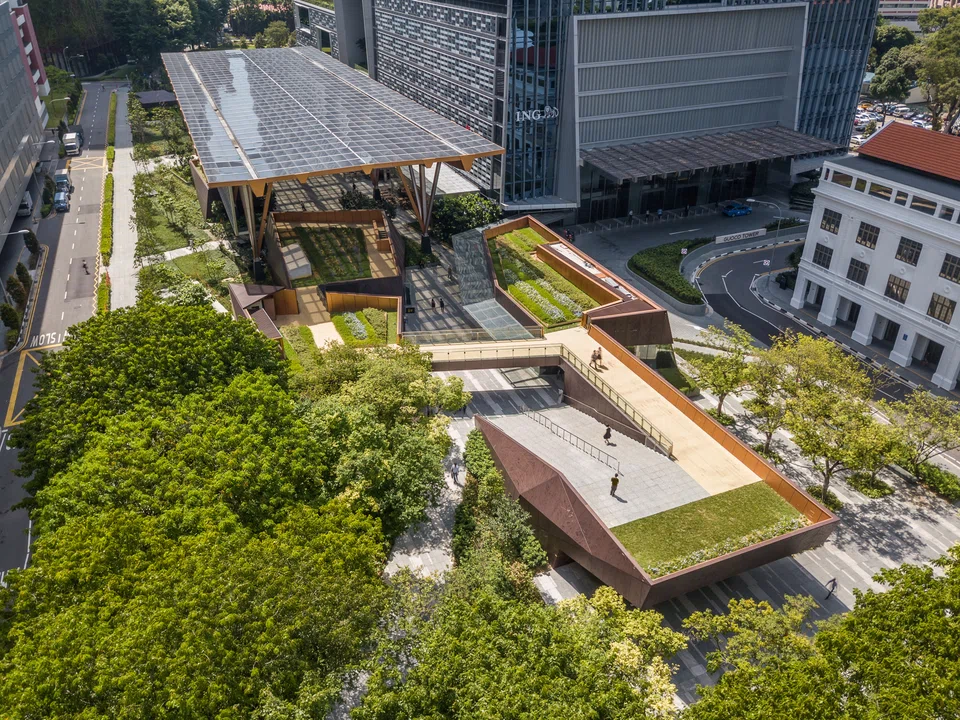
There are reasons to be positive about the group’s prospects. GuocoLand posted a 122 per cent rise in net profit for the six months ended Jun 30. And 84 per cent of the homes in its Lentor Modern project were sold over two days at its launch last month. But the jewel in GuocoLand’s crown is, arguably, Guoco Tower in Tanjong Pagar, in the Central Business District (CBD).
Market watchers are positive on the outlook for Singapore’s premium CBD office buildings. Consultancy Colliers forecasts that core CBD premium and Grade-A office rentals will grow by between 6 and 7 per cent this year.
As at end-June, the office and retail space of Guoco Tower, which sits on leasehold land with over 87 years outstanding, had a committed occupancy of 100 per cent and was valued at S$2.68 billion. For context, GuocoLand’s market capitalisation is around S$1.9 billion.
How can GuocoLand get the market to recognise the value of this prime asset?
Potential Guoco Tower Reit
For property developers like GuocoLand, the conventional means of unlocking value has been to recycle capital by selling assets to real estate investment trusts (Reits). This is an option for GuocoLand, which held nearly S$6 billion worth of investment properties as at the end of June. Yet, the company also has the opportunity to try something new – by listing a single-property Reit with Guoco Tower in it.
The introduction of Reits has enabled retail investors to own fractions in many properties that would previously have been inaccessible. Shoppers can assess the crowds at VivoCity, Bugis Junction or Paragon, and ride on the success of their preferred malls.
But as Reits scale up, exposure to any one particular asset gets diluted. An investor in Singapore’s first Reit, CapitaMall Trust, would have bought exposure to three malls here at the time of listing. But after a merger and multiple acquisitions, the recently renamed CapitaLand Integrated Commercial Trust (CICT) owns malls, offices and integrated developments, spread across Singapore, Australia and Germany.
Reits chase scale via asset acquisitions and mergers, to draw institutional investor interest. A larger portfolio of assets offers greater diversification, and asset acquisitions can boost a trust’s distribution per unit (DPU).
Some investors may dislike acquisitive Reits, however, as acquisitions can alter an investor’s exposure to a segment or geography. When an acquisitive trust raises equity, an investor’s interest may be diluted. Investors might instead welcome a Singapore-focused Reit committed to owning its initial portfolio for 20 years or more, and not making acquisitions. Actively managing leases, market rental growth and asset-enhancement initiatives can drive DPU growth at such a Reit. After two decades or more, the Reit could be wound up upon selling its asset – possibly for a profit.
Family offices and insurance funds may like such vehicles too, as some of these investors buy commercial buildings or strata commercial spaces.
If Guoco Tower is injected into a Reit at a net property income yield of around 4 per cent, the hypothetical Reit’s initial annual DPU yield could be around the mid-4 per cent. Such a yield is in line with the recent five-year green bond offered by Frasers Property (FPL) paying an annual interest rate of 4.49 per cent. There would also be a chance of capital gains from the Reit.
Unit prices of Reits have weakened amid rising interest rates. CICT, for instance, traded at an 11 per cent discount to its end-June NAV and an annualised DPU yield of 5.6 per cent.
A Reit that owns a top-grade asset here and eliminates the risks associated with acquisitions could, perhaps, trade at a lower yield than acquisitive geographically-diversified Reits. GuocoLand could distribute units in the hypothetical Guoco Tower Reit to its shareholders and/or sell units to new investors. While investors may apply a slight discount to the said Reit’s NAV, any such discount should be much less than GuocoLand’s discount to its NAV.
Owning Singapore real estate
Owning property is a hedge against inflation. Owning assets in Singapore, which is stable and has a strong currency, is attractive. Buying homes for investment, however, is tricky, as Singapore citizens pay hefty taxes when buying multiple homes.
Owning strata space in commercial buildings can be difficult, as the Urban Redevelopment Authority prohibits the strata subdivision of commercial developments as well as the commercial components of mixed-use developments located in prominent areas and routes in Singapore’s Central Area.
Reits that own prime Singapore properties and eschew acquisitions can offer investors exposure to top-grade assets to help fund retirement needs. Such Reits may need to look largely to retail investors for support. But retail investors do have firepower, as evidenced by the take-up for FPL’s recent green bond. It raised S$350 million from the public offer tranche, and S$150 million from the placement tranche that was taken up by private banks and institutions.
GuocoLand can lead by launching Guoco Tower Reit, perhaps in 2023, if interest rates stop rising and a suitable capital market window opens.
Should the said Reit be well received, other property owners can follow suit. GuocoLand could subsequently launch a Reit that owns the office and retail space of the upcoming Guoco Midtown in Beach Road.
The writer holds shares in GuocoLand.
TRENDING NOW

If Europe goes to war, the fallout will be felt in East Asia

Indonesia stocks suffer worst plunge in nearly 30 years as MSCI proposes standalone status

Vietnam’s race for growth tests pace of energy transition: experts

China’s market is tougher than ever. Where can Singapore firms still find room to grow?

