

Listed property groups worth a look despite lack of share price catalysts for now
Investors should consider buying shares of deeply discounted listed property groups, which can be held for the long term

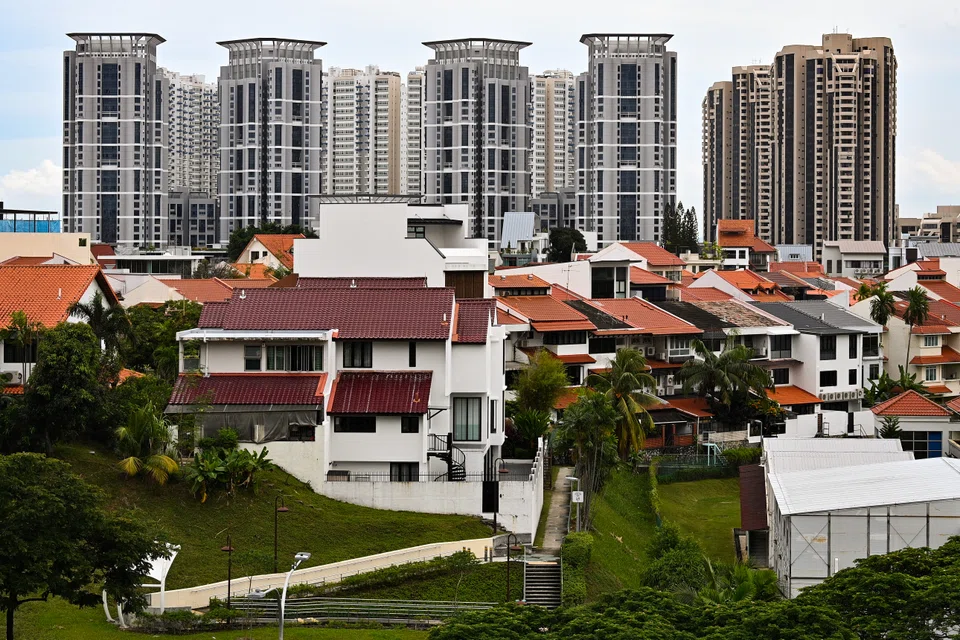
I OFTEN hear gripes about high private home prices in Singapore, a trend mirrored in other global cities. There is a sense that one should get on the private homeownership ladder soon, before prices escalate further.
However, while one may struggle to snare a unit that is being sold at market value at a hot new condominium launch, one can buy some proxies for Singapore property at deeply discounted prices on the local bourse.
Shares of established property development and investment groups – Frasers Property , GuocoLand , Ho Bee Land , Singapore Land Group , UOL Group and Wing Tai Holdings – are trading at discounts to their last reported net asset values (NAVs) of between 48 per cent and 64 per cent, based on share prices as at Oct 10, 2022.
The NAVs of these property groups are likely to be conservative. Investment properties are typically held at valuations provided by independent valuers. Often, transacted prices of investment properties in Singapore exceed valuation. This shows the appetite for physical property in safe-haven Singapore from a wide range of investors.
The property groups generally hold residential property under development at cost, unless there is an impairment. Thus, the balance sheets of property groups exclude the potential profit of the projects.
Value traps
With the property groups, one gets geographically diversified exposure and not just pure Singapore exposure, including any adverse foreign exchange impact, such as the impact ot a weak British pound on Ho Bee’s extensive commercial property portfolio in the United Kingdom.
The large discounts to book values of the property groups give investors plenty of buffer. But even if the NAVs of listed property groups are robust, the argument against buying such stocks is the expectation that low share prices will persist. Indeed, investors may pay high prices for trophy buildings or high-flying businesses, because what may be expensive can become even pricier.
Shares of listed property groups are perceived to be value traps. Historically, discounts to NAV have been large, and such discounts may remain going forward.
Various property groups are hampered by having small free floats. Frasers Property and Singapore Land have free float of below 15 per cent. As many institutional investors will not invest in groups with insufficient free float and trading liquidity, the pool of potential investors shrinks.
Some groups undertake property development projects with long gestation periods, and profits in the development business can be lumpy. Moreover, some asset heavy property groups generate unexciting return on equity, which could average in the mid-single digits.
Nevertheless, I think a retail investor should consider buying deeply discounted listed property groups. Such shares can be put into the basket of investments which one holds for the long term.
Take a look at two groups with financial year (FY) ended Jun 30, 2022. GuocoLand and Wing Tai declared total dividend per share of S$0.06 each for their latest FYs, which translates into dividend yield of between 3.7 and 3.9 per cent based on share prices as at Oct 10, 2022.
Such a yield tops what one can get on Singapore dollar fixed deposits. With the latest issue of the Singapore Savings Bond that is open for application, the average return per year, if held over 10 years, is 3.21 per cent, which is an all-time high.
Sure, the dividend paid by a property group can fluctuate. But, GuocoLand has been paying annual dividend of at least S$0.06 per share since FY ended-June 2016. Ho Bee has been paying dividend of S$0.10 per share for its last five FYs.
If business grows, shareholders can hope that the dividend per share rises over time. A higher dividend payment also benefits the families who are major shareholders of the property groups.
In sum, an investor in a listed property group is being paid a decent income stream even if the share price goes nowhere.
Share price upside
While it can be hard to persuade a major shareholder to place out shares at discount to NAV in order to boost free float and trading liquidity, an investor can bank on property groups growing their NAVs. Between end-June 2017 and end-June 2022, GuocoLand’s NAV per share grew by about 25 per cent. If the discount to NAV remain constant over time, the share price will rise as the NAV grows.
Investors may enjoy upside if a property group becomes the target of a privatisation exercise.
Over recent years, several property-related groups – such as Fragrance Group, SingHaiyi Group and Top Global – have left the local bourse due to successful privatisations by major shareholders. Privatisation offers have succeeded with offer prices that are above market trading price of the shares, but below NAV.
Going forward, the upside to share prices from privatisations of property groups could rise if minority shareholders put up more resistance or rules are tightened to make it harder for an offeror to exercise the right to compulsory acquisition.
Perhaps, in future, an offeror needs to offer at least the NAV of a property group for a privatisation exercise to succeed. In such a scenario, there is still fat for the offeror from unrealised development profit, and potentially selling investment properties at above valuation.
Typically, a small investor in any listed group has little sway over how boards and management steer a business or unlock value. Also, one would not know if and when a major shareholder would privatise a particular company.
Still, the huge discount at which one can buy the shares of various listed property groups is hard to ignore. These groups ride on favourable trends such as demand for hard assets in safe haven Singapore, growing wealth in Asia, and Singapore’s growing stature as a business hub. Generally, the groups have good track records in property development and some of them are lowly geared.
Investors get good downside protection and potential solid long term upside, from buying the shares of many Singapore-listed property groups.
The writer owns shares in Frasers Property, GuocoLand, Ho Bee, Singapore Land, UOL and Wing Tai.
TRENDING NOW

Peter Kwee’s Ridley Park bungalow on the market with S$100 million asking price

Motoring tycoon Peter Kwee is back in court: Here are his previous legal battles

Demand, tech capabilities position Apac and AI as Skyscanner’s next growth frontiers: CEO Bryan Batista

South-east Asia has lost Nvidia’s best salesman

