Monsanto's long road to extinction
The company with legal and ethical problems has been bought by Bayer.
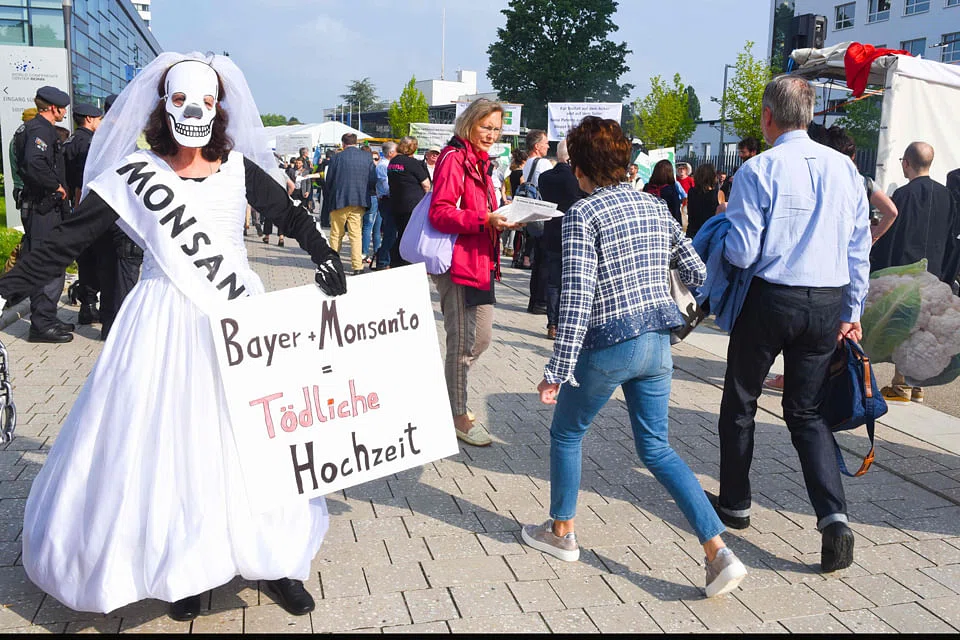
THE name Monsanto is gone. The St Louis-based company was acquired by the German conglomerate Bayer on June 7.
It will be known as Bayer, which will retain the brand names of the original Monsanto products, but Bayer also inherits an entire briefcase of legal and ethical challenges, both past and present, in several countries.
The global agro-biotechnology giant had faced a rapid flurry of setbacks in India just prior to its takeover by Bayer. The Indian authorities are taking steps to block the market monopoly of the company's products, which are believed to pose significant risks to the health of people and the environment.
Monsanto's appeal to the Supreme Court of India failed on May 7 this year when the court refused to stay a May 2 order by the Delhi High Court that prohibited companies such as Monsanto from patenting plant varieties and seeds in India, and that royalties on genetically modified (GM) technology would be decided by a specialised agency of the agriculture ministry.
In effect, a patent held by Monsanto's Indian unit, Mahyco-Monsanto Biotech Ltd (MMBL), over its cotton seed variety which resists agricultural pests - known as Bollgard-II Bt cotton - was deemed unenforceable in India.
Monsanto's chief technology officer Robert Fraley voiced his disappointment, tweeting: "It's sad to see the country go down an anti-science/anti-IP/anti-innovation path."
Monsanto has exercised an absolute monopoly in India ever since it introduced its GM-technology to the country in 1995. More than 90 per cent of the Indian cotton crop is genetically modified, and the company's products are used by more than seven million Indian farmers.
Under India's Patents Act of 1970, the courts had rejected Monsanto's attempt to block its Indian licensee, Nuziveedu Seeds Ltd, from selling the Monsanto seeds. Nuziveedu had argued that Monsanto was not eligible to claim patents and royalties from Indian seed companies.
In a ruling, the antitrust regulator, Competition Commission of India, had blamed Monsanto for potentially abusing its dominant position in the market.
The company suffered an earlier setback in March, when India cut royalties that local seed companies pay Monsanto for the second time in two years. That month, the Indian agriculture ministry reduced royalties paid by Indian seed companies to Monsanto for its GM cotton by more than 20 per cent. Two years earlier, the royalties were cut by more than 70 per cent. The move sparked a dispute between the Indian and US governments.
The Indian government has also lowered the price of GM cotton seeds by 7.5 per cent in order to help farmers who were confronting pest infestations.
There are new worries that Monsanto's GM seeds that were resistant to pests are no longer so, and that the pests that this GM variety was meant to safeguard against are back. They are now pesticide-resistant, and are destroying crops.
Monsanto had previously threatened to pull out of the country. Indian officials have said that Monsanto was free to leave the Indian market if it did not accept the price and royalty cuts.
MMBL argues that it was "unfortunate" that the cuts further slashed royalties, which are now less than 0.5 per cent of the cost of cultivation. Monsanto believes that its cotton seed technology has revolutionised Indian agriculture as both production and exports have risen.
TOXIC HERBICIDES
Early this year, the government of the Indian state of Andhra Pradesh curbed the indiscriminate use of toxic herbicides, especially of the chemical glyphosate, which is found in Monsanto's weedkiller, and has been identified as a carcinogen by the World Health Organization. The state government believes that glyphosate and other weedkillers not only poison the soil but also enter the food chain.
In February, the Maharashtra state government constituted a special investigation team to probe the operations of three entities, Mahyco Monsanto, Monsanto Holdings Private Limited and Monsanto India Limited, as well as other companies, that were allegedly carrying out unauthorised production, stocking and sale of a type of cotton seeds - known as Bt cotton seeds with a herbicide-tolerant (HT) transgenic gene - in Maharashtra that had not been approved for sale. India has approved commercial sale of Bt cotton seeds of Bollgard I (since 2002) and Bollgard II (since 2006), but the HT variety has not been approved.
Foreign biotechnology companies such as Monsanto, Bayer, Dupont Pioneer and Syngenta have set up their Indian units that are putting their own spin on the issue. Some seed industry officials argue that the future of the biotechnology industry is at stake. They believe that foreign companies are becoming cautious because without legal protection for their patents, they would not be able to recoup their investments.
The Indian scholar Vandana Shiva, however, argues: "Control over seed is the first link in the food chain because seeds are the source of life. When a corporation controls seed, it controls life, especially the life of farmers."
She adds: "Through patents on seed, Monsanto has become the 'Life Lord' of our planet, collecting rents for life's renewal from farmers, the original breeders. Patents on seed are illegitimate because putting a toxic gene into a plant cell is not 'creating' or 'inventing' a plant.
"These are seeds of deception - the deception that Monsanto is the creator of seeds and life; the deception that while Monsanto sues farmers and traps them in debt, it pretends to be working for farmers' welfare, and the deception that GMOs [genetically modified organisms] feed the world. GMOs are failing to control pests and weeds, and have instead led to the emergence of superpests and superweeds."
Monsanto's entry into India was facilitated under the World Bank's 1988 seed policy that was imposed on India, which required the country to deregulate the seed sector.
Scholars argue that Monsanto has hurt India's farmers, consumers and the environment as well as the Indian market.
When the company began collecting royalties for the seeds, which had been the farmers' common resource, not only did the seeds become the "intellectual property" of Monsanto, their cost went up.
The naturalness of agriculture was replaced by GM hybrid seeds, and a renewable resource became a non-renewable, patented commodity.
Bayer has now taken over the entire baggage of Monsanto's law suits. One court case currently being heard in San Francisco has been brought by persons who believe that the company's weedkiller actually caused cancer in them or their families.