Myanmar in the spotlight: will the military play ball this time around?
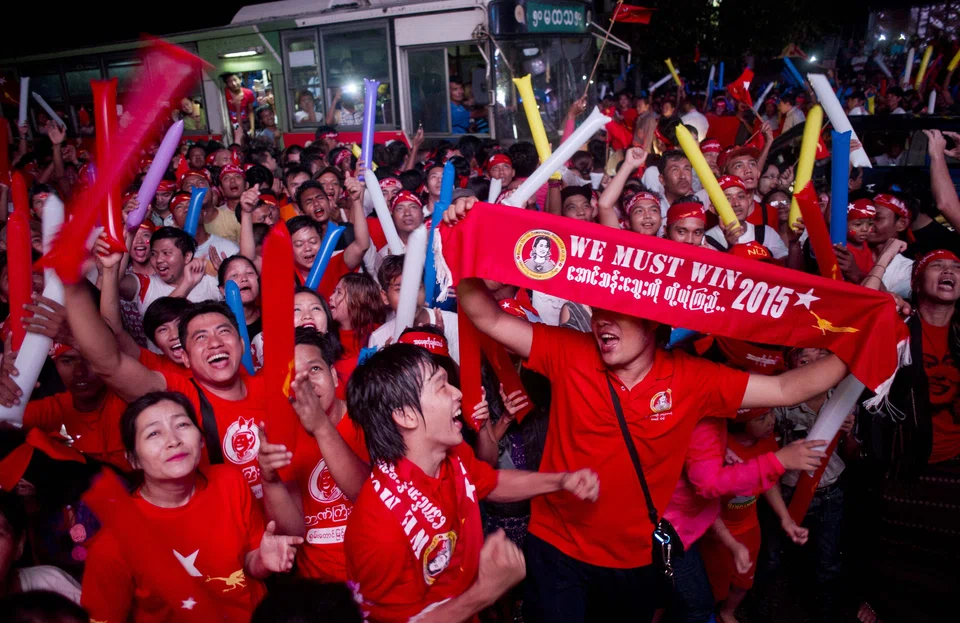
WITH the successful staging of its historic Nov 8 general election, Myanmar marks a major milestone in the journey of economic, social and political revival it has undertaken in recent years after decades of military rule.
But further political reform must come as the resource-rich nation strives towards realising its potential as possibly the fastest-growing economy in South-east Asia, if not Asia. While the official final results are not expected for another week or more, the tally so far points to a landslide win for opposition leader Aung San Suu Kyi's National League for Democracy (NLD). It has so far (with nearly half the seats declared) clinched more than 90 per cent of the vote.
The ruling military-backed Union Solidarity Development Party (USDP) - which has apparently garnered only 5 per cent of the contested seats so far - seems to have accepted the people's will equably: it has said that the government will abide by the outcome of the election and "work on transferring power peacefully" to the NLD. President Thein Sein - the former army general who has steered the country towards free-market reforms over the past five years - has reportedly congratulated Ms Suu Kyi on her party's success and also agreed to her request to hold reconciliation talks soon, although only after the results are officially finalised.
The Nov 8 elections - relatively free of fracas and generally seen as the most democratic in Myanmar for 25 years - and early post-poll developments bode well for the country, now emerging after decades of struggle under a dictatorial regime, and crippling economic and diplomatic sanctions. Yet it would be too early to hail any triumph of democracy. Ms Suu Kyi herself has described last Sunday's election as "largely free" though not entirely fair, there having been some irregularities. Even if the military ends up with only a small minority of seats in the Hluttaw (the country's Parliament), it is clear the army will not lose its influence altogether.
To begin with, Myanmar's (military-drafted) constitution guarantees 25 per cent of the 664 seats in the Hluttaw for unelected military representatives - who hold veto power over any constitutional change. The constitution also bars Ms Suu Kyi from becoming president despite being leader of the winning political party - because her sons are British citizens.
To an extent, just how both sides (the military and the NLD) manage the handover of power - and, overall, how Myanmar transits from military (or quasi-civilian, since 2011) to civilian rule - will be key to the country's political and social stability, and continued economic dynamism. Also, the issue of Ms Suu Kyi calling the shots "above the president" (as she has openly declared her intention to do) could potentially be a major bone of contention.
It's worthy of note that the NLD won nearly 80 per cent of available seats (and 52.5 per cent of the national vote) in Myanmar's 1990 general election - only for the results to be subsequently nullified. This time, the rhetoric at least has been promising so far, with President Thein Sein having pledged to honour the election results. The international community will expect no less, including foreign investors who have ventured into the frontier economy and reaped early-mover gains.
Having seen how the economy has taken off after sanctions were lifted in 2013, Myanmar's leaders surely would not want to risk a return to the country's dark days - when it was cut off from the outside world for decades by internal political repression.