
New German government will be changemaker
As the new administration assumes power, Berlin's changed priorities will be felt well beyond Europe, including in Moscow and Beijing.
 Add BT as a preferred source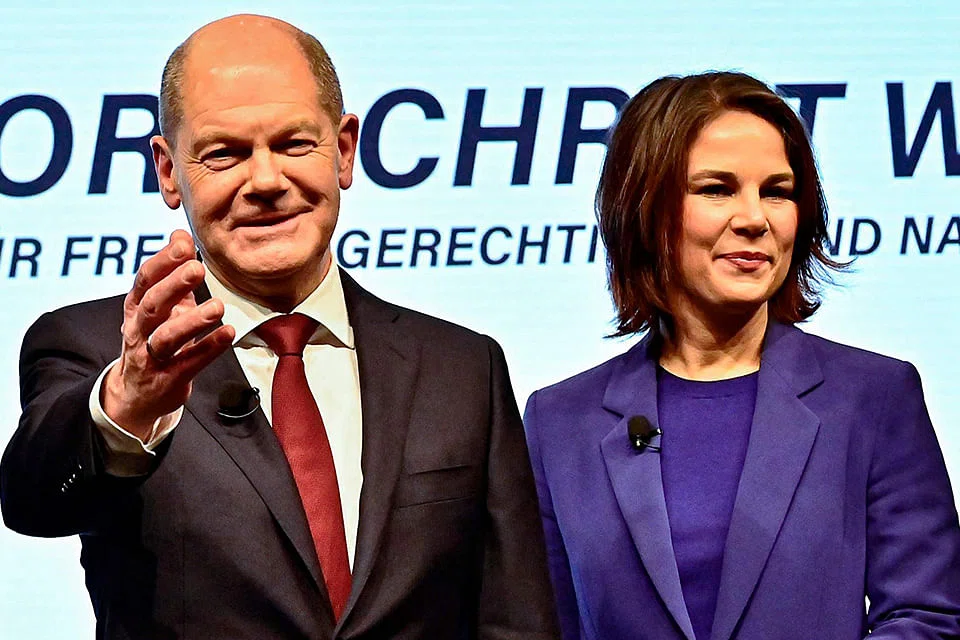
WHILE Olaf Scholz has long been a government insider as Germany's vice-chancellor, his elevation on Wednesday as the nation's ninth post-war leader could herald significant change on the horizon across the nation, Europe and wider world too.
As finance minister and No 2 to Angela Merkel in the previous government, Scholz's policy domain has largely been limited to economic matters. He has supported efforts to bring in a global minimum tax of at least 15 per cent on large companies, led efforts to cushion the pandemic's financial impact, while also being criticised over the collapse last year of payment processing company Wirecard.
The top job, however, is now his after the breakthrough deal for his centre-left Social Democrats to lead Germany's next government was inked in a three-way agreement with the Greens and the pro-business Liberals following lengthy negotiations after September's elections.
The influence of the Liberals will be felt, particularly, in the finance and transport ministries going forward and this will help herald a changed landscape domestically in Berlin after more than a decade and a half of Merkel's team in power.
Yet, the impact of the new administration will be felt internationally too. After all, the German economy is the largest in the eurozone, and the country is also the continent's most populous nation. Moreover, influence within the EU may grow significantly post-Brexit with the departure of the United Kingdom from the Brussels-based club.
The Greens
Navigate Asia in
a new global order
Get the insights delivered to your inbox.
It is Green leader Annalena Baerbock who, as the incoming foreign minister, will drive this change agenda with Scholz. The last time the Greens were in power in Germany, from 1998 to 2005, they also held the foreign ministry, with the outspoken Joschka Fischer showing strong opposition to the Iraq War which helped split the West on this major international issue as Paris under then-president Jacques Chirac also backed Berlin's stance.
Going forward, change under Baerbock will be felt right across Europe, not just the EU. This includes in regard to the UK where she and Scholz have expressed deep concern over the post-Brexit issue of the UK's continued adherence to the Northern Ireland Protocol. In Brussels, she may now promote a significantly stronger federalist agenda than the Merkel team. This could see key changes on the horizon in 2022, especially if French President Emmanuel Macron is re-elected next year, and forms a strong relationship with Scholz and Italian Prime Minister Mario Draghi.
Developments to watch out for include a big new push hard for the creation of a deeper European Defence Union which has assumed new importance for some in the EU since the announcement of the US-UK-Australia security deal. This and other changes could see the EU follow a pathway in the 2020s of deepening cooperation with states sharing more power, and decisions agreed faster plus enforced more quickly.
To enable this, Baerbock and Scholz are likely to seek to curb further tension between Brussels and key Eastern European states, especially Poland and Hungary, with an increasingly eurosceptical bent.
However, if such former Eastern bloc countries seek to counter reform, there is also the possibility that Germany, France, Italy and others including Spain will see more coalitions of the willing emerging in select policy areas to take forward the integration agenda on a flexible, rather than across-the-board basis. A model here is the eurozone where some 19 of the current 27 EU members have entered into a monetary union with the euro as the single currency.
Outside of the EU, the new German government is also looking to announce itself on the global stage, including with its presidency of the G7 in 2022. Perhaps the key German foreign policy change on the horizon with the new coalition government will be its stance towards authoritarian states like China and Russia. Take the example of Moscow which Baerbock has advocated a much tougher line against, including in the context of the US$11 billion Nord Stream 2 gas pipeline promoted by Merkel. The pipeline will double the capacity of the existing undersea natural gas route from Russia to Europe.
Merkel has pushed hard for this to happen to enhance Germany's energy security as it completes the post-Fukushima disaster shutdown of its nuclear power plants, and phases out the use of coal by 2038.
Baerbock has asserted that while some see Nord Stream 2 as a 'purely economic project', she considers it 'a treacherous plan' on the part of an increasingly authoritarian Moscow. As she highlighted, "imagine a winter in Europe; (when) we won't be able to say 'Now we don't have any more gas'; Vladimir Putin wants to destabilise . . . us as Europeans".
Rhetorically, Baerbock's position on this issue is significantly closer to that of the US administration than Merkel. The Biden team remains very concerned about Nord Stream 2, despite recent compromises with Berlin on this issue, with US Secretary of State Tony Blinken highlighting over the summer that "the pipeline is a bad idea, bad for Europe, bad for the United States, ultimately it is in contradiction to the EU's own security goals... It has the potential to undermine the interests of Ukraine, Poland and a number of close partners and allies".
Divergence over China
There is also a potentially sharp divergence, compared to the Merkel era, over China, including over human rights in general, and Xinjiang specifically. This is because Baerbock and her Green Party favour a more 'human-rights centric' approach to Beijing.
Beijing over the last decade and a half has regarded Merkel as a stabilising ally who has helped counteract the growing number of US and European politicians calling for decoupling from China.
In recent months, for instance, she has pushed hard for ratification of an EU investment deal with Beijing, which was signed last December, and spoke out against the idea that democracies should unite to isolate Beijing diplomatically.
Yet, Merkel's 'change through trade' strategy has fewer remaining supporters in Germany. Under President Xi Jinping, China's economy remains under tight state control, its foreign policy has become more assertive, and alleged human rights abuses against Uighurs in Xinjiang and political dissidents have reportedly intensified. These examples underline the crossroads that German foreign policy could now be at. As the new administration assumes power, Berlin's changed priorities will be felt well beyond Europe, including in Moscow and Beijing.
The writer is an associate at LSE IDEAS at the London School of Economics
Decoding Asia newsletter: your guide to navigating Asia in a new global order. Sign up here to get Decoding Asia newsletter. Delivered to your inbox. Free.
Share with us your feedback on BT's products and services

