

New UK government still troubled by Truss tenure
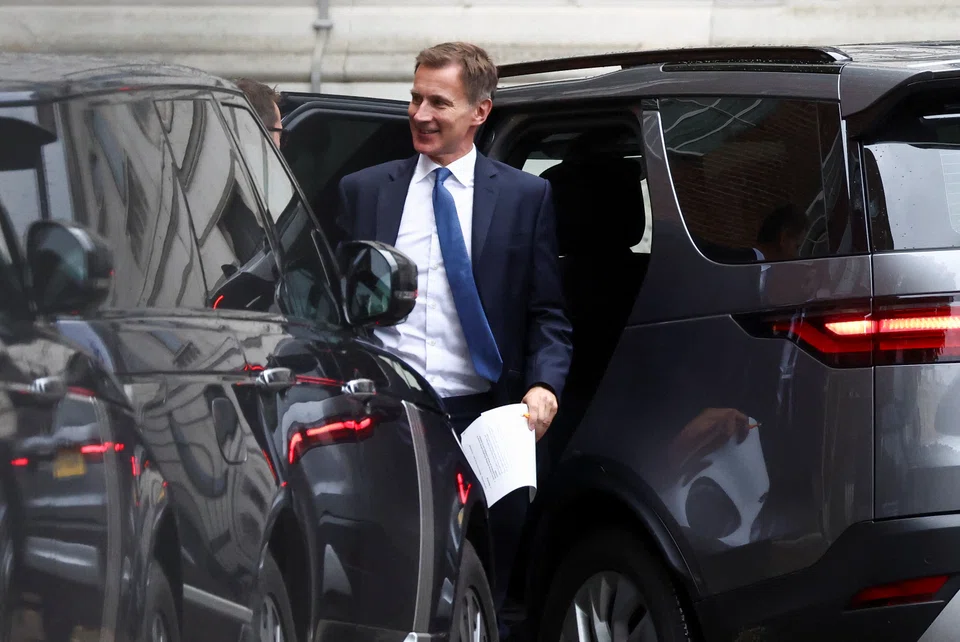
UK FINANCE minister Jeremy Hunt has pledged not to return the United Kingdom to the financial austerity of the years from 2010 to 2015, yet he seems set to announce on Thursday (Nov 17) collective tax rises and spending cuts of at least £50 billion (S$81.2 billion) to £60 billion.
Hunt was appointed last month to the Treasury following the debacle of the Truss government’s emergency fiscal statement in September. That so-called “mini budget” caused major problems for both then chancellor Kwasi Kwarteng and then prime minister Liz Truss, with both of them forced out of office in October. The political challenge that Hunt has to contend with is loss of trust in Conservatives since September’s fiscal statement.
No UK government in the post-war era that has presided over a domestic or international financial debacle, such as that of this autumn, has survived at the ballot box at the next election. Take the example of the so-called Black Wednesday crisis in September 1992. The UK government was forced to withdraw sterling from the then European Exchange Rate Mechanism and, even though the economy improved in the next few years, the Conservatives suffered a landslide defeat in 1997.
It is in this very challenging political context that Hunt faces very difficult economic choices, more than 12 years since the Conservatives first regained power. The UK economy appears weak and data released last week shows it shrank by 0.2 per cent in the third quarter, setting the nation on course for the quickest return to recession since 1975, with the economy having only come out of its last recession eight quarters ago. The poor predicament of the economy reflects, in large part, the legacy of recent policy decisions. This includes not just September’s emergency budget, but also the specific post-Brexit economic model that has been adopted since 2016 that even leading Brexiteers like Lord Wolfson, a business CEO and Conservative politician, have disowned in recent days.
This point was picked up on Monday by Michael Saunders, who left the Bank of England’s monetary policy committee over the summer, when he asserted that Brexit has “permanently damaged” the UK economy and is one of the key reasons why the nation is now entering a new period of austerity. It is perhaps no coincidence that support within the UK population for the United Kingdom rejoining the EU has been growing steadily over the past year, with one recent poll suggesting 57 per cent in favour of rejoining, with 43 per cent against. The 57 per cent figure is the highest since before the UK referendum on EU membership in 2016.
However, with Labour having ruled out rejoining the EU, it is unlikely that this will happen in the 2020s, or indeed this political generation. Instead the party’s focus is much more on making Brexit work better for the UK.
Labour leader Keir Starmer has set out a plan to “deliver on the opportunities the United Kingdom has, sort out the poor EU withdrawal deal Boris Johnson signed, and end the UK’s Brexit divisions once and for all”. So rather than seeking renewed EU membership, Starmer wants the nation to make the most of the country’s untapped potential, including investing more, post-Brexit, in UK people and places.
All of this highlights what might be a significant shift underway in UK politics. After more than a dozen years of Conservative rule, the political pendulum appears to be slipping from the party in a way that may significantly reshape UK politics for the remainder of the 2020s.
TRENDING NOW

Who is Leo KoGuan, the Singapore-based billionaire backing Nvidia’s Jensen Huang?

Demand, tech capabilities position Apac and AI as Skyscanner’s next growth frontiers: CEO Bryan Batista

Higher rates, weaker spending: Is the Philippines entering stagflation?

South-east Asia has lost Nvidia’s best salesman

