

New US-Japan security initiative aims to counter China hegemony
The move comes as Chinese naval ships appear near Philippine-owned islands.
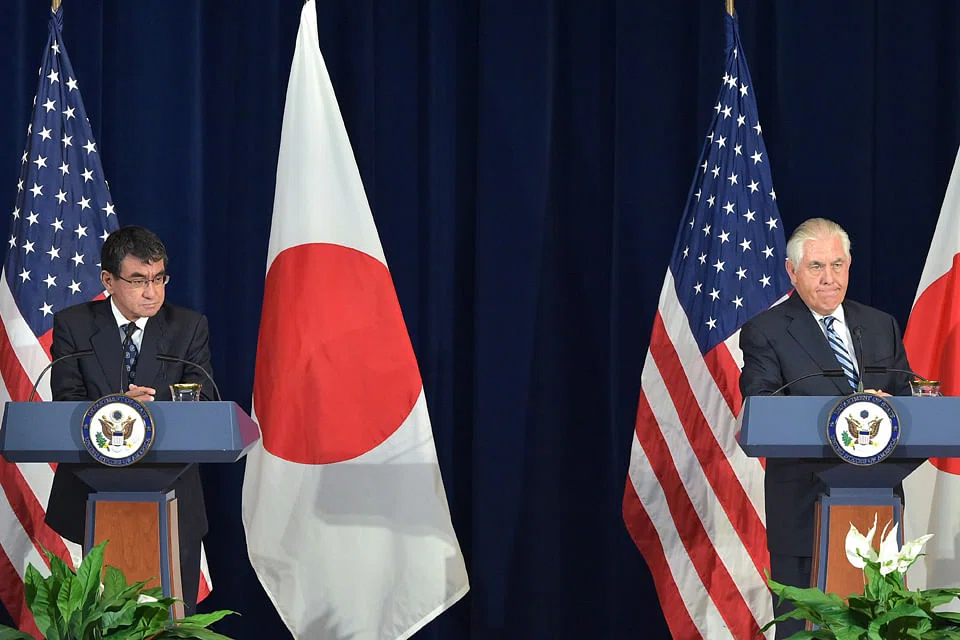
THE United States and Japan are elevating to an unprecedented level their multilateral military and security alliance with India, South Korea, Australia and South-east Asia. The new initiative coincides with Chinese Navy ships suddenly appearing near Philippine-owned islands this month, and China's continuing confrontation with India on the border.
US Secretary of State Rex Tillerson met Japanese Foreign Minister Taro Kono and Defence Minister Itsunori Onodera in Washington on Aug 17 when they made a commitment to deepen and broaden their military cooperation with their Asian allies.
They pointedly pressured North Korea to end its provocative militarisation, but their initiative was also aimed at moderating China's aggressive behaviour with neighbouring countries.
Mr Tillerson declared: "We will also cooperate to advance trilateral and multilateral security and defence cooperation with other partners in the region, notably the Republic of Korea, Australia, India, and other South-east Asian countries." The "trilateral" cooperation refers to the existing joint US-Japanese collaboration separately with each of the Asian powers named above.
The allusion to China was crystal clear. Mr Tillerson discussed with the Japanese ministers their shared concerns about the security environment in the East China Sea (ECS) and the South China Sea (SCS).
"The United States and Japan oppose any unilateral action that seeks to undermine Japan's administration of the Senkaku Islands," Mr Tillerson said. They reaffirmed the US-Japan Security Treaty covering those islands that both China and Japan claim.
Mr Kono reaffirmed raising the level of military cooperation among the Asian allies: "ROK (Republic of Korea), Australia, India, and South-east Asian countries - we will promote more than ever before cooperation and security and defence," adding that Japan would provide the coastal nations of the Indo-Pacific region about US$500 million until 2019 to strengthen their security.
India, however, has been cautious about joining an anti-China dialogue, or coalition, as it has a long-standing border dispute with China that both sides want to resolve peacefully. But a more recent confrontation with Beijing at the Doklam plateau that both Bhutan and China claim may lead New Delhi to change its stance in view of an alarming rise in Chinese militancy across the region.
China worries many countries and territories because it is locked in territorial disputes of varying intensity with at least 10 Asian countries and territories - with India and Bhutan over land borders; with North Korea over river waters and islands; with Vietnam, the Philippines, Malaysia, Taiwan and Brunei over the SCS islands; and with Japan and South Korea over the ECS islands.
The Japanese saw signs of Chinese belligerence as early as 2007, when Prime Minister Shinzo Abe proposed a "Quadrilateral Initiative", a formal security dialogue in which India was expected to join the US, Japan and Australia. China dubbed it as Cold War mentality and the formation of a small North Atlantic Treaty Organization-type group to resist China.
Soon afterwards, Beijing asked the quadrilateral partners to explain its purpose. The quadrilateral plan did not survive as the partners believed it was provocative.
But since then, Chinese military activities have intensified, leading the US and Japan to revive the initiative. The US-Japan statement this month exalts regional defence and security dialogue to an even higher level than the still-born "Quadrilateral Initiative".
Even in its absence, trilateral dialogues have continued to operate. One of them is between India, the US and Japan. Another is the Australia-Japan-US Trilateral Strategic Dialogue (TSD).
More progress can be expected when Mr Abe visits India in September. Mr Abe wants to reach an agreement with Prime Minister Narendra Modi to strengthen bilateral cooperation on maritime security to check China's growing assertiveness in the ECS, the SCS and the Indian Ocean.
These worries about Chinese behaviour were raised at the TSD of the foreign ministers of Australia, Japan, and the US on Aug 7 in Manila. They expressed serious concerns over maritime disputes in the SCS, and voiced their strong opposition to coercive unilateral actions that could alter the status quo and increase tensions.
Soon after the TSD ministerial meeting, China began probing even closer to the Philippines. According to The Interpreter journal of Australia's Lowy Institute and Philippine media, a flotilla of Chinese fishing vessels, accompanied by Chinese Navy frigates and Chinese Coast Guard vessels, have stationed themselves very close to Thitu (which Manila calls Pagasa), the largest island feature occupied by the Philippines in the Spratly Islands.
Chinese vessels began arriving on Aug 11, and since Aug 15, at least one Chinese warship has conducted helicopter flights over a number of sandbars immediately to the west of Thitu, which is situated just over 12 nautical miles from Subi Reef, where China has built one of its seven artificial bases.
Philippine parliamentarian Gary Alejano has stated that "the Chinese may have a sinister plan to occupy sandbars just west of Pagasa that belong to us". A Philippine government ship from the Bureau of Fisheries and Aquatic Resources was barred by Chinese fishing vessels from going near the Philippine sandbars.
At about the same time, China's air force chief asserted his right to conduct military exercises in the Sea of Japan, arguing the sea did not belong to Tokyo.
The leadership in Tokyo is deeply worried. The Japanese annual Defence White Paper for 2016 believes that China is making efforts to "strengthen its asymmetrical military capabilities to prevent military activities by other countries in the region, denying access and deployment of foreign militaries" to the ECS and the SCS, and pursuing large-scale military reforms with actual combat in mind.
The White Paper notes with alarm that "China has intruded into Japanese territorial waters frequently by its government ships, and has engaged in dangerous activities that could cause unintended consequences", such as confronting a Japan Maritime Self-Defence Force (SDF) navy destroyer, or Chinese fighters flying abnormally close to SDF aircraft. Both Japan and the US believe that China is attempting to gain sovereignty over the international airspace above the disputed islands in the ECS and the SCS.
It is, therefore, not surprising that the US and Japan are launching a new initiative to create a region-wide defence and security dialogue in order to counter Chinese hegemony.
TRENDING NOW

Indonesia’s coal tycoon Low Tuck Kwong replaced as Bayan Resources president-director

OCBC names Ang Eng Siong as global corporate banking head in rejig of wholesale banking business

Consider lowering homeownership barriers for some non-resident foreigners

DBS opens flagship investment strategy to retail investors with new fund

