

The next step for K-pop companies is diversification

Tan Nai Lun
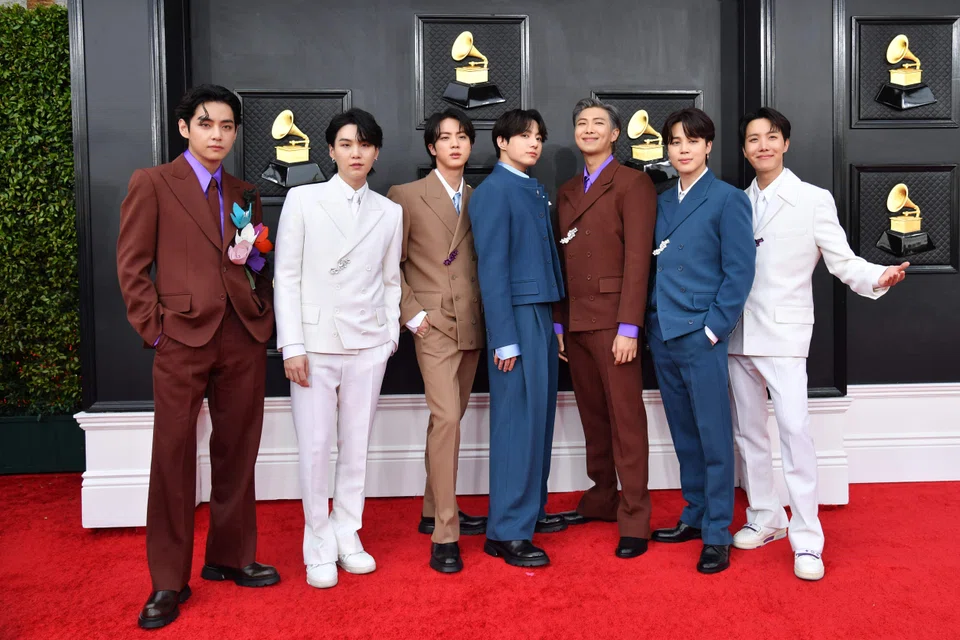
LAST week, shares of South Korean entertainment company Hybe Corporation suffered a US$1.7 billion rout after members of Korean pop sensation BTS – managed by Hybe – said they would halt group activities while they focused on individual projects for a while.
Hybe shares fell 28 per cent to an all-time low of 139,000 won (S$148) on Jun 15. They closed Wednesday (Jun 22) at 139,500 won, down 48.3 per cent from 270,000 won – the company’s opening price when it listed in 2020.
The market's reaction is understandable. Hybe manages several K-pop groups and has acquired various companies in recent years, but BTS still contributed 84.7 per cent to its revenue in 2020. No breakdown was given for 2021.
Similar problems have plagued other entertainment companies in South Korea. In April, YG Entertainment, another South Korea-listed entertainment company, also saw a sell-off due to speculations about its boy band Big Bang.
Prior to a 5-year hiatus, due to the individual members’ mandatory military enlistments, Big Bang was one of YG’s biggest moneymakers. The band entered Forbes’ Celebrities 100 list in 2016 with US$44 million in pre-tax earnings. That year, YG posted revenue of 321.8 billion won and net income of 14.1 billion won.
YG shares had rallied to as high as 71,100 won upon news of Big Bang’s return, but fell 12.4 per cent a few days after the comeback amid speculations that a released single alluded to the group’s disbandment.
Although the company released a statement soon after to affirm that the group was not disbanding, its shares have continued to trend downwards. They closed at 43,450 won on Wednesday, down 22.8 per cent this year.
Factory lines
The business model of K-pop managers is a tough one. Few bands achieve the success of a BTS or Big Bang. And even fewer have staying power.



This means managers are constantly on the lookout for fresh talent.
Known for “factory producing” their artistes, K-pop management companies often put individuals through years of vocal and dance training before putting them in a group.
These groups rarely make their own music, and companies such as YG reportedly spend over 100 million won on each trainee per year in search of the next big moneymaker.
Individuals put together to form a band are sometimes held together only by a contract, and often go their separate ways at the end of it.
The appeal of K-pop to a global audience has also led to more of such artistes being manufactured each year. The pace at which new bands are introduced has created a saturated and competitive market.
In 2021, 2 entertainment companies – YG Entertainment and SM Entertainment – were reclassified as mid-sized businesses from blue-chip companies by the Korea Exchange, due to poor performance and increased equity losses.
Both companies still have bands with potential. YG’s sole girl group Blackpink is gaining attention in the global music market, and SM’s youngest boy group NCT is attempting to expand globally with a band-in-band strategy: NCT currently has 23 members that form sub-unit bands for specific markets, such as WayV for the China market, with plans for future units including NCT Hollywood for the US and NCT Tokyo for Japan.
But the 6-year-old Blackpink has yet to match up to the financial success of 16-year-old Big Bang. The former’s In Your Area world tour from 2018 to 2020 raked in US$56.8 million in revenue across 36 shows, whereas Big Bang’s Made world tour in 2015 and 2016 recorded US$147.2 million in revenue across 66 shows.
Concert revenue of NCT, which debuted in 2016, also pales in comparison to one of SM’s most successful groups, EXO, which debuted in 2012. One of its units, NCT 127, had a tour from 2019 to 2020 that brought in US$28.9 million across 45 shows. In comparison, the EXO Planet #3 tour from 2016 to 2017 raked in around US$80 million across 37 shows.
Hybe, too, is trying to repeat its BTS success. One of the boy bands it manages, Seventeen, remains popular in South Korea, accounting for 3.7 million of Hybe’s 15.1 million album sales in 2021. But most of its other groups are fairly new, having debuted within the last 3 years.
Diversification strategy
To shake off an over-reliance on their artistes, companies such as YG and Hybe are expanding into adjacent industries.
YG in 2014 acquired a public relations company and rebranded it YG Plus. The latter is now a separately listed company with a clothing line, golf management agency, food brand and cosmetics brand.
Hybe, too, owns a stake in YG Plus, and the companies have a deal under which YG artistes use Hybe’s artiste-to-fan communication site Weverse and its accompanying merchandise e-commerce shop Weverse Shop as a content platform.
Hybe has also bought a gaming company; other South Korean music labels; and Ithaca Holdings, the record label of US musicians Ariana Grande and Justin Bieber. In fact, album sales at Hybe more than doubled in 2021 largely due to the acquisition of Ithaca, which contributed 12.3 million in album sales for the financial year.
While revenue from artistes still take a large slice of the pie, diversification into other ventures may be the way to sustain income in the longer run.
Decoding Asia newsletter: your guide to navigating Asia in a new global order. Sign up here to get Decoding Asia newsletter. Delivered to your inbox. Free.
Copyright SPH Media. All rights reserved.
TRENDING NOW

First Resources blames El Nino, outside fires for Kalimantan hotspots amid haze scrutiny

High Court rules against Julius Baer’s Singapore trust arm in US$50 million family trust dispute

Singapore key exports jump by higher-than-expected 68.4% in September, led by non-electronics

MSCI proposes downgrading Indonesia to standalone market status

