

Obama believes US can avoid a war with Islam
His low-key response to recent terror incidents in Europe indicates he may be following a realpolitik strategy by trying to distance his nation from the legacy of European imperialism
Washington
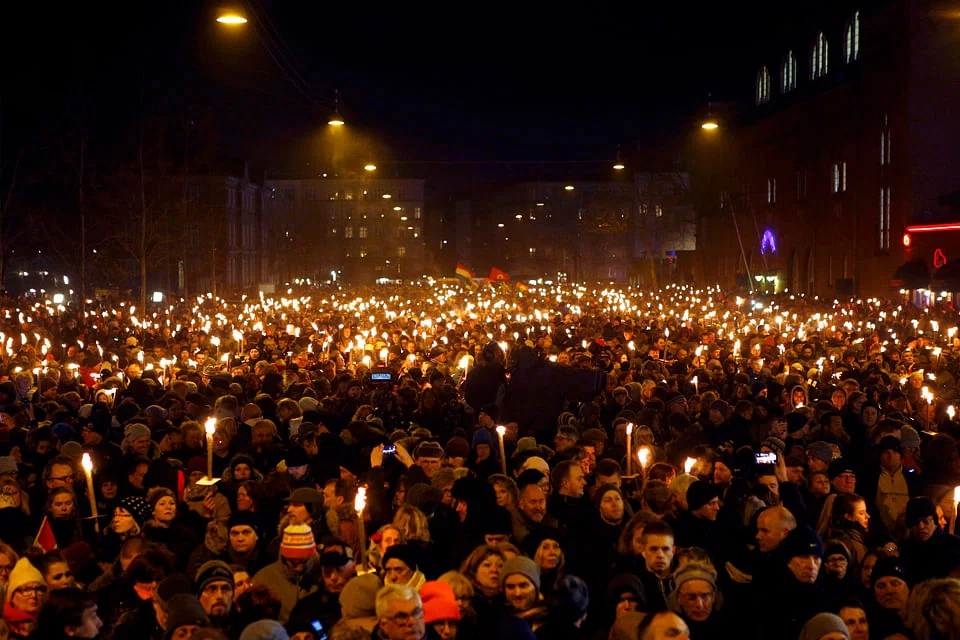
PUNDITS in Washington are still trying to deconstruct US President Barack Obama's somewhat low-key response to the recent terrorist acts in Europe and his continuing resistance to label the attacks in Paris and in Copenhagen (where a Danish film director and a Danish Jew guarding a synagogue were shot dead recently) or for that matter, the recent beheading of a dozen Egyptian-Christians in Libya, as elements in a global campaign that is driven by individuals and groups that are committed to the cause of Islam. All of this has nothing to do with Islam, the US President contends.
President Obama's decision not to go to France alongside other world leaders during their unity rally after the horrendous terrorist attacks there - and not to even send someone with a higher profile than the American ambassador to the event - also raised quite a few highbrows in Washington and in Europe. So did his labelling of the Jewish individuals who were brutally killed by the terrorists in Paris as "a bunch of folks" who were randomly shot by "zealots", as though the terrorists were not Muslims who had targeted a group of Jews.
And then a few days after Islamic State (IS) militants shocked the world by releasing a video showing a captured Jordanian pilot being burned to death, Mr Obama told a mostly Christian audience gathered for the annual National Prayer Breakfast (NPB) in Washington, DC, to get off their proverbial moral "high horse" and stop thinking that the brutality committed by IS and other Islamist terrorist groups was unique, recalling that "during the Crusades and the Inquisition, people committed terrible deeds in the name of Christ". Those comments in turn ignited criticism, especially among conservatives, that Mr Obama was drawing a moral equivalency between radical Islamists and Christians.
Moreover, Mr Obama and other officials in his administration have gone out of their way to stress that the United States was not fighting "radical Islamists" or "Muslim terrorists" or "jihadists" but instead have been referring to the generic "violent extremists". There is no war between Islam and the West, and forget about a "Clash of Civilisations", they insist.
In fact, as Mr Obama argued during his NPB address that the terrorists in Paris, the IS in Syria and Iraq, the Taliban in Afghanistan and Pakistan, have nothing to do with Islam and actually "distort" and "pervert" through their "nihilistic acts" what is in essence a tolerant "religion of peace", in the same way the Crusaders and the Inquisition had supposedly nothing to do with the message of Christianity.
Some would argue that Mr Obama's remarks may have been an attempt to avoid alienating Muslims by blaming their religion for groups like IS. After all, the US has a growing and vibrant Muslim population and Washington has major allies in the Muslim world, including Turkey and Saudi Arabia, that are cooperating with the Americans in the fight against IS and other Middle Eastern terrorist groups.
At the same time, bashers of President Barack Hussein Obama on the political right would explain his comments about Muslims and Islam by "accusing" the current White House occupant of being a Kenyan-born "Muslim" who is an ally of the Muslim Brotherhood and other Muslim causes.
In reality, Mr Obama may be following a more long-term realpolitik strategy. He seems to be trying to distance the US from the historical legacy of European imperialism, including the era of British and French imperialism when large parts of the Middle East and South Asia came under the control of the European powers.
In a way, it was the bloody anti-colonial struggles and eventually the immigration of hundreds of thousands of Muslims from the Middle East and South Asia into Europe which helped create the conditions for the current friction between Muslims and non-Muslims there.
The message of Mr Obama is that the US was not part of that historical narrative. As he pointed out on numerous occasions, unlike the problems Muslim immigrants face in Europe, most of the Muslims who have settled in the US have been successfully integrated into American society and have done well in all walks of life.
It is therefore the responsibility of the Europeans to absorb their growing Muslim population, and there is no reason why the US should be drawn into the current mess there. If anything, the Europeans could learn a lesson from America's immigration policies and its struggle for civil rights.
In any case, Mr Obama remains committed to the long-term strategy of ending US military interventions in the Middle East, starting with the steps taken to end the wars in Iraq and Afghanistan. He has emphasised that the US is not going to deploy troops to battle IS in Iraq and Syria and that the main responsibility for the fight should be placed on the Iraqi government, the Kurds and other regional powers.
Moreover, his efforts to reach a diplomatic deal with Iran go beyond the issue of its nuclear military programme. He wants to end the long-time enmity between the US and Iran and co-opt it as a major player in the evolving regional balance of power, in the same way that former US president Richard Nixon launched his opening towards China in order to re-arrange the strategic chessboard.
And as America becomes a major energy producer and reduces its dependency on Middle Eastern oil it could start gradually disengaging from the region and pivoting to the Pacific. The demographic changes taking place in America where the white majority is expected to become a minority in a nation that would become more Latin, Asian, and African, will only help transform the European identity and detach it from an ageing and ailing Europe and from the adjunct Middle East. Let the Europeans spend more resources in dealing with that region and its problems, including the Israeli-Palestinian dispute that remains central to their strategic interests.
From that perspective, Mr Obama's efforts to refrain from alienating the Muslim world and reaching some sort of a modus vivendi with it makes a lot of sense. But then whether Mr Obama likes it or not, the US remains stuck in the Middle East and is seen by many Arabs and Muslims as the global hegemon that is responsible for their problems as the protector of the monarchs and the dictators they hate as well as Israel's main patron.
Mr Obama may want to convince the world's Muslims that America isn't their enemy. The problem is that his power of persuasion could prove to be quite limited.
TRENDING NOW

Once staunchly pro-China, Malaysian Chinese businesses are now distancing themselves from Beijing

Grab CEO’s wife Chloe Tong on life with Anthony Tan and finding her purpose

Could stablecoins be the future of money?
ST Engineering opens tech-focused aircraft maintenance facility in Changi; to create over 500 jobs

