

OUE Commercial Reit should consider turning hospitality-centric for better valuation

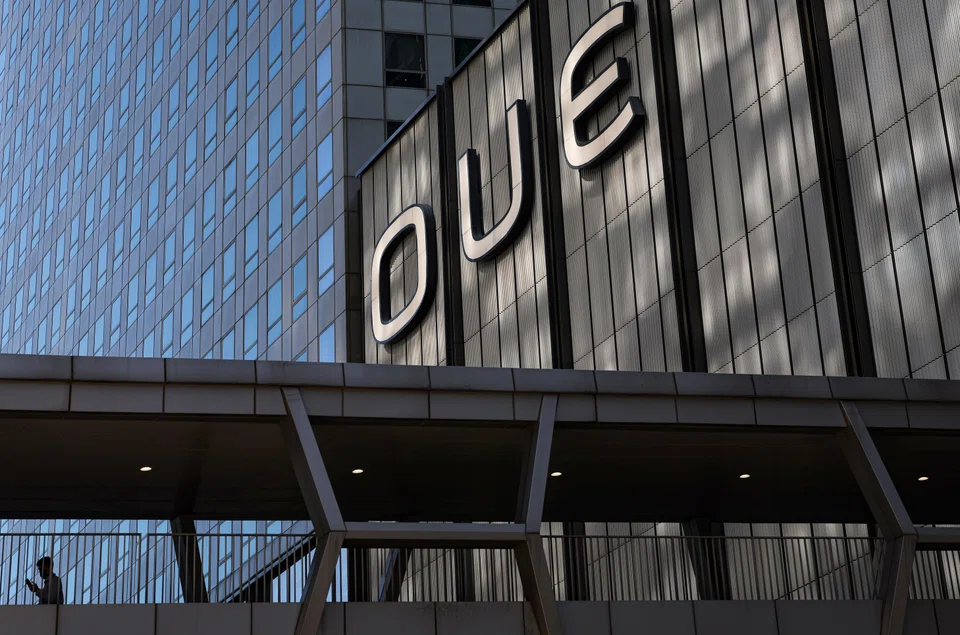
SINGAPORE’S hotel owners are raking it in amid the tourism sector’s strong recovery post the Covid-19 pandemic. International visitor arrivals and hotel revenue increased sharply in 2023 from a year ago.
Industrywide, revenue per available room (RevPAR) among Singapore hotels rose 41 per cent year on year (yoy) for the first eight months.
Year-end festivities will likely bring even more cheer to hotel owners. With higher revenue, hotel owners can mitigate rising expenses due to inflation.
In the first half of the year, RevPAR at Hilton Singapore Orchard, which has 1,080 guest rooms, was S$246, up 17 per cent from a year ago.
Crowne Plaza Changi Airport, which has 563 guest rooms, saw RevPAR rise 54 per cent yoy to S$207 in H1. RevPAR for both hotels in H1 was higher than pre-Covid in 2019.
Even as these two hotels are buzzing, however, the unit price of their owner OUE Commercial Real Estate Investment Trust (OUE C-Reit) languishes.
As at Oct 4, OUE C-Reit traded at S$0.23 – or a 61 per cent discount to its end-June net asset value (NAV) of S$0.59.
Addressing undervaluation
Possibly, OUE C-Reit’s sponsor OUE can distribute units it holds in the trust to its shareholders. With better free float and trading liquidity, OUE C-Reit might trade better.
Based on the latest available annual report, OUE’s total interest in OUE C-Reit is 48.4 per cent.
If OUE distributes to its shareholders one OUE C-Reit unit for every one OUE share held, OUE shareholders will get a distribution worth around 22 per cent of OUE’s share price – based on share prices as at Oct 4. Such an exercise would see OUE distribute over 15 per cent of OUE C-Reit.
OUE shareholders should be happy receiving OUE C-Reit units, as the latter’s distribution yield tops the former’s dividend yield.
Another option, given OUE C-Reit’s steeply discounted price, would be privatising the trust at an offer price of around book value. This would better help unitholders realise value.
Yet, OUE trades poorly – its share price as at Oct 4 was a 76 per cent discount to its end-June NAV of S$4.33. Thus, OUE is hardly well-placed to privatise OUE C-Reit.
Better valuations
Perhaps, OUE C-Reit’s manager can aim for better unit pricing by becoming hospitality-centric. Hospitality trusts with smaller portfolios have been able to garner better valuations.
CDL Hospitality Trusts , Far East Hospitality Trust and Frasers Hospitality Trust were trading at discounts of 28 per cent, 34 per cent, and 22 per cent, respectively, to their end-June NAVs as at Oct 4.
Should OUE C-Reit trade closer to the book value multiples of the above hospitality trusts, say, at a discount to NAV of 40 per cent, the uplift in unit price will be over S$0.12 per unit.
OUE C-Reit owns a diversified Singapore-centric property portfolio. In Singapore, besides the two hotels, it owns three predominantly office assets in the Central Business District (CBD): OUE Bayfront, One Raffles Place and OUE Downtown Office. It also owns the Mandarin Gallery mall along Orchard Road; and commercial building Lippo Plaza in Shanghai, China.
Based on its half-year results’ presentation, the two hotels accounted for about 29.3 per cent of OUE C-Reit’s property portfolio by asset value.
OUE C-Reit’s manager could, perhaps, raise the hospitality component to 60 per cent or more of the trust’s portfolio value in order to get investors to value the trust largely for its hospitality exposure.
Among various property segments, structural drivers for hospitality assets, warehouses and data centres appear to be strong.
Hotels here benefit from growing regional prosperity. The hosting of major events here, such as concerts, conventions and sporting events, drives spikes in room rates. Singapore’s safety and connectivity, coupled with investments to upgrade her offering to visitors, further support the hospitality segment.
OUE C-Reit can become hospitality-centric by selling some non-hospitality assets. Some of the proceeds raised could then be used to fund purchases of hospitality assets. Still, the trust may struggle to buy hotels in Singapore. These assets are often tightly held and deals would likely be struck at thin yields.
OUE C-Reit could also try enticing listed hotel-owning property-related groups to inject their hotels into it in exchange for units in the trust. Some possibilities include Sofitel Singapore City Centre in Tanjong Pagar or Sheraton Towers Singapore in Newton – owned by GuocoLand and Bonvests Holdings , respectively.
Listed property-related groups that trade at huge discounts to NAV may find OUE C-Reit is a more efficient vehicle through which to own their hotel assets. If required, OUE can give parties who inject hotels into OUE C-Reit ownership interest in the trust’s manager.
Alternatively, OUE C-Reit could explore merging with a hospitality trust. A merger may see OUE C-Reit’s unitholders swap units in an undervalued vehicle for securities in another entity that trades better.
While OUE could lose some of its fee revenue from managing OUE C-Reit, it ought to be more than amply compensated by the rise in value of its ownership interest in the trust.
Prospects for OUE C-Reit’s assets appear fine. The trust’s Singapore hotels and Mandarin Gallery will benefit from continued growth in visitor arrivals.
Ongoing asset enhancement work at Crowne Plaza Changi Airport can boost its competitiveness. The trust’s Singapore CBD office buildings also enjoy support from office occupiers looking for quality properties.
Nevertheless, OUE C-Reit’s severe undervaluation needs correcting.
OUE C-Reit was listed in 2014, with a focus on commercial property. A merger with OUE Hospitality Trust in 2019 saw OUE C-Reit gain hospitality exposure.
Perhaps, OUE C-Reit’s next chapter should see it enhance value for investors by turning hospitality-centric.
TRENDING NOW

Two Singapore-listed palm oil firms named in Greenpeace report on Indonesian plantation fires

Singapore Airlines flight returns to San Francisco after ‘unruly’ passenger incident

Singapore looking into which companies responsible for haze-causing fires: PM Wong
Deluge IPO 3.86 times subscribed ahead of SGX debut

