

Petrol companies must come clean on latest increase in prices
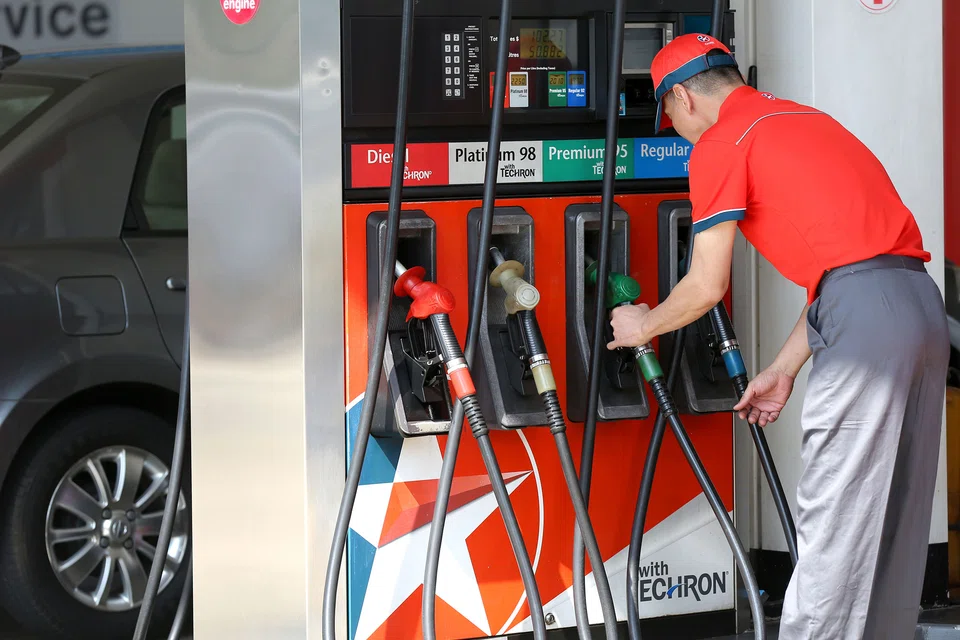
THERE was a collective groan from motorists across Singapore when Deputy Prime Minister and Finance Minister Tharman Shanmugaratnam announced a surprise increase in petrol duty towards the end of his Budget statement on Monday.
The duty for premium- and intermediate-grade petrol went up by 20 and 15 cents per litre with immediate effect - a calculated move by the government to discourage car usage and reduce carbon emissions. Mr Tharman explained that with falling global oil prices, pump prices after the petrol duty changes kicked in would remain lower than the levels in the last two-and-a-half years.
Drivers, however, were in for a double blow on Tuesday when they discovered that pump prices at three of Singapore's four petrol companies were raised beyond the levels of the petrol duty hike. A litre of 98-octane petrol was higher by up to 25 cents, and for 95-octane the hike was as much as 18 cents.
This led the Competition Commission of Singapore (CCS) to write to the petrol companies to ask them to explain their fuel price adjustments, while consumer watchdog Case went a step further by accusing them of "profiteering". CCS and the Ministry of Trade and Industry (MTI) added in a joint statement on Wednesday that they "will not hesitate to take firm action against parties who are found to be engaging in anti-competitive behaviour at the expense of consumers".
Some companies quickly scaled back on their increases, although not by as much as drivers would have liked. Shell, for instance, dropped its petrol prices by two cents on Wednesday, but its overall increment was still higher than the petrol duty hike. The companies reasoned that they have to include other components into their formula such as the Goods and Services Tax (GST), while other factors such as exchange rates, production and distribution costs, and storage and service station operating costs are taken into consideration when determining petrol prices.
But this begs the question: would the companies have been so forthcoming with this information had it not been for the intervention by the authorities?
While it is not illegal for one to profiteer from a situation, Case's executive director Seah Seng Choon stressed that petrol companies, as important businesses in Singapore, must operate in a responsible manner. He makes a valid point.
Motorists here have long accused petrol companies of being too slow to cut their prices when the price of crude oil goes down, and raising prices far too quickly when the opposite happens. Often, the adjustments take place at around the same time.
It is time that the authorities bare their teeth and demand that petrol firms exercise greater transparency whenever they choose to adjust their pump prices. There must be a deadline for the companies to respond and justify their latest increases, and if the reasons provided are unsatisfactory, the errant parties should be punished accordingly.
On its part, MTI and CCS should clearly spell out the consequences and how they would penalise companies for moves that are deemed anti-competitive. It will require the efforts of every stakeholder to work together to ensure a fair deal for all.
TRENDING NOW

Indonesia’s coal tycoon Low Tuck Kwong replaced as Bayan Resources president-director

OCBC names Ang Eng Siong as global corporate banking head in rejig of wholesale banking business

Consider lowering homeownership barriers for some non-resident foreigners

DBS opens flagship investment strategy to retail investors with new fund

