

Philippine president playing with fire
Duterte's belligerence towards the US alters strategic environment, but China may not budge on South China Sea.
Washington
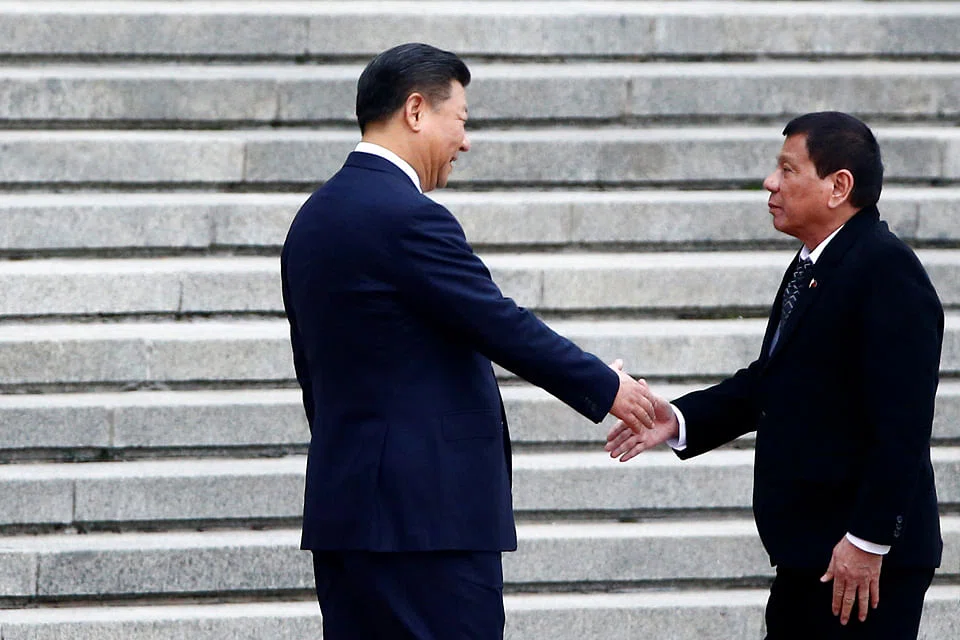
PHILIPPINE President Rodrigo Duterte visited China for four days beginning Oct 18 in a strategic bet that he can patch up contentious relations with Beijing, seek economic aid while loosening long-standing ties with the United States. The results of the trip, during which he announced his "separation from the US" (only to backtrack on it the next day) will be closely monitored for signs of how serious the new president is about orienting the Philippines towards China and away from the US, which would have an outsized impact on regional geopolitical dynamics and US efforts to rein in China's ambitions in the South China Sea.
Relations between Manila and Beijing unravelled in 2012 when China seized fish-rich Scarborough Shoal, roughly 201 km off the Philippine coast in the South China Sea. China's move prompted the Philippines to bring a case against Beijing to an international arbitral tribunal in The Hague, causing China to react angrily. Mr Duterte's predecessor, Benigno Aquino, signed a defence cooperation agreement with the United States in 2014, giving the US military increased access to five bases and providing the Philippines increased aid and training for maritime domain awareness. Stepped up engagement with Manila was a key plank in President Barack Obama's rebalance to Asia.
Since taking office in June, the 71-year-old former mayor of Davao City has launched a bloody campaign against drugs, resulting in the deaths of more than 3,500 people. When the US government criticised his tactics, Mr Duterte fought back with an outburst of profanities and told Washington to "go to hell". He reminded the US of massacres that took place in his home province of Mindanao in the early 1900s and raised questions about whether Washington could be relied on to help the Philippines if it were attacked.
In his first three months in office, Mr Duterte has created uncertainty about Manila's relations with Washington. US officials have kept a stiff upper lip through Mr Duterte's rants and said that they support his efforts to ease tensions with China. "The prospect of the Philippines pulling out of a long stretch of tense relations with Beijing is a desirable one," Daniel Russel, senior US diplomat for East Asia, told journalists before Mr Duterte headed to Beijing.
A key motivator driving the Philippine president to mend fences with China is economic. He recognises that the spat with Beijing has meant that the Philippines is missing out on China's largesse. Mr Duterte would like help developing the country's overextended infrastructure, particularly railways in Mindanao and Luzon. He would also like loans to buy weapons for the Philippines' military modernisation programme. The day before his visit, Mr Duterte was quoted in state-run Xinhua news agency as criticising Washington for its limited assistance and saying "only China can help us".
China retaliated against Manila for bringing Beijing to the international tribunal by suspending banana and other agricultural exports and telling Chinese tourists to avoid the Philippines, at considerable cost to the country's economy. Mr Duterte, accompanied by more than 200 Philippine business leaders, would like Beijing to lift these restrictions. In a sign of potential aid to come, a Chinese tycoon is financing construction of a giant drug rehabilitation centre near Manila.
During the election campaign, Mr Duterte took a tough stance on the Philippine maritime dispute with China, pledging to ride a jet ski to the Spratly Islands and plant the nation's flag there. His bravado has eased since he took office. Before leaving for China, Mr Duterte told journalists that he would ask Beijing to allow Filipino fishermen to resume fishing in Scarborough Shoal, but added that Philippine sovereignty over its claims in the South China Sea was not on the negotiating table.
Mr Duterte has said repeatedly that the tribunal ruling must form the basis of any settlement of Philippine maritime disputes with China. As he arrived in Beijing, a Xinhua editorial said that his visit would be a step towards overcoming years of estrangement between the two nations. "Should he demonstrate his good faith, the trip will present a long overdue opportunity for the two nations, which enjoy longstanding friendship, to heal the wounds of the past few years and steer their relationship back to the right course."
Mr Duterte pointedly told Chinese media: "Maybe because I'm Chinese, and I believe in sincerity." Press reports state that his grandfather was Chinese.
During a meeting with Chinese President Xi Jinping, the two leaders agreed to resume talks on the dispute in the South China Sea. Mr Duterte said the day before the meeting that the July ruling by the international tribunal would take a "back seat". The two sides agreed to set up a joint coast guard committee on maritime cooperation, and China pledged to provide aid for aquaculture and commercial fish processing. Beijing promised to provide preferential loans to finance infrastructure development such as railroads and roads, lifted an import ban on Philippine fruit, and said that it would encourage Chinese tourists to visit the Philippines. The two countries signed some US$13.5 billion in trade deals, Philippine officials said.
In the weeks before the trip, Mr Duterte announced that he was suspending joint exercises and patrols with the United States in the South China Sea in an apparent signal that his goal of implementing a more "independent" foreign policy would result in distancing the country from Washington. Earlier, he had said that he would ask the roughly 100-strong US forces providing counterterrorism assistance in attacking the Abu Sayyaf extremists in Mindanao to leave. National Defense Secretary Delfin Lorenzana said subsequently that this would be implemented once Filipino troops could fill this role.
Mr Duterte said that he would continue to honour the country's existing treaties and military alliances, but was moving to limit cooperation with the US to avoid antagonising China. The defence secretary told journalists that the US and the Philippines conduct nearly 30 joint exercises each year.
Mr Duterte's impromptu announcements have created considerable uncertainty about future of US engagement with the Philippines, a country with which Washington signed a mutual defence treaty in 1951. US officials say that Manila has not yet officially informed Washington of any proposed changes to its relations with the US.
Many observers question whether Mr Duterte's expectations about what China would offer are realistic and point out that he could have reduced his leverage with Beijing by publicly insulting the US. China has given no indication that it would agree to a bargain in which Manila would reduce defence ties with Washington in exchange for large-scale Chinese economic assistance and concessions on disputed territory.
Domestically, Mr Duterte will likely face limits on how far he can go in improving ties with China or distancing the country from the US. A poll conducted in late September showed that 76 per cent of Filipinos surveyed had "much trust" in the US despite Mr Duterte's anti-American outbursts, but only 22 per cent felt the same about China.
Nonetheless, an anti-American protest calling for the withdrawal of US troops from the Philippines erupted outside the US Embassy in Manila during Mr Duterte's visit. About a dozen protesters were injured when a police van crashed into the crowd.
To be sure, the stunning rhetoric coming from Mr Duterte has changed the strategic environment dramatically, but his actions must be monitored over the coming months to see whether the country's foreign policy is adjusted significantly in the wake of Chinese pledges of assistance and cooperation. Mr Duterte might abandon some joint exercises with the US, but in the end, it's unlikely that he will jettison ties with Washington when he has no certainty that discussions with China will result in significant concessions in the South China Sea. YALEGLOBAL ONLINE
TRENDING NOW

He built the Vingroup empire. Now South-east Asia’s richest man is handing some key roles to his sons
32 companies, 6 individuals bag accolades at Singapore Corporate Awards 2026
Can a first-time homebuyer couple earning S$18,000 a month afford a new EC unit?
Floods compound Philippine growth woes from public-works scandal

