Port giant PSA could be a prized candidate in Singapore’s pursuit of high-quality listings
The company, whose earnings have exceeded S$1 billion in recent years, could prove popular with investors

[SINGAPORE] Singapore is pouring in billions of dollars to breathe life into its equity market, as it pulls out all the stops to attract companies to list and increase investor interest.
The Monetary Authority of Singapore (MAS), in its latest move, announced on Tuesday (Sep 29) that it will place S$1.45 billion with five more asset managers under an upsized S$6.5 billion Equity Market Development Programme.
It is part of efforts to develop the local fund-management industry and improve investor participation in Singapore equities.
MAS also announced a S$20 million market-making sleeve under the Grant for Equity Market Singapore scheme, which helps to improve trading efficiency and increase the number of institutional-grade stocks.
There are also a slew of other similar measures with the same objectives, including the MAS and Singapore Exchange’s (SGX) S$30 million Value Unlock programme, which aims to help listed companies realise their full valuation potential.
Chia Der Jiun, managing director of MAS, earlier said at an event: “The stage, the lighting, the costumes, the music. We have gotten all of these ready, for all of you chairmen and board directors of listed companies – to now play your parts.
“We want all our listed companies to be in a position to shine, and we hope that some of our listed companies will grow into superstars.”
MAS and the bourse operator are seeking to attract high-quality listings to deepen Singapore’s equity market and strengthen its appeal to investors.
However, they need not look far: The Republic has several high-quality, unlisted companies in its own backyard. One is PSA International, wholly owned by state investor Temasek and whose bonds are already listed on SGX.
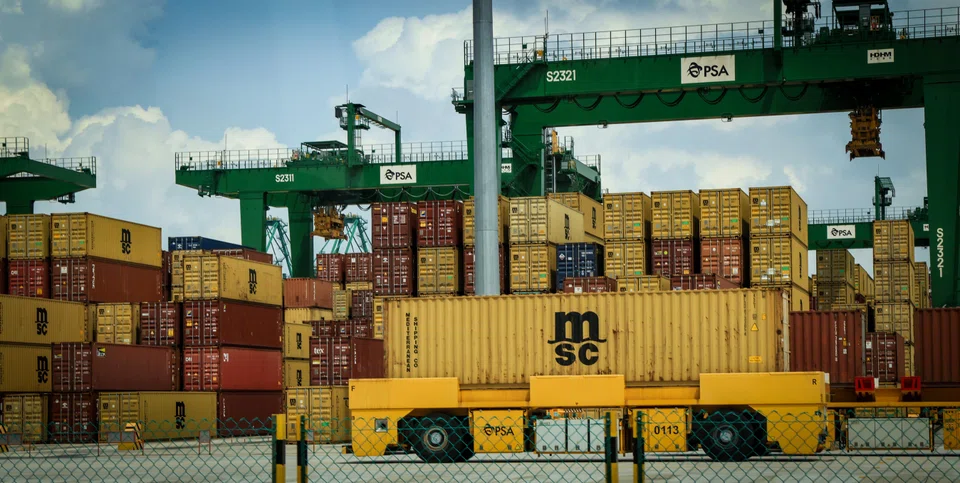
Headquartered in Singapore, PSA International owns a portfolio of port, supply chain and marine services businesses spanning 45 countries, including its main flagship mega-hub in the city-state.
Such a portfolio offers geographic diversification while its supply chain business helps to mitigate concentrated risk in port operations.
With more than 80 per cent of the global trade transported by ocean, PSA International is in an industry that captures the trade volume.
In 2025, it handled a record 105 million twenty-foot equivalent units (TEUs) globally, including 44.5 million TEUs in Singapore – US trade tariffs notwithstanding.
PSA International’s earnings have exceeded S$1 billion in recent years, with total net cash inflows from operating, investing and financing activities ranging from about S$400 million to S$1 billion in the last two fiscal years.
One might draw a comparison with SGX-listed Hutchison Port Holdings Trust (HPHT) , the world’s first publicly traded container port business trust.
However, apart from both being companies operating ports, there are very few similarities. They have completely different business models and geographic scopes.
HPHT, as a trust, is focused on delivering stable and high distributions per unit to investors, constraining its capacity to increase capital expenditure. It is also deeply concentrated in the Greater Pearl River Delta, with highly localised hubs processing a significant segment of South China’s trade volume.
HPHT is thus not as diversified as PSA International, both in terms of geography and businesses.
Notably, PSA International is the second-largest unitholder of HPHT, with a 14.2 per cent stake as at March 2026.
Although PSA International has already tapped the debt market, where financing typically costs less than equity, a stock-market listing would diversify its sources of capital and broaden its investor base.
The Singapore government, through the minister for finance, could hold a special share (management share) in PSA International that carries no ordinary dividend rights but grants veto powers over major decisions.
These could include changes to the company’s articles of association or hostile foreign takeovers, ensuring it remains aligned with the Republic’s strategic interests as a global maritime hub.
PSA International could prove to be as popular with investors as Temasek’s other investee Singapore Airlines , especially as it is a well-recognised name and also benefits from Temasek’s halo effect.