

President Biden shifts to the political centre
The Ukraine invasion provides an opportunity for the US president to rally Americans behind him as he tries to unite the nation and the world against Russia.
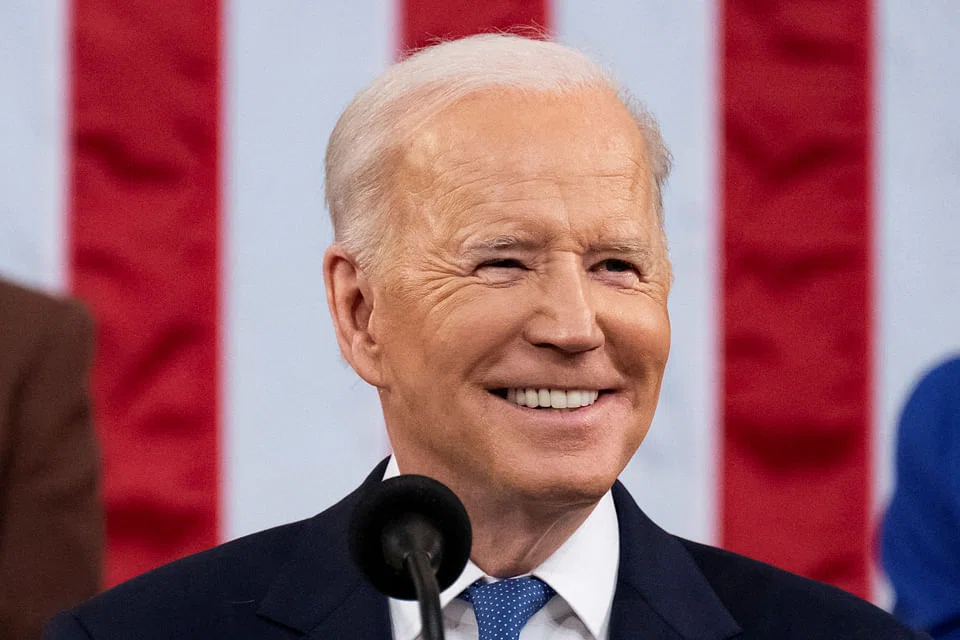
MOST US presidents tend to win a few political points following a State of the Union (SOTU) address. But with few exceptions, particularly during international crises, the national televised event has rarely provided a White House occupant with a long-term boost.
President Joe Biden's SOTU speech last Tuesday (Mar 1) may end up being one of those few exceptions. Taking place against the backdrop of Russia's invasion of Ukraine, it provided an opportunity for the president to rally Americans behind him as he tried to unite the nation and the world against Russian President Vladimir Putin's aggression.
It may be too early to know whether his combative SOTU address last week would be recalled as the night in which President Biden started to renew his ailing presidency and regain electoral momentum.
But after several months dominated by bleak political news for Biden, results of post-SOTU opinion polls suggest that his public approval ratings have risen, and that he may be regaining support across the board, and in particular among a demographic group that would be critical to his political fortunes - independent voters.
According to a NPR/PBS NewsHour/Marist opinion poll, the overall approval rating for President Biden jumped 8 points, to 47 per cent after the address, and it seems that the public is now more supportive of his handling of both foreign and domestic policies.
Hence, according to the same poll, President Biden's handling of the Ukraine crisis was up 18 percentage points to 52 per cent. It also indicated that the president's handling of the coronavirus pandemic is now at 55 per cent, up 8 points; and even more significant, that 45 per cent of Americans now approve of his handling of the economy, up by 8 points from a poll conducted two weeks earlier.
While Republican voters continue to give Biden low marks, support for the president's handling of the war in Ukraine among politically independent voters has risen to 48 per cent, from 31 per cent in February.
Reflecting the traditional rallying-around-the-flag's public attitudes when the nation faces a foreign threat, a clear majority of 83 per cent of Americans now say that they support the economic sanctions that the Biden administration imposed on Russia, including 8 in 10 Republicans.
Shift to political centre
But the chances that President Biden would see public support rising in the long run may have increased if one considers the tone and the substance of his SOTU address which reflected a shift to the political centre on his part. That followed his failure to win congressional and public support for his ambitious social-economic agenda that was regarded as too left-leaning by many independent voters.
So instead of rehashing his first-year domestic agenda that has taken him down to a low political point, President Biden seems to be attempting to embrace the kind of strategy that helped Democratic president Bill Clinton win two national elections: Trying to focus on areas of common ground with the Republicans and at least refraining from accentuating the political differences with them, while at the same time attempting to maintain the support of his electoral base.
Political pundits refer to this kind of strategy as "triangulation" - embracing a position that is located above or between the left and right sides of a political spectrum, which involves adopting for oneself some of the ideas of one's political opponents. As President Biden put it on Tuesday, he was advancing a "unity agenda for the nation" insisting that his proposals have no "partisan edge".
Hence Biden devoted a large part of his address to discussing proposed legislation to improve US technological and economic competitiveness with China, a measure that enjoys wide bipartisan support on Capitol Hill.
He also spent time discussing the implementation of the bill to fix America's infrastructure, which was passed in Congress with Republican support, as well as considering issues which, like fixing the country's roads, enjoy wide public support: Providing free coronavirus tests; assisting the nation's veterans; fighting the opioid pandemic; curing cancer.
Moreover, President Biden - in a sign that he was parting ways with some members of his party's progressive wing - placed the fight against crime at the centre of his agenda, rejecting calls by more radical Democrats who, in the name of promoting racial justice, have called for defunding the police.
"We should all agree - the answer is not to defund the police," President Biden stated on Tuesday. "It's to fund the police. Fund them. Fund them with resources and training. Resources and training they need to protect their communities." His vow was received with applause by both Democrats and Republicans.
Whether the current political moment dominated by the call for national unity in general, and against Russia's aggression in particular, would provide President Biden the kind of momentum he needs to revive his presidency as he prepares for this year's midterm election and the 2024 presidential race is another issue.
The NPR/PBS NewsHour/Marist opinion poll that indicated that he may be seeing a rise in public support, also suggested that his rating on the economy remained low with 53 per cent of Americans still disapproving of the way he has been managing it.
Even when it comes to foreign policy, a slim majority of 51 per cent think that his foreign policy decisions have weakened American standing on the world stage.
There have been clear signs that the US economy is recovering and moving to the post-pandemic world, with the latest Labour Department report issued last Friday pointing out that American employers have added 678,000 workers to their payrolls in February, the biggest gain in seven months. At the same time, the unemployment rate fell to 3.8 from 4.0 per cent, getting close to the pre-pandemic 3.5 per cent rate.
Rising inflation
But notwithstanding the dramatic improvement in the job market and signs that the economy is coming back to life, the rising rate of inflation continues to dominate Americans' economic concerns, and they are blaming President Biden for the rising oil and food prices.
Moreover, even when it comes to the Ukraine crisis, President Biden's ability to maintain public support for his policies would depend very much on what would happen in the coming days and weeks in Ukraine, and on America's responses to Russia's moves, especially when those affect the US economy.
In fact, while most Americans are now applauding the decision to impose economic sanctions on Russia, those moves are likely to create new pressures on the global supply chains. And more importantly, with Russia's strong presence in the energy markets, the sanctions could lead to rising oil prices and exacerbate the inflationary pressures that would affect American consumers. In that case, would Americans continue to support the tough posture vis-a-vis Russia?
President Biden's long-term political fate would depend on the policies by another global figure whose last name also starts with a "P" - Federal Reserve chair Jerome Powell, whose expected moves to raise interest rates may or may not counterbalance the inflationary pressures that Putin's aggression is bound to increase.
READ MORE: Asian markets dive as oil prices spike, Ukraine crisis rattles investors
TRENDING NOW

China Investment Corp, PGIM’s 50% stake in Nex mall up for sale; asking about S$1.2 billion

Higher rates, weaker spending: Is the Philippines entering stagflation?
Singapore tech stocks plunge as Nasdaq bloodbath spills into region
OCBC wealth clients turn defensive amid market volatility as Q3 profit rises 3%

