

Presidential hopeful who's big on the nitty gritty
A policy wonk promoting "economic patriotism" - but will Elizabeth Warren's message win Democrats' support?
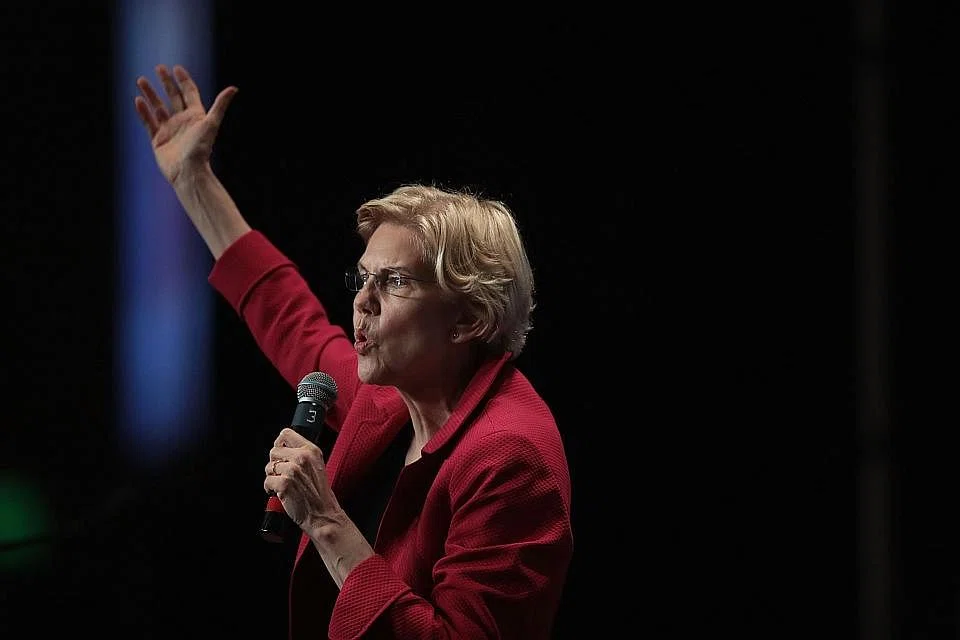
ONE of the conventional wisdoms of American politics is that while voters may be attracted to candidates with Big Ideas, they pay less attention to the specifics of policy proposals. Slogans energise your average voter; statistics make him or her fall asleep.
Republican presidential candidate Donald Trump running as an economic nationalist was able to capture the hearts and minds of many Americans by pledging to Make America Great Again without providing concrete details on how he was planning to do that and what would be the consequences of his policies.
The idea of bringing manufacturing jobs back home and "punishing" China for "stealing" them sounded great. But how would that happen and was it even doable? And in particular, shouldn't we be worried that Chinese retaliation would hurt the American economy, like its agricultural sector?
But, hey, the Donald was not an economics professor and or a think tanker, and voters do not expect the next White House occupant to be a policy wonk. And in any case, detailed policy plans are so, so boring!
Or maybe not. Democratic presidential candidate and Massachusetts Senator Elizabeth Warren, who happens to be a former Harvard law professor (and looks and sounds like one) is trying to prove that the conventional wisdom is wrong and to demonstrate to sceptical pundits that being a policy wonk who bombards voters with policy ideas full of numbers is not only "electable", but that he or she would actually turn out to be politically sexy.
Indeed, as she prepares for the Democratic primaries where she is going to face at least 22 more presidential hopefuls, Senator Warren's campaign seems to be attracting larger than expected crowds that applaud and cheer whenever she introduces a new policy plan: Imposing annual 2 per cent "wealth tax" on those with assets worth more than US$50 million and another 1 per cent tax on assets above US$1 billion; cancelling up to US$50,000 in student loan debt; and a universal childcare system that would be free for low-income families; and limit other families' costs to 7 per cent of their income; rules to limit company size; new ethics rules for Supreme Court justices; steps to manage the value of the US dollar; breaking up the big high-tech companies; getting rid of the electoral college system in presidential elections.
While the other leading presidential candidates have been promoting Big Ideas like "Medicare for all" and pledging to spend trillions of US dollars on fighting climate change, candidate Warren does not hesitate to draw attention to the nitty-gritty of each of her plans - like how much it would cost, who will pay for it and who would benefit, while discussing alternative ways in carrying out her proposed programmes.
Overall the strategy seems to be working for the 69-year-old Democratic politician who announced her run for the presidency six months ago when her support among Democrats was in the single digits. She was dismissed then by many veteran politicos who insisted that she just did not have it when it came to winning the hearts and minds of voters; that she was not, well, electable.
But things are looking much better now for candidate Warren. While opinion polls suggest that former vice president Joe Biden remains the frontrunner in the race, with support from about 25 per cent of the Democrats in Iowa, where the first caucus will take place next year, Senator Warren was the first choice of about 15 per cent of the voters, running neck- and-neck with the 77-year-old vermont Senator and socialist Democrat Bernie Sanders and the 37-year-old South Bend (Indiana) Mayor Pete Buttigieg. And she is now ahead of two African-American Senators - Kamala Harris of California and Corey Booker of New Jersey - who were considered to be among the frontrunners only a few months ago.
Early this month Candidate Warren created a buzz when she announced her "plan for economic patriotism" which was seen as part of her strategy to counter President Trump's message of economic nationalism by targeting the voters that helped him win the presidency: blue collar workers in the de-industrialised areas of key electoral states like Pennsylvania, Michigan and Ohio.
Indeed, not unlike President Trump and his attacks on the globalist elites, Ms Warren asserted that "the giant 'American' corporations who control our economy have no loyalty or allegiance to America".
But while President Trump seemed to suggest that all of America's economic problems would be resolved by punishing trade partners, Ms Warren has been calling for major structural changes in the American economy that could be achieved through a coherent industrial policy that places priority on rebuilding the nation's industrial base and raising workers' income.
"America chose to pursue a trade policy that prioritised the interests of capital over the interests of American workers," said Ms Warren, pledging to advance a trade policy that competes with other economies by supporting domestic industries and American workers.
Among other things, she has proposed a new Department of Economic Development that would increase federal funding for core research and require companies that benefit from it to manufacture in the United States. She also called for investing US$2 trillion in environmentally-friendly industries.
Many economists and policy wonks are intrigued by Ms Warren's policy ideas and in particular by her demand that Washington embrace industrial strategy. There are clearly topics for a fun discussion during a think tank seminar.
But it is not clear whether most American voters would be interested in joining this kind of discussion, especially since they are aware that while a presidential candidate can float around many interesting ideas that perhaps make sense, the elected president - faced with opposition from Congress, the bureaucracy and interest groups - is limited in his or her ability to carry out all the grand plans discussed earlier in the campaign. For example, Mr Trump's failure to implement his immigration policy and his ambitious plan to rebuild America's infrastructure.
Indeed, the chances that a President Warren could carry out her plans for restructuring the American economy and redistributing the nation's wealth are very small if non-existent under the realities of America's politics and legal systems that can accommodate only gradual reforms but not a political-economic revolution.
At the end of the day, voters recognise that what counts are the leadership qualities of a president and not her or his ability to formulate new and creative ideas. In order to do that, all the president needs to do is hire a talented Harvard professor for the job.
TRENDING NOW

OCBC mobile, online banking services restored after Friday afternoon disruption

SGX CEO Loh Boon Chye to step down; succession planning under way

Waymo founder predicts ‘landslide’ robotaxi adoption in Singapore, driven by high car costs

Vietnam’s northern provinces, not Hanoi or Ho Chi Minh City, are powering near 10% GDP growth

