Cash-rich PropNex could sweeten shareholder returns with special dividend
Market leader is leveraging technology to build business moat as it strives to stay ahead


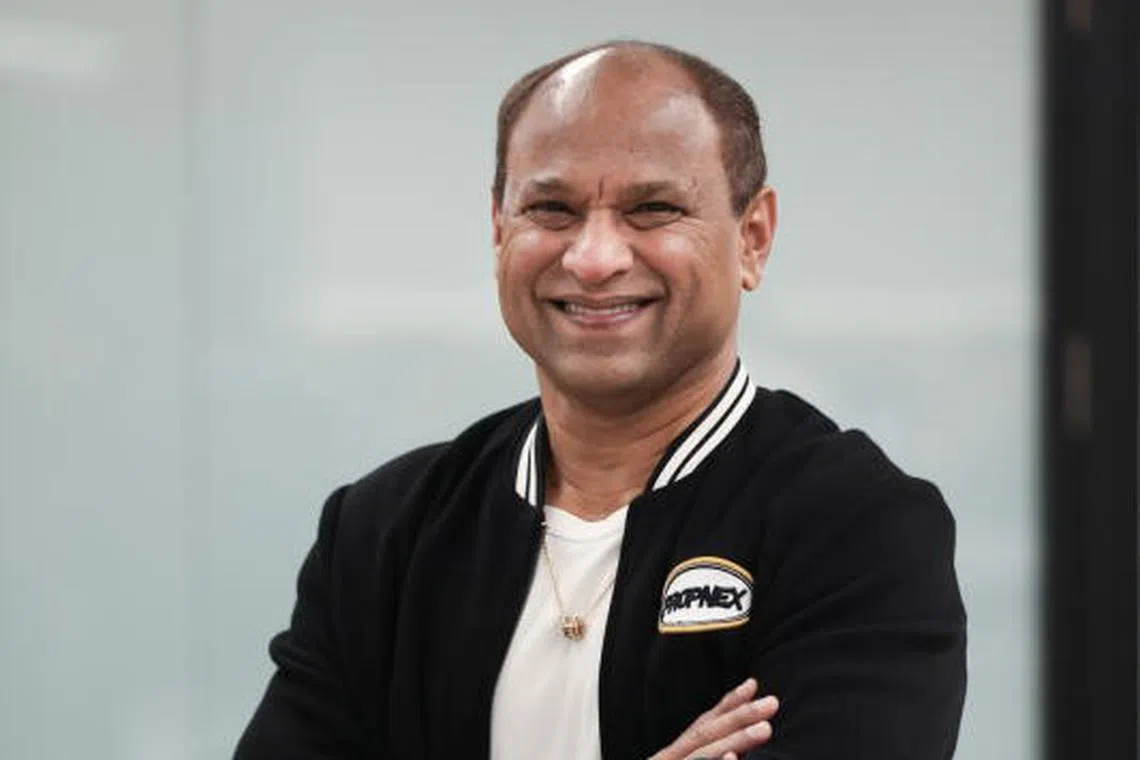
“THIS year is going to be a good year,” said PropNex executive chairman and chief executive officer Ismail Gafoor, right at the start of his interview with The Business Times.
The real estate agency is bullish about its prospects this year, on the back of a Singapore property market that holds much promise.
Gafoor’s upbeat sentiment comes as PropNex celebrates its 25th anniversary this year. And the mainboard-listed company is open to dishing out a special dividend to commemorate the occasion.
The head honcho noted that the number of condominium apartments for sale this year – including unsold units from past years – would amount to about 20,000. Some 12,850 new units are expected to be launched this year, compared with only 7,300 new units rolled out in 2024.
More apartments for sale bode well for the market leader, which has the largest army of agents in Singapore – nearly 13,000 as at Jan 24.
PropNex’s agents sold more than half (55.5 per cent) of the new launches – including executive condominiums, non-landed and landed properties – in the first half of 2024.
The agency also clinched the lion’s share of the deals in the resale markets for public flats and private property – at 66.5 per cent and 60.1 per cent, respectively – over the same period.
In the six-month period, it accounted for 48.4 per cent of the transactions in the landed resale market and 37 per cent of the deals in the private leasing market.
PropNex’s results for the 2024 financial year will be published at the end of February.
While recent new condominium launches have been well-received, Gafoor noted that there is a lag of three to four months before the agency can book the revenue.
Thus, these new launches will contribute only to the company’s FY2025 results, he said.
Nonetheless, favourable market conditions such as a dip in borrowing cost after the United States Federal Reserve cut policy rates last September and stable employment levels have buoyed demand for property.
“People are able to secure anything between 2.5 and 2.6 per cent (as) fixed interest rate over a period of two years. So the market confidence has really changed towards the last quarter, and it continues in the recent launches,” added Gafoor.
Building on tech
Although PropNex is already the market leader with a 63.3 per cent share of the local private residential and public housing resale market, it is striving to boost this to at least 66 per cent.
This, its CEO explained, would mean the company would get more data, which is provided to its agents, agents’ customers and developers for them to make informed decisions. This will help the company fend off challenges from proptech platforms, while uplifting its role to beyond that of a middleman.
For example, developers can get the data on what design concepts, unit mixes and price points sell, because PropNex has the statistics across the market.
“Our data is pumped in by agents on a 24-hour, daily basis,” Gafoor said, adding that even the Singapore Department of Statistics (Singstat) will not have the latest information because it takes some time for properties to be caveated.
Leveraging technology, the company rolled out in January what the CEO described as akin to a private banker’s exclusive service that enables its agents to send personalised property reports to select past customers each quarter, updating them on the latest transaction prices, valuations, and insights relevant to their properties.
PropNex invests heavily in technology, but declined to disclose the annual spending. More than 25 per cent of its 200-strong staff are in IT roles, and it reallocated another 5 per cent of its initial public offering proceeds, or S$2 million, to enhance its technology capabilities last August.
Investors have bought PropNex shares in recent months, amid expectations that the company will ride the property upturn and that it would reward shareholders with a 25th-anniversary special dividend. In the year to Feb 6, the counter has gained 16.4 per cent.
Gafoor does not shy away from admitting that it could sweeten shareholder returns with a special payout. “If you look at (our) cash position, I think we are in a good shape to consider such rewards.”
As at Jun 30, 2024, PropNex had no borrowings while its cash pile stood at S$134.4 million.
But even without giving a special dividend, the company has been generous to its shareholders – dishing out more than the 75 to 80 per cent stated in its dividend policy. For example, it paid 87.6 per cent of its earnings in H1 FY2024 and 92.9 per cent of its net profit in FY2023.
Gafoor noted that PropNex has positioned itself as a dividend play because of its asset-light and cash-generating business.
He added that the company has not had an immediate need for funds, and therefore has been able to distribute it to shareholders.
Keeping cool amid curbs
When asked about acquisitions that might cause it to dip into its cash reserves, the 61-year-old helmsman said that such a corporate action will not be easy for PropNex in Singapore because it might be subject to regulatory scrutiny, given its position as market leader.
For ventures overseas, cash outlay is not required because PropNex makes inroads via the franchise model, generating franchise fees from day one as well as taking a cut of the commissions.
PropNex has a presence in Malaysia, Indonesia, Cambodia, Vietnam and Australia, with its Malaysian franchisee performing so well that the Singapore agency bought a 20 per cent stake in it.
Gafoor attributed PropNex’s competitiveness and appeal to its training, structure of dual-career paths that allows agents to eventually take on management roles, and support system.
The agency is on track to achieving its target of a Singapore sales force of 15,000 by 2026, thanks to newbies as well as experienced hands who have joined the company.
“We tend to get the majority of (the new agents),” he noted.
This is in spite of the agency, unlike its counterparts, not paying for its agents’ annual licence fee and professional indemnity insurance premium, which he said is because PropNex does not want “to carry non-productive agents”.
As for the impact of any potential cooling measures on its business, he pointed out that the agency has diversified its revenue streams.
About 50 per cent of its revenue in H1 FY2024 – 20 per cent from HDB resales, 23 per cent from rentals (usually recurring), 3 per cent from commercial and industrial, and 5 per cent from landed resales – was resilient or not subject to the impact of such restrictions.
The remaining segments comprising private resale and project marketing are more susceptible to any government action to rein in rising property prices and market exuberance.
“Our business is diversified,” Gafoor said. “No one cooling measure will shrink our pie by 40 to 50 per cent – it will not. It’s just that it takes one to two months for people to understand and re-strategise about how to overcome these challenges.”