

Proxy fighters in the South China Sea
Most S-E Asian coast guards are likely to remain under-equipped while China is likely to be more prone to use coast guard vessels to further its claims in the area.
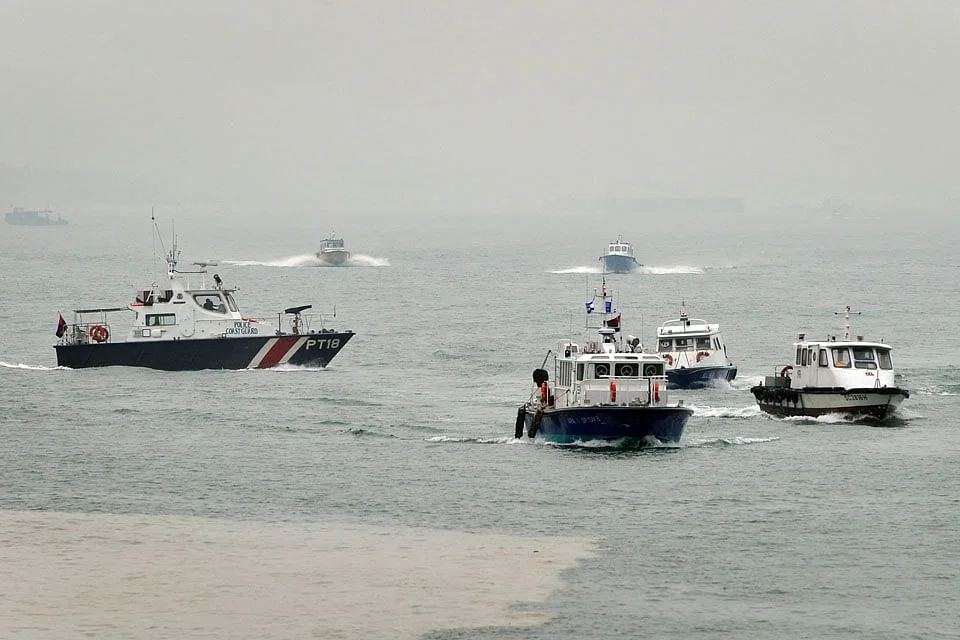
THE upcoming Imdex Asia, a maritime defence exhibition and conference, to be held in Singapore next week from May 19 to 21, is one of Asia's most important showcases for regional naval capabilities. However, while considerable attention is paid to the buildup of navies in and around the South China Sea (SCS), a lesser-known but equally critical story has been the growth of regional paranaval forces - that is, coast guards and other civil maritime services.
These so-called "white hulls" have been increasingly used to enforce maritime rights - particularly Exclusive Economic Zones (EEZs) in these two seas - and patrols by such forces have been both more frequent and, in some cases, more aggressive.
There is no commonly accepted definition of what constitutes a "coast guard". In general, they are maritime security services that fall somewhere between navies (which are oriented for warfare) and law enforcement agencies (ie, transportation police), although most coast guards have armed ships and undertake limited law enforcement duties.
Coast guards typically patrol maritime borders, protect local navigation, engage in search-and-rescue operations, and interdict smugglers and illegal immigration. Increasingly, however, they have been employed in anti-piracy and counter-terrorism operations and in enforcing sovereignty rights in territorial waters and EEZs.
In the case of South-east Asia, local coast guards are being increasingly employed as proxies for regional navies when it comes to aggressive enforcement of sovereignty rights, particularly in the South China Sea.
As such, coast guards are taking on a greater importance in regional security calculations. Chinese Coast Guard vessels have rammed Vietnamese and Philippine fishing boats, and have also tried to block Philippine vessels attempting to re-provision the BRP Sierra Madre, a grounded ship in the Second Thomas Shoal in the Spratly Islands.
CHINA'S WHITE-HULLED FLEET
China, not surprisingly, possesses the largest Coast Guard in the SCS. Until recently, it operated five civil maritime forces: China Marine Surveillance, the Border Patrol, the Fisheries Law Enforcement Command, Customs, and the Maritime Safety Administration (MSA).
Many of these forces overlapped in their missions and competed with one another. In 2013, the first four were combined into a single China Coast Guard (CCG), under the command of the State Oceanic Administration.
The main missions of the CCG are patrolling territorial waters and disputed territories, anti-smuggling and anti-piracy, search and rescue, fisheries protection, and harbour and coastal security protection.
The CCG operates over 100 patrol boats, in particular, the 41-metre Type-218 offshore patrol vessels, each armed with twin 14.5mm machine guns. In 2007, the PLA Navy transferred two 1,700-ton Type 053H (Jianghu-I) frigates to the CCG, making them the largest ships in the coast guard.
China's other paramilitary coastal defence force is the MSA, which is run under the authority of the Ministry of Transportation. The MSA operates mainly along the Chinese coastline and the Yangtze, Pearl, and Heilongjiang rivers, and is responsible for maritime and shipping safety, including the prevention of pollution from ships, inspection of ships and offshore facilities, navigational safety measures, search and rescue, port operations, and general maritime law enforcement.
The MSA comprises a patrol force of 1,300 vessels and watercraft of various types, including several large patrol boats and helicopters.
SOUTH-EAST ASIAN COAST GUARDS
Several countries in the region, including Malaysia, the Philippines, and Vietnam, are following China's lead and adding new and better ships to their white-hulled maritime forces. Most nations in South-east Asia have chosen in the past decade or so to expand their coast guards. For the most part, this is driven by the growing importance of regional waters (such as the SCS and the Malacca/Singapore straits) to international security. Preserving freedom of navigation and operations in regional sea lanes of communication (SLOCs) has become increasingly paramount. This includes combating piracy and other sea-based criminal activities, human-trafficking, and drug smuggling. The concern motivating many countries adjacent to these SLOCs is that, if they are unable to adequately patrol and protect them, then countries from outside might do it for them, resulting in a loss of sovereign control.
EEZ enforcement is, of course, another key driver. Coast guards generally used to enforce EEZ rights, particularly fisheries. As EEZ claims in the SCS have heated up in the past few years, coast guards have become increasingly important to countries boarding on it.
Not every South-east Asian nation bordering on the SCS possesses a coast guard or even much of a civil maritime force. Brunei and Cambodia mainly rely on their navies for offshore patrol operations, and on maritime police forces for border protection, search-and-rescue, and combating illegal maritime activities. Indonesia's Coastal and Seaward Defence Command was created in 1978 as the Maritime Security Agency. It patrols both territorial waters (out to 12 nautical miles), as well as the country's 200 nm EEZ. Nevertheless, the service is poorly equipped, with only three offshore patrol vessels and nine coastal patrol boats.
In 2005, Malaysia established a coast guard - the Malaysian Maritime Enforcement Agency (MMEA) - which is tasked with patrolling Malaysia's maritime waters (including the Malacca straits) and EEZ. The MMEA is responsible for maintaining law and order, for preserving peace, safety and security, and for search-and-rescue operations all within the Malaysian Maritime Zone, which includes inland waters, Malaysia's territorial waters (ie, out to 12 nm), and the country's continental shelf and EEZ out to 200 nm. The MMEA incorporates the function of the marine police, fisheries department, immigration, and customs under a single enforcement agency. This coast guard has two Langkawi-class offshore patrol vessels, 15 Kris-class and four Sipidan-class coastal patrol boats, as well as over 100 smaller vessels.
The Philippine Coast Guard is a maritime law enforcement agency under the control of the Department of Transportation and Communications. This service operates five offshore patrol vessels and 10 coastal patrol boats, mostly provided by Australia and Japan, plus numerous smaller patrol boats. It is in the process of acquiring two Eurocopter EC-145 helicopters.
Patrolling Singapore's coastal waters are the responsibility of the Police Coast Guard (PCG), established in 1993. The PCG operates mainly in the country's territorial waters (ie, out to 12 nm), guarding mainly against illegal immigration and terrorist intrusions, and protecting offshore islands. The PCG operates 10 Shark-class offshore patrol boats and several smaller miscellaneous watercraft.
Vietnam established its coast guard in the late 1990s, and it has only a dozen large patrol vessels and four CASA C-212 aircraft. The US recently agreed to transfer five fast patrol boats to Vietnam to bolster its paranaval forces, and the US Coast Guard has signed an agreement to help train its Vietnamese counterparts.
Despite growth over the past decade, there will be continued constraints on the continued expansion of regional paranaval services. In particular, coast guards must compete with navies for funding, and grey fleets still tend to win out in procurement battles. Consequently, most South-east Asian coast guards are likely to remain under-equipped, or forced to accept second-hand equipment discarded by their navies or other maritime services.
WHAT'S NEXT?
China, in creating a unified coast guard force, is likely to be more prone to use these vessels to further its claims in the SCS. Furthermore, China's aggressive artificial island-building projects are likely to bolster its capacity to deploy vessels further out into the SCS.
Confrontations between coast guards have thus far been restrained, as these vessels are more lightly armed than naval ships. Consequently, this has lowered the risk of catastrophic clashes in the SCS. However, if clashes increase or the stakes are raised, they could escalate into more violent action involving navies. For example, using paranaval forces to sink commercial ships, resulting in a large loss of life, or employing coast guards to forcibly remove personnel from bases in the SCS or block oil and gas exploration from disputed areas and thus provoking armed resistance - all of these actions could increase the risk of conflict.
TRENDING NOW

He built the Vingroup empire. Now South-east Asia’s richest man is handing some key roles to his sons

US dollar falters after Iran’s offer to reopen Hormuz sends oil lower

Temasek’s Wan Chee Foong to helm PIL, Lars Kastrup to be board adviser

Despite the de-dollarisation debate, demand for dollar liquidity in Asia is growing

