

Radical economic policy lands UK in crisis
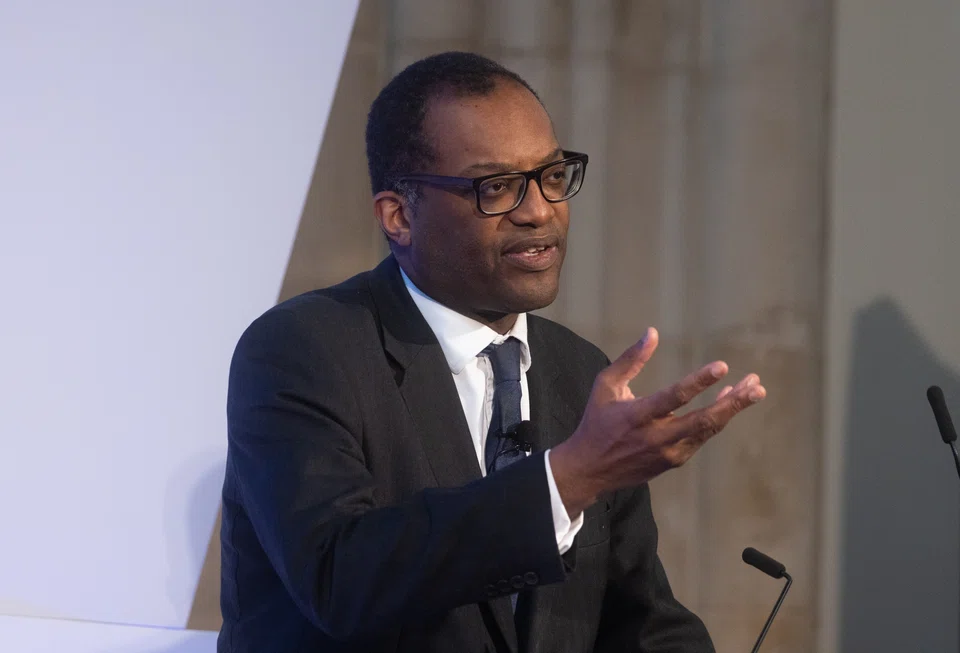
Having dug himself into a deep political hole, new UK finance minister Kwasi Kwarteng now has a massive challenge to get out of it. His own political future may also be in jeopardy.
LIZ Truss was selected as UK prime minister less than a month ago by party activists who saw her as a safe pair of hands, yet her government is already facing a potential full-scale loss of market confidence in its economic strategy.
Last Friday (Sep 23), new UK Finance Minister Kwasi Kwarteng launched an extraordinary emergency budget that turned on the fiscal taps with both massive new spending and also tens of billions of pounds of tax cuts in the largest dose of unfunded stimulus since at least the 1970s. Dramatically, markets have given Kwarteng’s proposals a big thumbs-down with the most negative reaction to any UK fiscal event in living memory.
The crisis deepened on Monday, after the Bank of England’s decision to rule out an emergency rise in interest rates prompted fresh selling of the pound. Financial markets remain far from clear about how the central bank will now respond – reflected by the pound’s movements on Monday, as optimism over an interest rate intervention was followed by disappointment at the failure to deliver this. As of Tuesday, sterling is trading only marginally above parity with the US dollar, its lowest rate with the US currency.
The Bank of England will hope that the initial market panic as investors unpick the implications of Kwarteng’s budget eventually subsides. Yet there is also a significant risk that the bank, and the government, will lose control of fast-moving events.
In a sign that international policymakers are growing increasingly alarmed by the recent turmoil, Raphael Bostic, president of the Atlanta Federal Reserve, spoke out on Monday. He said that the sell-off in the pound reflected rising uncertainty about the direction of the UK economy, adding to concerns last week from former US treasury secretary Larry Summers.
While Kwarteng must have anticipated a negative market reaction to his budget, he clearly did not appreciate the full depth of investor angst. This was a big oversight on his part, and it has been clear for some time that his announcement could trigger a serious financial meltdown.
Take the example of Deutsche Bank FX strategist Shreyas Gopal who warned on Sep 7, the day Truss was formally appointed prime minister, that the risks of a “sterling crisis” should not be underestimated. He said the “risk premium on UK gilts (government debt) is already rising … a crisis may sound extreme, but it is not unprecedented: a combination of aggressive fiscal spending, severe energy shock, and a slide in sterling ultimately resulted in the UK having recourse to an International Monetary Fund loan in the mid-1970s”.
Gopal was far from alone in his warnings within the financial market community. Moreover, Truss was also very clearly warned on many occasions by former finance minister Rishi Sunak that her economic plans were “comforting fairy tales”.
It is not 100 per cent clear why Kwarteng refused to listen to such warning – nor indeed why he decided to sack earlier this month the Treasury department’s permanent secretary Tom Scholar, who might have been one key person to have given the new government constructively critical counsel over its fiscal options.
Having dug himself into a deep political hole, Kwarteng now has a massive challenge to get out of it. On Monday, he failed to reassure jittery markets with a promise that he would outline the government’s debt-reduction strategy in a statement at the end of November.
Many financial market participants appear now to believe that talking tough will not be enough, however, and that official borrowing costs will need to rise more sharply and faster than previously anticipated to reverse sterling’s slide. The irony is that this may well wipe out any boost from his growth push, and lead to soaring mortgage rates for millions of home and business owners with the economy already widely believed to be in recession.
Politically, the budget debacle is the worst possible start to Truss’s prime ministership, and there is already significant angst among Conservative Members of Parliament (MPs) about the political and economic judgement of the new finance minister and prime minister. It should be remembered here that Truss is the first Conservative leader for almost a quarter of a century who was selected by party activists, despite not winning the support of most Conservative legislators, so the potential for management problems with MPs in Westminster is obvious.
There is already major disquiet among MPs who were supporters of Sunak. However, few are speaking out on the record, for now, with numerous moderate Conservatives who survived former prime minister Boris Johnson’s cull of MPs in 2019 who voted Remain in the Brexit referendum, concerned that the party whip may be removed from those who publicly defy Truss, or try to vote down her finance bill, decimating the moderate wing of the Conservatives at the next election.
In this context, Kwarteng’s political future could still be in jeopardy in coming months. While Truss will not throw him overboard without a real fight, this is a significant possibility nonetheless, unless the finance minister’s package delivers clear growth dividends.
The chief beneficiary of Truss’s travails is likely to be Labour, which is holding its annual conference in Liverpool this week. A new poll released Monday from YouGov puts the official opposition party some 17 percentage points ahead of the Conservatives, its highest lead since then-prime minister Tony Blair’s second landslide election victory in 2001.
While Labour takes nothing for granted given the volatile political mood, there is a growing sense in the party that the tide may now be turning against the prospects of the Conservatives winning a historic fifth straight term of office. Indeed, some comparisons have been made between this month’s events and the Black Monday crisis in September 1992 when the then-Conservative government of Prime Minister John Major was forced to hike interest rates after the failure of his economic strategy to keep sterling in the European Exchange Rate Mechanism, a precursor mechanism to the euro single currency.
No political era is identical to another, and 1992 has key differences as well as similarities with 2022. However, the odds appear to be growing that the Conservatives could indeed lose a significant number of seats at the next election, and that Labour may once again emerge as the largest party for the first time since the Blair-Brown governments.
The writer is an associate at LSE IDEAS at the London School of Economics.






