

Ready for the release of Trump 2.0?
Whether a retired Marine general can bring order to the White House remains to be seen
IF you want evidence proving the saying "A day is a lifetime in politics", you just need to recall the way Washington's political narrative ended late last week.
Last Thursday's cover of the tabloid New York Post depicted Donald Trump's White House as an episode in television reality show Survivor - the mottos in the White House version being "Outspin" and "Outlast" - with President Donald Trump surrounded by his infighting top aides and Cabinet members, including (the erstwhile) Chief of Staff Reince Priebus and newly-appointed communications director Anthony Scaramucci.
In the most recent episode of the show, the remaining White House survivors were fighting for their jobs. It seemed that the Donald didn't like Attorney-General Jeff Sessions, who could soon be out; it was rumoured that Secretary of State Rex Tillerson was considering leaving his job, and the status of the White House's chief strategist Steve Bannon remained unclear.
But viewers came to be really mesmerised by the fight going on between the King Kong and Godzilla of the West Wing - the Priebus-versus-Scaramucci match, which pitted the low-key and unassuming Washington insider with the charisma of a cucumber against the colourful, rogue Wall Street insider also known as the Mooch and Trump's Mini-Me.
The question of who was going to stay on in the White House depended on the decision of the Big Man in the Oval Office. The suspense was killing everyone in Washington after the Mooch unloaded a crude verbal tirade, laden with many versions of the "F" word, against the beleaguered White House Chief of Staff during a chat with a reporter from The New Yorker.
Politico and other Internet news sites favoured by members of the inside-the-Beltway crowd delivered the latest gossip from the White House on who is in or out, but by late Friday afternoon, it was all over.
President Trump announced via Twitter that Mr Priebus was out of a job, and, while descending from Air Force One on a tarmac near Washington and emerging from under an umbrella, told reporters that the man he had just fired was "a good man".
A sad Mr Priebus, alone and without an umbrella, stepped off the plane into the drenching rain, with the dark skies over Washington conveying perhaps his personal tragedy. From now on, he will be known as the shortest-serving Chief of Staff in American presidential history.
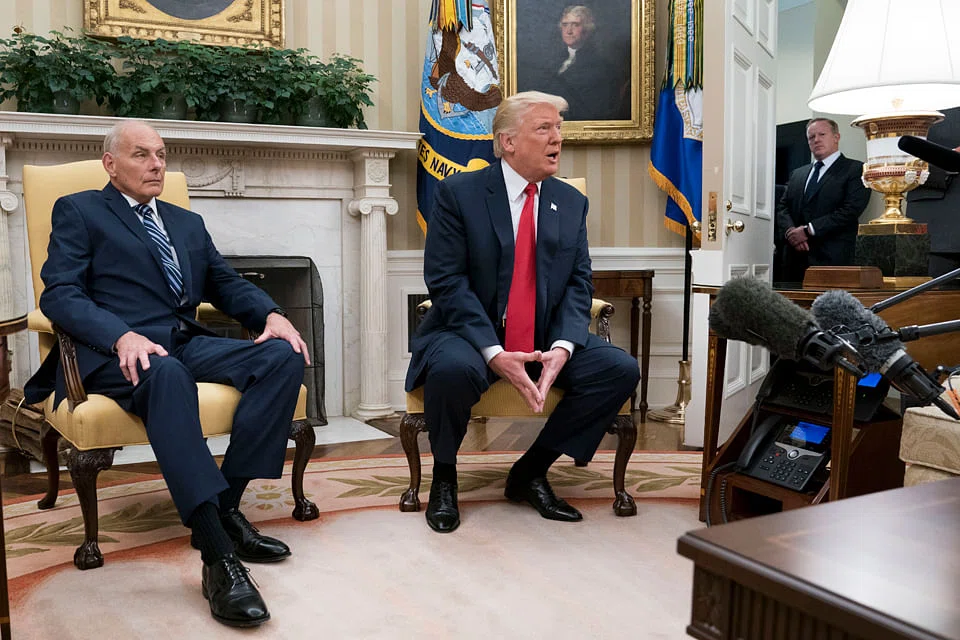
But if you thought that the highlight of the show was John Kelly, the Secretary of Homeland Security and retired four-star general that the president announced would replace Mr Priebus as the new Chief of Staff, you were wrong.
Instead, the focus of the Mainstream Media (MSM) and social media was on the perceived winner in the last round in the White House, the Mooch, who now promised to fire anyone in the White House staff for leaking information to the press and insisted that he had a direct line to his old pal in the Oval Office. The Donald is my buddy. Yeah. F**k the Chief of Staff!
For three days, pundits debated what the rise of the Mooch meant for President Trump, the Republican Party, the American people and the future of western civilisation, even as journalists scrambled to interview anyone and everyone who had known Mr Scaramucci, starting with his friends from kindergarten.
They discovered in the process that his (third) wife had filed for divorce after three years of marriage and before giving birth to their child last week, citing her husband's "naked political ambition" as the reason for the separation.
After she delivered the baby, the Mooch congratulated her over the phone; he would see his child when he was less busy at the White House.
But then the Scaramucci episode in SurvivorWhite House drew to an abrupt end on Monday, when it became known that it was Bye, Bye to Mooch, after just 10 days in the job.
It prompted those who had scheduled parties to welcome him to the White House to turn them instead into farewell parties.
The social media went crazy. Late-night television comedians bade him farewell, with CBS Late Night's Stephen Colbert announcing that "he said he was going to fire everybody and I got to admit: he delivered". The talk show went on to give Mr Scaramucci a musical send-off set to Queen's "Bohemian Rhapsody".
Early this week came the news that President Trump's decision to fire Mr Scaramucci came after Mr Kelly demanded that he be ousted. The move wasn't only in response to his profanity-laced language in the interview with The New Yorker.
In a way, Mr Scaramucci has come to symbolise the brutal infighting that has engulfed the White House, which has telegraphed the impression that the place is mired in chaos and lacks policy direction and leadership.
Retired Marine general Kelly, an officer and a gentleman admired by almost everyone in Washington, is expected to change all that, to shake things up, and, as one tweet put it, to bring into the White House more order and less Game of Thrones, a television series where backstabbing and political beheadings are common and no one really knows what's going to happen in the next episode.
Who could fix all of this better than someone whose entire career has entailed imposing military discipline? There is no doubt that an effective Chief of Staff can, indeed, bring order to the White House, improve coordination between the President's aides and between his Cabinet members, boost communication between the President and Congress, and streamline the presidential decision-making process.
Indeed, many presidential historians credit James Baker - a veteran Republican operator who served as the first White House chief of staff under President Ronald Reagan - not only with imposing order in the West Wing, but also with helping the former California governor to learn the way Washington worked and to advance his policy agenda.
But while President Reagan was willing to listen to Mr Baker and make decisions and operate in a political and bureaucratic system he designed, it remains to be seen whether President Trump will accept the changes (in the ways he handles the presidency, makes his decisions and manages his message) which Mr Kelly is bound to propose.
Indeed, much of the chaos in the last six months in the White House reflects the way President Trump has performed in office as a manager and as a leader; he has encouraged rivalries between his staff and administration officials, refused to follow their strategic planning and resisted efforts to develop a coherent and consistent message.
Most recently, after the president announced via Twitter that transgender individuals would be barred from military service, General Joseph F Dunford, chairman of the Joint Chiefs of Staff, declared that there would be "no modification" to current policy until the Pentagon received an actual directive from the President - which, apparently, it hasn't.
There have been the growing tensions between the White House and members of the GOP, after congressional Republicans failed to agree on a replacement for Obamacare, and President Trump launched an unprecedented attack on his own Attorney-General.
It's difficult to see how the new White House Chief of Staff is going to change the way a 71-year old business tycoon behaves as a person and operates as a manager, though it could happen.
If it does, however, it might happen too late for President Trump. Washington veterans noted this week that the last general who had served as a White House Chief of Staff was Alexander Haig, who was appointed to the position by President Richard Nixon in May 1973.
Mr Haig did a good job and brought order to what was also then a chaotic White House - but it was chaos that had arisen then out of the Watergate affair. Facing political and legal pressures, President Nixon was forced to resign from the presidency in May 1974.
TRENDING NOW

Singapore’s central gas buyer affirms Indonesia’s role as ‘important partner’ amid export review warning

Why the biggest business decision about AI isn’t which model to choose

Is Manila Asia’s new dining hot spot?

KKR founders among investors buying 42% of Peter Lim’s Valencia; club valued at US$1.4 billion

