Schauble and Varoufakis: united by fear of failure
Washington
TIMING is everything. So too body language. And sometimes it's all about location. Certainly this week in the political-cum-economic dogfight between Germany and Greece over Athens' ability to meet its debt obligations, rather than to crash out of the euro and maybe the European Union.
The finance ministers of the lead creditor and the big debtor synchronised their appearances in the same Washington building on Thursday at the start of the spring meetings of the World Bank and the IMF.
Yanis Varoufakis of Greece followed Wolfgang Schauble of Germany to the Brookings Institution, separated by minutes, but seemingly worlds apart in terms of a deal. Until, that is, you listened to them, watched their body language, sensed the stark contrast between age and (relative) youth. And maybe diagnosed their common fear of failure.
I had a word with Mr Schauble as he left Brookings, just before his Greek counterpart arrived. "I would never exchange my job for his," he remarked of Mr Varoufakis. "I'll be seeing him here over the next few days, I'm sure, and we don't need intermediaries."
A telling remark. Maybe the two economic prizefighters, from different generations and with such contrasting styles, have a little more understanding of each other than the headlines suggest. Both know about loss. Both evoke a responsibility to save the present, not endanger the future.
Both end up as losers if their negotiations collapse. With ramifications not just for the euro but for global economics. That's a burden, and a legacy, that no one wants. These were a frantic few hours. The world's media and assorted cognoscenti assembled, standing room only, for a glimpse of German-Greek zoology.
The telltale signs were bleak. Christine Lagarde, the IMF managing director, had told Mr Varoufakis she wouldn't countenance a grace period for Greece's next debt repayment, due on May 12. Mr Schauble had ruled out any compromise when euro finance ministers meet on May 11. Athens had been desperately seeking further relief. Standard & Poor's placed the country in junk bond territory.
Mr Schauble - a greybeard if ever there was one, in severe academic spectacles, in the wheelchair that has been his life since an assassination attempt 25 years ago - talked tough. "Greece has to deliver what has been agreed. And if they think Moscow or Beijing will lend them money, good luck."
But there was the compassion of a man who has lost much in his life, and learned a great deal, too, over four decades as a centre-right politician in a country that had to play by the West's rules, then dramatically recast its future as united Germany when the Cold War ended. "The Greek people are suffering much, much more than the people of Germany right now," he noted, just a hint of emotion in his voice. "Our goal is not about the debt, it's about making Greece an effective, competitive economy, and for its people to prosper."
And then, from my perspective, the clincher. Someone asked Mr Schauble: Is Europe ready to lose Greece? "No," he replied, and it was the only one-word answer of the afternoon.
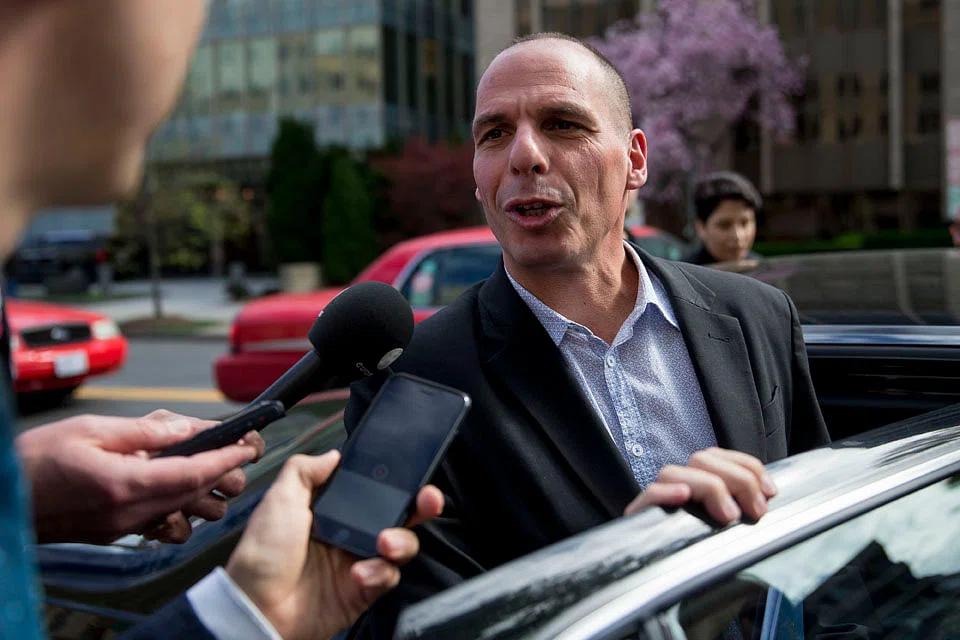
If Mr Schauble, at 72, represents the wisdom of life-changing experience, then Mr Varoufakis the rock-star economist evokes the conviction and determination of the next generation to put right the wrongs of those before him. With shaven head and open-necked shirt in a room where dark suits predominate, he bounds to the podium to deliver a cocktail of compromise and commitment.
He admitted Greece's many failings, its "chronic malignancies". He acknowledged the damage from indulgent pension plans, a bloated public sector, the failure to privatise. He insisted he would embrace any package that makes economic sense, and gives his country a way forward.
But he warned of failure. "The outcome of the negotiations over Greece will play a major role in whether Europe aids or impedes the world wish to put the crash of 2008 behind it . . . This crisis needs to bring us together, not pull us apart." OMFIF Briefing