Shenzhen express set to go but it's not for everyone
The 200-plus start-ups listed on Shenzhen's nascent Nasdaq-style ChiNext board are seen to be not "for the ordinary people".
CHINA has not succeeded in deflating a massive home-made asset bubble, in spite of stock market turmoil early this year, a long-running shake-up of its property market and a tidal wave of capital outflows. That's why its recent decision to open up its stock markets is so imperative.
To illustrate the scale of the Chinese asset bubble, Hong Hao, who works for a Hong Kong unit of state-owned Bank of Communications, cites a figure: one-third of residential housing in Beijing carries a price tag of at least 10 million yuan (S$2 million). Then, there is the frothy valuation of China's domestically-listed A-shares: 15 times price-earnings ratio for those listed in Shanghai and more than 40 times in Shenzhen, compared with just 10 for stocks on Hong Kong's main board.
"Many things are more expensive in China than Hong Kong," observes Mr Hong, head of research of Bocom International Securities. "It's typical of an isolated market."
Such bubbles reflect faithfully in real estate as well as in stocks and bear no semblance to the low headline inflation figures.
Mr Hong sees China's recent announcement to allow two-way investment in stocks between Hong Kong and Shenzhen, called Shenzhen-Hong Kong Stock Connect, as an attempt to open up the Chinese capital market and address the asset valuation issue and as evidence of China's long-term commitment to financial liberalisation.
"It's part of the reform commitment begun 30 years ago. The country is opening up more and more; probably the progress is slower than most people would like it to be. But in general this is what most Chinese people want and I think it is in the best interest of the people and the country."
PRICKING THE BUBBLE
The ultimate goal would be the internationalisation of the yuan, also known as renminbi, so that it would be determined to a large degree by a stable market mechanism, in the process pricking the asset bubble smoothly. Combining this with the ageing population in China and an irreversible loss in productivity, the value of the Chinese yuan would be destined to a long decline.
Billy SC Mak, a finance professor at Hong Kong Baptist University, says that China's willingness to allow freer cross-border flows of capital, such as investment in stocks, is all about the eventual convertibility of the Chinese yuan, about opening up its high-restricted capital account that has the unsavoury effect of creating an unstable currency (by extension, the economy) and about loosening control on the yuan's exchange rate. Expanding investment in China-listed stocks and vice versa would spread the use of the yuan, as the rationale goes.
And it could be just the beginning. "Hong Kong is just a link, one of the offshore yuan-trading centres. Now, there are so many of them. Besides stocks, they also talk about applying it to commodities."
After two years of tryout with a similar scheme between Hong Kong and Shanghai, the Shenzhen connect, the last mile to China's stock universe, is "effectively encompassing all investable stocks in the A-share market", numbering 1,450, and allow mainland investors to invest in another "30 per cent" of eligible Hong Kong stocks, taking the total to 420, according to a tally by Macquarie Securities.
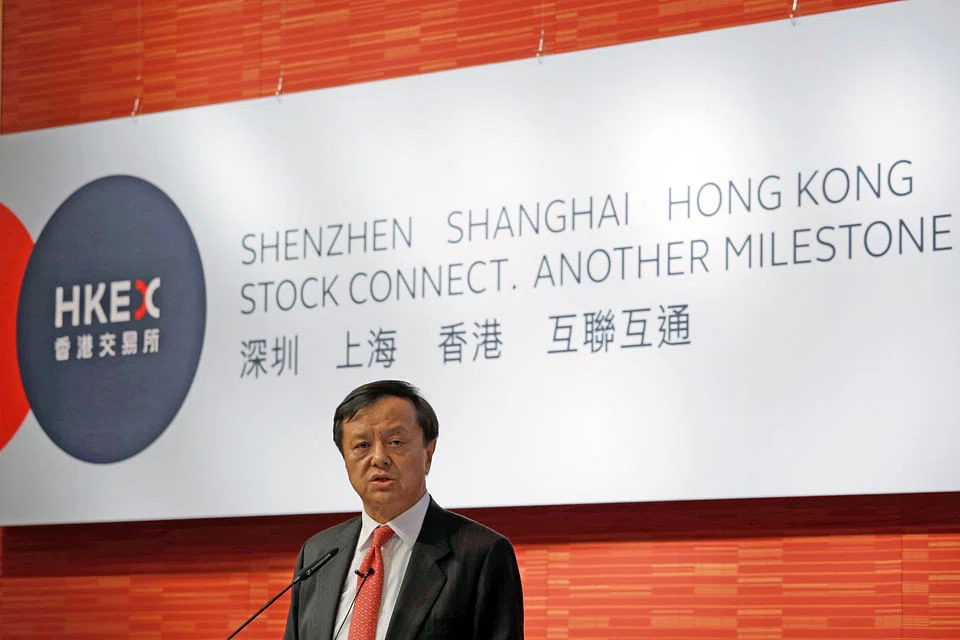
It would be a mission accomplished when it is officially launched later in the year for Charles Li, CEO of the Hong Kong Stock Exchange, who wrote on Aug 21 on his blog that the Shenzhen connect, "marks the completion of our mutual market access plans for China's secondary equity market".
He would hope the Shenzhen link would add significantly more buzz. The current Shanghai connect accounts for a paltry 1.3 per cent of HKEx's first-half revenue this year. In the short term, the impact would be limited but any signs of the yuan weakening would make investors rethink.
The crowning moment for China to plug into the global stock investment community would come much later: first in the rollout in 2017 of ETFs, which are included in the first time in the Shenzhen connect, and, if as expected, China's inclusion into the MSCI emerging markets index (though the proposed initial inclusion is just 5 per cent of China's A-shares).
The former could open the floodgates of Chinese investors to buy foreign stocks not just in Hong Kong but anywhere. Already, they display a particular affection for bluechip stocks in Hong Kong. The latter would funnel the opposite flow of investment, giving international investors a speedy route not just into but out of China's stock markets.
Prof Mak points out that when ETFs are included, mainland investors would be able to access overseas investment targets virtually everywhere, not just those in Hong Kong, adding that the diverse range of ETFs listed in Hong Kong are linked to stocks in Singapore, Japan, the US, and virtually all the major markets around the world.
PUNTING NEW ECONOMY STOCKS
The new Shenzhen leg would present international investors an opportunity to take a punt on stocks representing China's new economy and the private enterprise. Even though a daily net quota of 10.5 billion yuan and 13 billion yuan each would remain for investors going through the two connect channels, an overall quota cap, having been rendered meaningless by lukewarm response from investors in the last two years, has been removed. In total, 80 per cent of that overall quota for investment heading south to Hong Kong is used; only 50 per cent on the north-bound train to Shanghai is filled.
Mr Li of HKEx explains that the daily quota will stay "for risk management considerations" and it has effectively been doubled by the new quota given to Shenzhen, allowing mainland investors a total of 21 billion yuan quota to invest in Hong Kong stocks. In fact, only a couple of times over nearly two years had demand from investors been strong enough to fill the daily quota, he says.
Still, the Shenzhen express would not be for the faint-hearted. Mr Hong of Bocom advises caution, saying that the 200-plus start-ups listed on Shenzhen's nascent Nasdaq-style ChiNext board "would not be for the ordinary people".
As things normally stand in China, not anyone can invest in cross-border stock connect. Currently, only well-off investors, those with assets of 500,000 yuan parked in their trading accounts, gain entry into the exclusive club and they have to ply their money boat to and fro the connect channel, monitored closely by the Chinese authorities, but not outside of it, lest they stray to an unknown shore.
Think of it as a temperature-adjusted greenhouse for Beijing to keep close tabs on and cultivate a new breed of investors.
READ MORE: Shenzhen-Hong Kong link likely to start in November