SIA’s net-zero path is not an easy one

Tay Peck Gek
THE ability of national carrier Singapore Airlines (SIA) to decarbonise its operations is said to be crucial for its major shareholder Temasek to hit its net-zero targets. The state investor has noted that the only way SIA can reduce its carbon emissions is by switching to sustainable aviation fuel (SAF).
But it’s tough to pass the cost of the much more expensive fuel on to customers, going by the modest take-up of SIA group’s voluntary carbon offset programme.
Temasek reported last week that the total emissions of its portfolio rose to 27 million tonnes of carbon dioxide equivalent for the year ended Mar 31, 2023, up from 26 million tonnes in the previous financial year. The state investor, which actively engages its portfolio companies on their decarbonisation plans, is aiming to be net zero by 2050.
Temasek chief executive officer (CEO) Dilhan Pillay told reporters that SIA was the major contributor to the increase, due to the resumption of air travel.
“Much depends on the airline,” he said, when asked whether Temasek, which owns about 53.6 per cent of SIA, is on track to halve its 2010 level of emissions by 2030. This would require its total portfolio emissions to be cut to 11 million tonnes by 2030, from 27 million tonnes now.
SIA reported about 12.8 million tonnes of carbon dioxide equivalent of direct emissions from flights in FY2023 to March, up from 7.8 million tonnes the prior year.
Pillay noted that SIA was utilising only 79 per cent of its fleet capacity and has not returned to its pre-pandemic levels of operation.
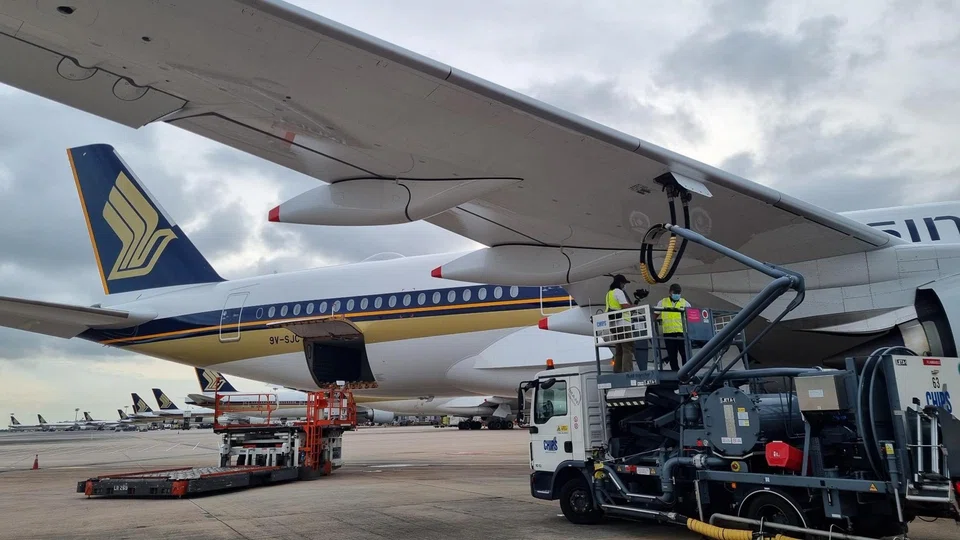
The only way to reduce emissions in the long term is to switch from fossil fuel to SAF, the helmsman at the state investor said. This would mean that SIA and its low-cost unit Scoot would now be feeling the heat to use more of the greener fuel to cut carbon dioxide emissions.
The carriers’ flights out of Changi Airport used a blend of regular jet fuel and SAF under a year-long trial that started in July 2022. This use of 1,000 tonnes of undiluted SAF is expected to reduce carbon dioxide emissions by around 2,500 tonnes.
When asked whether the group was still using SAF after the pilot, an SIA spokesperson stated: “Beyond the one-year pilot programme, we have been working on other plans related to the adoption of SAF. We will announce these plans when they have been firmed up.”
SAF, which meets all the quality and performance requirements of conventional fossil fuels, has been touted as the most promising near-term solution to greatly reduce carbon emissions generated by planes. SAF is said to be able to lower overall lifecycle carbon emissions by up to 80 per cent, when compared with fossil fuels.
However, the current cost of the eco-friendly fuel is three to five times that of regular jet fuel.
To put things in perspective on the potential financial impact on SIA group, its fuel cost before hedging for FY2023 was S$5.9 billion, accounting for 39 per cent of its total expenditure of S$15.1 billion. This cost, which is probably dominated by regular fuel, was its single largest expense item. Bear in mind that SIA is not operating at full capacity yet.
SIA customers’ willingness to pay for a more sustainable fuel is questionable. Take-up for SIA’s voluntary carbon-offset programme, launched in 2021, is “not strong”, SIA CEO Goh Choon Phong said at the company’s results briefing in May. If passengers are not keen to pay extra to offset the carbon footprint of their journeys, it is doubtful that they would be happy to pay more for a flight that uses sustainable fuel.
That would leave the carrier group shouldering the additional cost of SAF on its own if there is no government subsidy. Alternatively, SIA might have to raise airfares – a move that is not easy to do in a highly competitive industry.
If the transition to SAF is inevitable, SIA needs to condition its customers to place a higher value on a sustainable flight. While it transitions into a net-zero environment, the group should ease its customers into the journey as well, by first making it easy for them to buy carbon offsets or SAF credits – and this should be when they make flight bookings. They should not have to buy these on a microsite.