Singapore digital banks face down ticking clock
Both GXS and MariBank are on the cusp of becoming full digital banks, but the true test will come with their financials

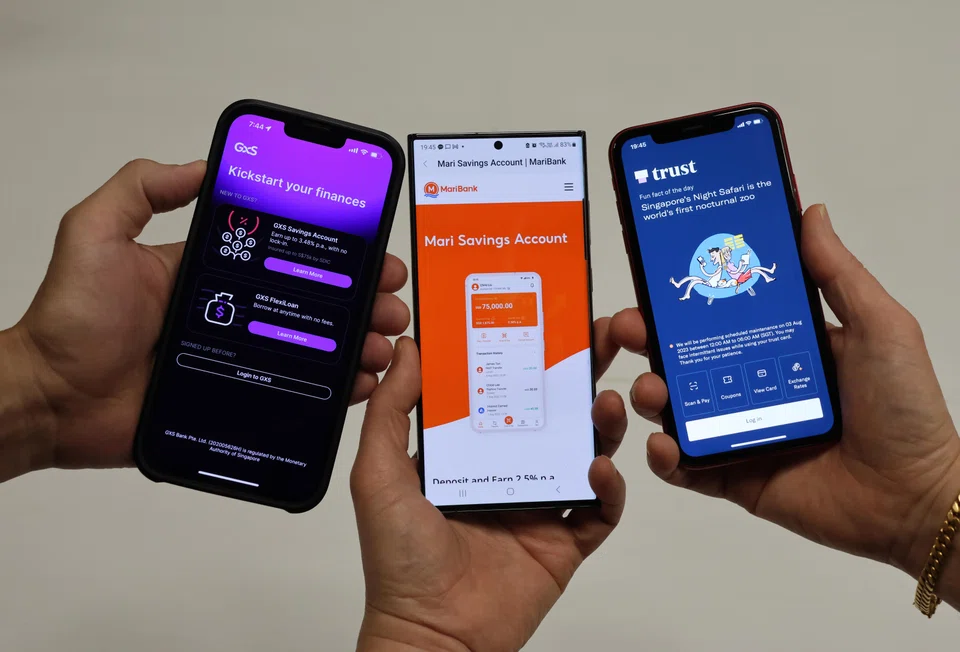
TIME flies and it has already been four years since the digital retail banks in Singapore were awarded their licences. With the initial hype behind them, both GXS bank and MariBank have a tough race against the clock to improve their financials, if they are to become full-fledged digital retail banks.
GXS and MariBank are the main players on the local scene. Others include Trust Bank, which already operates as a full bank. There are also Anext Bank and Green Link Digital Bank, which are wholesale banks serving only businesses.
In its responses to frequently asked questions about the digital bank framework on its website, the Monetary Authority of Singapore (MAS) states its preference for applicants with an earlier break-even year in their financial projections.
While the regulator did not specify a definitive time period to break even, it is understood that digital banks are expected to phase in corporate governance requirements – like a board with a majority of independent directors – by the fifth year.
In fact, MAS has stated that it expects GXS and MariBank “to be fully functioning and to meet the minimum paid-up capital of S$1.5 billion within three to five years from commencement of business”.
However, the two banks are a long way from meeting these capital targets.
Currently, MariBank has only S$480 million in paid-up capital, far below than the S$1.5 billion expected. GXS is in a better position, with about S$1.1 billion in paid-up capital, just slightly over S$400 million shy of the mark.
Of the two, GXS’ backers – Singtel and Grab – have made a shareholders’ resolution to inject capital totalling S$374.6 million into the bank in two tranches this year. While MariBank’s backer – Sea – last injected capital in December 2023, its numbers are still a far cry from the S$1.5 billion threshold.
These capital requirements can be easily funded by both Grab and Sea, with cash reserves in the billions at the end of 2023. However, against the backdrop of the scale of their operations and the level of competition in the region, it could make parting with a significant chunk of their war chest a hard ask.
Sea is still engaged in the fight for e-commerce supremacy in South-east Asia via its subsidiary, Shopee. Notably in Indonesia, TikTok Shop is still a threat after merging with e-commerce platform Tokopedia.
It is also in Indonesia where Sea has been hit with an antitrust investigation over its logistics arm, SPX Express, built to take on logistics for Shopee. Shopee has since made changes to appease Indonesia’s antitrust agency, KPPU.
Sea’s first-quarter 2024 results also show losses, with e-commerce a loss leader among the business units. While Sea’s chief executive officer Forrest Li said the the company is on a “clear road map to profitable growth”, the e-commerce fight is still likely to require more capital for the road ahead.
Similarly, Grab is also grappling with turning profitable, with its latest Q1 2024 results also showing a loss. Although losses narrowed to US$115 million in Q1 2024 from US$250 million in the year-ago period, costs continue to drag Grab’s bottom line down.
In Indonesia, Grab is still facing off with GoTo, notably with Gojek’s ride-hailing and food-delivery businesses. While both Grab and GoTo are striving towards profitability, capital is still required to maintain their current market positions.
The digital banks themselves are still operating in a startup phase.
Neither GXS nor MariBank is currently profitable. According to regulatory filings pulled by data platform Handshakes, both have reported growing revenues, but losses have been growing in tandem as well.
MariBank’s latest financial statements showed 2023 total income grew to S$10.1 million, up from S$1.6 million in 2022. Losses grew to S$52.2 million in 2023 from S$40.5 million in 2022.
The digital bank opened its doors to Sea ecosystem customers only in March 2023, with it having been only available to Sea employees in the preceding year.
Similarly, GXS’ latest financial statements showed total income rose from S$5.1 million in 2022 to S$16.1 million in 2023. Losses, too, widened from S$131.1 million in 2022 to S$208.2 million in 2023.
Expenses have grown as the banks need to spend on marketing to establish their brand and invest in IT systems. On the other hand, competition among banks remains fierce.
As GXS and MariBank prepare to step up to operate as full digital banks, the real test will come in how fast they can reduce losses and turn profitable.