

Is S'pore ready to go cashless with NIRP?
Advances in cashless payment technology here have expanded the space in which interest rates can be reduced without causing disruptions in consumer banking.
ON MARCH 10, the European Central Bank (ECB) cut its interest rate further to -0.40 per cent. Earlier this year, on Jan 29, the Bank of Japan (BOJ) stunned markets with a surprise move to negative interest rates. So far, five central banks have adopted the negative interest rate policy (NIRP): the BOJ, ECB, Swiss National Bank (SNB), Danmarks Nationalbank (DN), and Sweden's Sveriges Riksbank (SR).
Therefore, zero does not seem to be a lower bound for central banks' policy rates. However, a recent study by the Bank for International Settlements (BIS) noted that there would be "great uncertainty about the behaviour of individuals and institutions if rates were to decline further into negative territory or remain negative for a prolonged period".
Why negative interest rates?
While all the central banks are faced with challenging macroeconomic conditions, the objectives for adopting NIRP are different across the central banks. As the BIS report summarised, "in some cases the central banks' declared objective was to counter a subdued inflation outlook, while in others they focused on currency appreciation pressures in the context of bilateral pegs or floors on their exchange rates".
How does a cashless society facilitate NIRP?
Theoretically, NIRP causes money to depreciate if it is kept with the bank. In such a scenario, the most profitable way of holding money is to withdraw it from the deposit accounts and keep the cash under a mattress to earn zero per cent interest. In reality, such bank runs have not happened in the countries adopting NIRP. Two reasons could explain this.
First, households' preferences between holding cash and other forms of money, such as deposits or credit cards, are associated with the costs of transacting using each form of money.
The costs associated with transacting using cash only are higher in practice than in theory. For example, it costs money to store cash securely. Paying bills over the counter using cash also is not entirely free of charge. In the Scandinavian countries, many bank branches are currently cash-free, and transactions involving a large amount of cash are checked for plausibility.
Since cash transactions are not as frictionless as in theory or as their electronic alternatives, there is more room for manoeuvre in the central bank's policy rate. In special circumstances, the interest rate may venture into negative territory by the extent to which the costs of deposits do not exceed the costs of cash transactions.
Second, in a cashless society, customers are not able to withdraw their money as cash in the scenario of negative interest rates. Their only choice is to spend it or let the bank take it.
In an article, Kenneth Rogoff, professor of economics at Harvard University, pointed out that phasing out paper money enables central banks to set interest rates that are sufficiently negative to boost the economy. The theory is that negative rates stimulate spending, which in turn spurs economic growth.
A glance at the money supply data from the central banks reveals that the countries adopting NIRP mostly have very low proportions of cash among the most liquid components of money supply, M1 (which includes demand deposits, checking accounts and negotiable order of withdrawal accounts in addition to cash). In particular, in January, Sweden had the lowest cash in circulation to M1 money supply ratio of 3.0 per cent, followed by Denmark (5.8 per cent), Switzerland (13.5 per cent), Japan (14.4 per cent) and the eurozone (15.6 per cent). It should be noted that some euros are not circulated in the eurozone but elsewhere in the world, and thus the figure could be inflated.
"In Sweden - which became the first European nation to issue banknotes in 1661 - even homeless street vendors take electronic donations now," said Patrick Carvalho in an article in Business Spectator.
Turning into a cashless society
Singapore launched the National Campaign to Minimise Cash Transactions in March 1985 to encourage Singaporeans to carry out their transactions electronically. The three goals at that time were "to encourage Singaporeans to receive their pay through direct credit to the bank, to persuade them to pay their bills electronically via General Interbank Recurring Order (GIRO), and thirdly to promote payments through the Electronic Funds Transfer at Point of Sale system (EFTPOS)".
Subsequently, Network for Electronic Transfers (NETS) was launched in January 1986. This was seen as a milestone in Singapore's drive to become a cashless society.
More recently, following the initiation of the Smart Nation project in November 2014, the Monetary Authority of Singapore (MAS) committed S$225 million over a five-year span from 2015 to provide support for the creation of a vibrant financial technology (fintech) ecosystem.
In a keynote address titled A Smart Financial Centre at the Global Technology Law Conference 2015 last June, MAS managing director Ravi Menon emphasised that Singapore needs to promote greater adoption of new payment technologies. "The aim is to make payments swift, simple and secure. The vision is less cash, less cheques, fewer cards," he said.
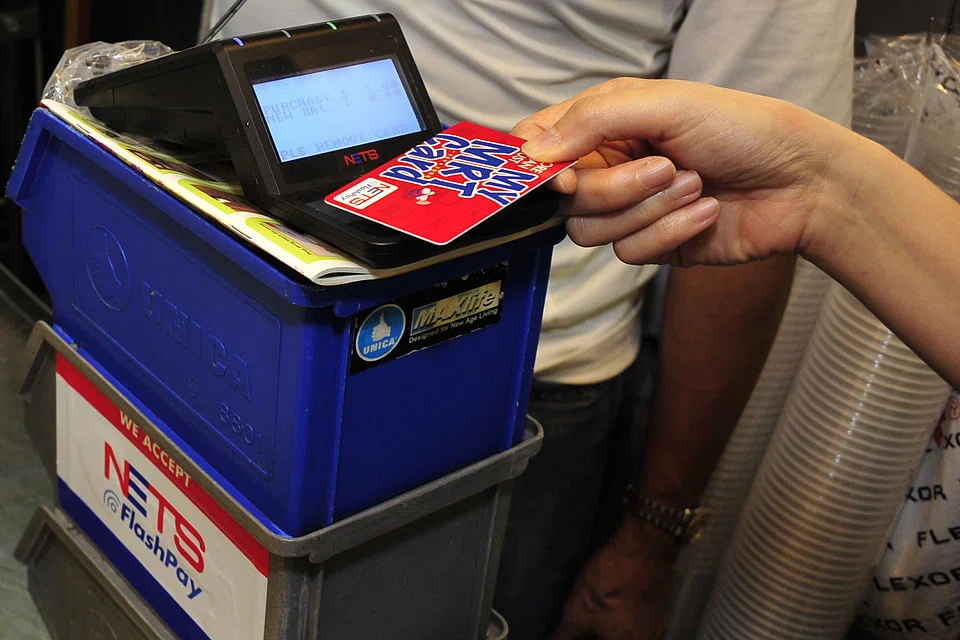
Today, NETS FlashPay, EZ-Link and credit card payment machines are ubiquitous, especially in convenience stores and food courts. These facilities enable customers to make payment via simple taps.
At the same time, costs of cash transactions are obvious when cashless facilities are easily accessible. One may conveniently avoid additional charges for topping up EZ-Link cards and CashCards at 7-Eleven stores by doing it at self-service machines in many car parks, Mass Rapid Transit (MRT) stations, at auto teller machines (ATMs) or even with mobile phones. One also realises that paying bills via Internet banking may save time and money on trips to the post office. Paying small bills with a card in a convenience store or a food court even saves one the trouble of counting and carrying coins.
Overall, Singapore's efforts in transforming into a cashless society have been gradual and effective. Official data from MAS shows that cash in active circulation within the M1 money supply declined steadily in the 1990s and has stabilised in recent years.
While the primary objective of going cashless is to increase productivity, this prudent move also has the added benefit that the central bank has more flexibility when responding to foreign policy changes.
Implications for Singapore's monetary policy
Singapore adopts an exchange rate policy rather than an interest rate policy. As most of the country's consumer goods are imported, adjusting the exchange rate is a more straightforward way to manage inflation in a small and open economy.
MAS has effectively given up control of domestic interest rates. Instead, interest rates here are mainly determined by US interest rates and investors' expectations of the future movement of the Singapore dollar.
This implies that Singapore should be prepared for any interest rate shock from the US, including a negative federal funds rate.
Comparing Singapore's degree of cashlessness with that of other countries already adopting NIRP, one finds that Singapore has a higher cash-to-M1 ratio than the eurozone (15.6 per cent), but a more conservative comparison should be done with Japan, due to the fact that some euros are kept outside the eurozone. In January, Singapore's cash-to-M1 ratio (22.0 per cent) exceeded Japan's (14.4 per cent) by 7.6 percentage points - not a negligible difference.
In fact, notes and coins are still widely used in Singapore. The extremely low crime rate here makes carrying cash safe. It is also easy to withdraw cash from ATMs. In some cases, merchants prefer to avoid fees charged by banks for electronic payments.
However, compared with 20 years ago, the cash-to-M1 ratio in Singapore has fallen markedly from 48.3 per cent in January 1991 to the current level of 22.0 per cent. Cash in circulation increased abruptly in the 1997-1998 Asian financial crisis, but in the 2007-2008 global financial crisis, the change in demand for cash was not as high. Advances in cashless payment technology and the consequent smaller dependence on cash holdings have greatly expanded the space in which interest rates in Singapore can be reduced without causing disruptions in the consumer banking sector.
Thus, in terms of the degree of cashlessness, Singapore may not be as ready to enter a negative interest rate environment as Japan and the European countries, but its capacity in responding to foreign monetary shocks has certainly improved over the past two decades.
As much as Singapore welcomes a cashless society, it should not rush into it for the sole purpose of tackling negative interest rates. Alternative markets that facilitate anonymous transactions (for example, Bitcoin) associated with illegal activities may arise as a safe haven against any misuse of monetary policy by a central bank if cash is abolished too fast.
There are also other factors that need careful consideration. For example, financial derivatives that were invented with the assumption of positive interest rates might need to be redesigned.
TRENDING NOW
Easy to rent out, hard to sell: Are buyers losing interest in Singapore’s one-bedroom condos?

GovTech retrenches another 38 staff in second round of layoffs

Stocks to watch: Seatrium, CapitaLand Investment, Keppel DC Reit, Suntec Reit, CLCT, TSH Resources

World’s largest offshore wind platform by Seatrium consortium on track to be completed by 2028

