

Sunak’s government reverts to Johnson era
Apart from appointing several ministers who served under Boris Johnson, the new UK PM has also framed his future success through the lens of his party’s 2019 election win.
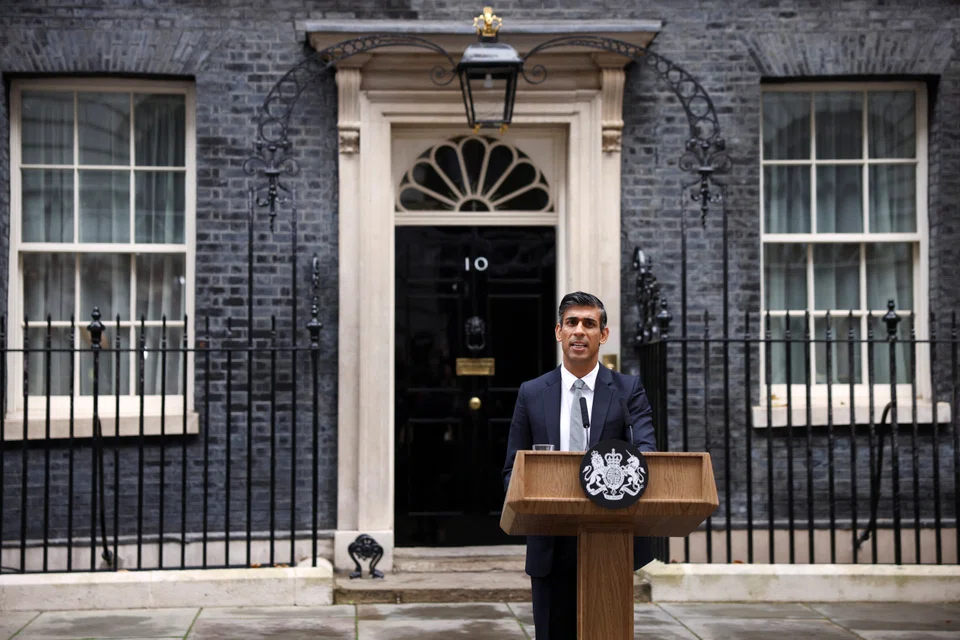
WHILE Boris Johnson failed to become prime minister for a second time in recent days, his huge political shadow looms large over new premier Rishi Sunak’s government.
More than a dozen cabinet ministers in Sunak’s new team are holdovers from Johnson’s governments from 2019 to 2022, a significant number of whom were in “political exile” under Liz Truss’ administration. Dominic Raab (who becomes deputy prime minister and justice secretary); Michael Gove (levelling up secretary), Oliver Dowden (cabinet office minister), and Ben Wallace (defence secretary) occupy the same roles as in Johnson’s last cabinet.
Other ministers who served in Johnson’s top team who are now in new cabinet jobs include Sunak himself; James Cleverly (now foreign secretary); Grant Shapps (business secretary); Gillian Keegan (education secretary); Therese Coffey (environment secretary); Steve Barclay (health secretary); Nadhim Zahawi (Conservative Party chair); Penny Mordaunt (leader of the House of Commons), Robert Jenrick (immigration minister), Gavin Williamson (minister without portfolio) and Suella Braverman (home secretary).
A significant number of these appointments hold political risk and leave a question mark over Sunak’s political judgement. The standout example here is Home Secretary Braverman, who resigned from this very same post last week in Truss’ government, having self-declared to committing a significant breach of the ministerial code.
There are also a number of absences that hold potential risk too. COP president Alok Sharma, for instance, has been demoted from cabinet, despite the next climate summit being next month in Egypt.
Sharma is unhappy with this, and rightly, said on Tuesday (Oct 25) in parliament that the Sunak team must now “explain and demonstrate” how new oil and gas exploration is in line with its net-zero climate commitments. Sharma said he did not support fracking, and criticised the 100 new UK licences for offshore oil and gas recently awarded.
In so doing, he highlighted a warning from the International Energy Agency that there can be no new fossil fuel projects if the world is to meet its goal to limit global warming to 1.5 deg C, beyond which the most dangerous impacts of climate change will be felt. Sharma, who will negotiate on behalf of the United Kingdom at COP27 next month, also said that the pace of renewables and installation acceleration must be faster.
Beyond Tuesday’s ministerial appointments, there is a deeper way too in which Johnson’s influence extends widely over Sunak’s government in a way that wasn’t so of Truss’. In his first speech as prime minister on Tuesday, Sunak drew great attention to Johnson’s “incredible achievements as prime minister” and insisted that “he will deliver on the promise of the (2019) manifesto”.
What is clear from that is that Sunak sees the success, or failure, of his government resting to a large degree on realising the vision that Johnson espoused at the 2019 election. In Sunak’s eyes, this includes “realising the benefits of Brexit”, and one of his key pledges is scrapping or reforming all EU law still on the UK statute books by the next general election.
While Sunak’s government is unlikely to implode in the same way as Truss’, he has a massive political hill to climb, and his plan appears to try to last the course till 2024 before holding a general election. A 2023 ballot cannot be ruled out, but like other previous prime ministers who take over in midterm, he appears to want to give himself sufficient time to establish himself before going to the polls.
Sunak is well aware that he must now hit the ground running in a perilous political environment where public opinion is sceptical of him and his government. The fact that he will probably not enjoy a “honeymoon” in Downing Street is shown by a YouGov opinion poll released on Tuesday, which found that 56 per cent want an early general election. Sunak knows that no party in modern political history has won five elections in a row, and he must try to do this in the context of a divided Conservative Party, high inflation, rising interest rates, anticipated significant further cuts in government spending, plus the ongoing war in Ukraine.
So he has a huge challenge ahead of him, and he does this in a context where Johnson (and indeed the wide number of ministers leaving office on Tuesday) could become significant political thorns in his side. A number of big “political beasts”, including Truss herself, could now be openly critical of Sunak’s agenda.
Especially if he remains an MP, Johnson has the clear potential to haunt Sunak when he makes political mistakes, as he surely will. Johnson remains very popular among Conservative members, more so than the new prime minister and any other politician in fact, and it is therefore plausible that he may try to run again for the Conservative leadership in the future, especially if his successor is perceived to “fail” by party members.
In the last century, four people have served second periods in Downing Street after losing an election. It absolutely cannot be ruled out that Johnson might be the fifth such person to achieve this feat.
What makes Johnson’s presence potentially potent is that he was turfed from Downing Street not by losing a national ballot. Instead, he was deposed in an internal party vote, which may be regretted by increasing numbers of Conservative Party members if the new PM underwhelms in office.
For Johnson to have a serious shot at a comeback, it may also be necessary for a wider slice of Conservative MPs and the electorate as a whole to become less negative about his legacy from 2019 to 2022. For instance, an Ipsos survey released over the summer showed almost half the UK public was of the view that Johnson had done a bad job as prime minister, the worst rating of any post-war leader.
Asked to rate British prime ministers since 1945, some 49 per cent of people said that Johnson fared poorly during his time in Downing Street. This rating is worse than both his immediate predecessors, with around 41 per cent of people thinking Theresa May had done a bad job, the second-highest total, while David Cameron’s 38 per cent was the third-highest.
Taken together, this is why Sunak’s prime ministerial inheritance is so potentially politically poisonous for him. He has framed his future success through the lens of the party’s 2019 win, yet this could yet come back to haunt him, with Johnson potentially becoming his most significant critic.
Andrew Hammond is an associate at LSE IDEAS at the London School of Economics.
TRENDING NOW

SoftBank’s Son plans US$50 billion Malaysia tech outlay: Anwar Ibrahim

Singapore expects all parties to honour commitments, says PM Wong after Indonesia cuts gas exports

Gas Supply may pursue remedies if contract breached following Indonesia’s export cuts: Tan See Leng

Why the biggest business decision about AI isn’t which model to choose

