

Tech-enabled coffee chains eyeing Singapore as prized battleground for supremacy
Such coffee chains are pouring into Singapore, but missteps could turn startups into ‘has-beans’

IN 2016, Alibaba founder Jack Ma coined the term “new retail” to describe how the blending of the physical and digital worlds was creating a new experience for consumers.
Two years later, technology-driven coffee chains became a hot favourite of venture capitalists. Luckin Coffee, founded in Beijing, was a poster child for how quickly a food and beverage brand could grow by weaving tech into every aspect of the business.
Luckin went public in New York in 2019 at a valuation of US$4.2 billion, barely two years after it started operations. Since then, the model has inspired a number of coffee chains in South-east Asia, such as Kopi Kenangan in Indonesia and Flash Coffee in Singapore.
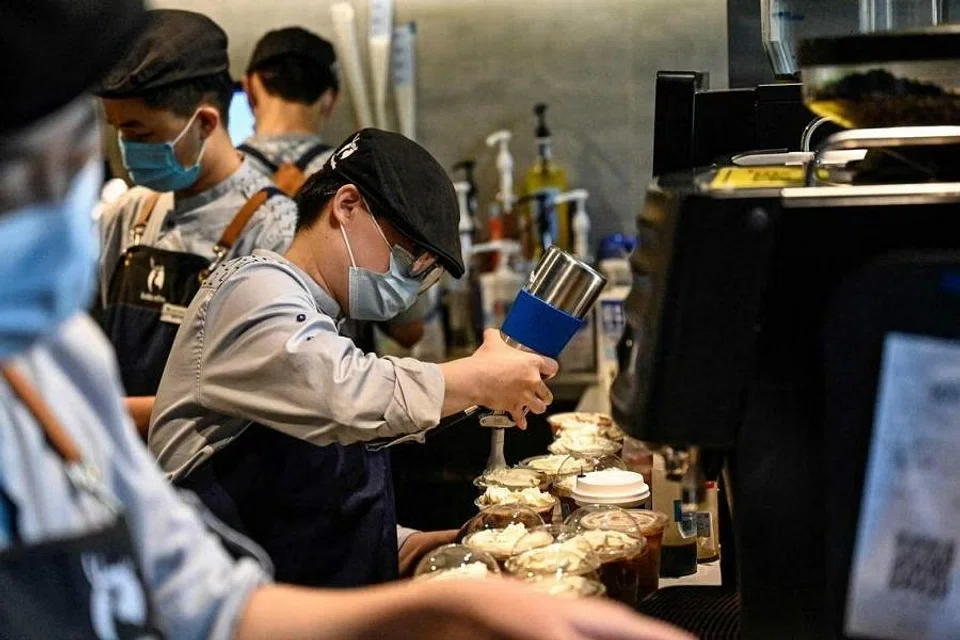
These businesses maintain a physical storefront, but orders are taken through a mobile app for pickup or delivery. This allows the company to reduce staff costs, and enhance the user experience by marketing new deals and products directly to consumers.
Retail data and user trends are tracked to assess the performance of each store, and allow the company to constantly iterate.
The starkest feature of this model is how rapidly each brand tears through the retail scene. Luckin overtook Starbucks as China’s biggest coffee chain within two years. It opened 2,963 stores in that time, almost half the stores Starbucks opened in China over two decades.
South-east Asia’s own upstarts have ambitions of conquering the region in a similar fashion – and their next big prize is Singapore.
Kopi Kenangan is gearing up for a Singapore debut after becoming Indonesia’s largest coffee chain, with about 850 stores across 45 cities.
Its regional competitors Fore Coffee and Filipino brand Pickup Coffee may also enter Singapore, while locally-headquartered Flash Coffee in May raised US$50 million to fuel its expansion.
Luckin already has 12 stores in Singapore after entering in March, in its first overseas opening. It might not be long before Chinese competitor Cotti Coffee, started last year by Luckin’s founding team, follows suit.
Singapore has a small population compared with the rest of South-east Asia, but it ranks among the world’s top coffee-drinking countries. The city-state consumed 122.7 litres of coffee per capita in 2022, according to analytics company GlobalData.
Companies like Kopi Kenangan and Pickup Coffee are aiming for the mass consumer segment below Starbucks and artisan coffee, and above the traditional Nanyang-style kopi that is a staple for many residents.
These brands have thrived on a careful blend of clever pricing and creatively-crafted drinks. In Singapore, the cost of a 16-ounce Americano from Luckin starts from S$4.80; its best-selling coconut latte starts at S$6.40.
Consumers can get their first drink at S$0.99, and receive perks for referring the brand to friends and family.
These aggressive venture capital-fuelled strategies could suck consumers in quickly, but reckless decisions could turn the coffee battle into a price war.
Luckin’s own journey showed that the unfettered expansion model does not work. The company took money from some of the world’s biggest investors and splashed it on discounts, opened stores at breakneck speed, and compromised the quality of its brew.
In 2020, its top executives were found to have inflated 2.2 billion yuan (S$411.3 million) in sales. Luckin was forced to delist in June that year.
Chinese and US regulators fined the company, which also had to settle lawsuits from creditors and shareholders.
It narrowly escaped a bankruptcy collapse and made a comeback last March after overhauling the business and management team.
In 2022, it grew net revenue 66.9 per cent to 13.3 billion yuan. It also recorded its first operating profit of 1.2 billion yuan, a reversal from an operating loss of 539.1 million yuan the year before.
Net profit was 488.2 million yuan, lower than 2021’s 578.7 million yuan, which the company booked after a one-off accounting gain.
Luckin’s shares, which have continued to trade as American depositary receipts over the counter, have gained nearly 250 per cent in the last 18 months, giving it a valuation of US$9 billion.
Some market watchers have dubbed the restructuring a “miracle comeback”. The dramatic overhaul of China’s largest coffee chain shows how much it takes to build a cash-generating business.
Flash Coffee, for instance, was forced to close several stores in Taiwan this year when it could not live up to the competition, local reports said.
Singapore could be an important litmus test for South-east Asia’s players. The market’s revenue per unit is attractive, but overheads are high.
Companies hoping to secure a foothold will have to pay attention to store management and supply-chain costs in order to keep a lean cost structure and get the kind of positive unit economics Luckin was able to achieve in China.
Beyond trying to improve quality control, price products sensibly and build a credible brand, Luckin has experimented with a mix of direct management and franchising models.
It remains to be seen how the new brands will differentiate themselves in Singapore. Companies often suffer a quick death when they fail to localise, and Singapore coffee-drinkers are savvier than most.
Kopi Kenangan, which is expanding internationally as Kenangan Coffee, thrived in Indonesia because of its social media virality and meme-inspired drinks. Singaporeans may not bite.
Nevertheless – especially after tech investors poured US$373 million into the region’s coffee chains, based on Preqin data – the battle in Singapore will be one to watch.






