The future of SPH Media - it isn't enough to be trusted


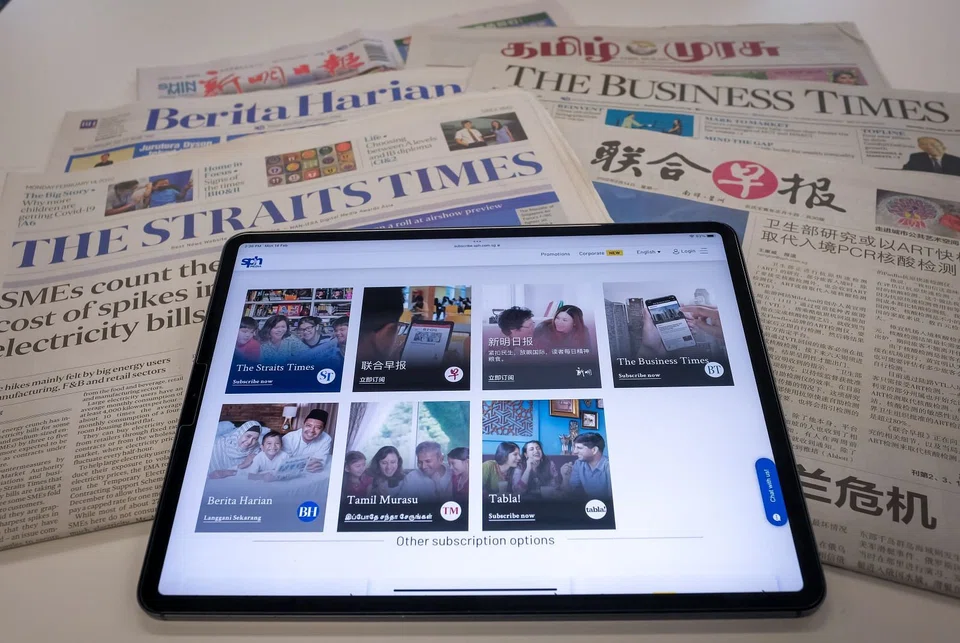
IT has been more than 3 months since Singapore Exchange-listed Singapore Press Holdings (SPH) fully transferred its media arm to the new SPH Media Trust (SMT), letting go of an increasingly less profitable business operating in a tough environment.
Since then, in the course of our work on audience strategy at The Business Times (published by SMT), we've come to realise the true scale of the challenges set before this new entity.
Better-resourced social media giants have vacuumed up ad dollars, and consumers prefer to spend their money on online streaming platforms like Netflix.
A 2019 digital news study by the Reuters Institute at Oxford University found that regardless of wealth or education, most people are willing to pay for only 1 news subscription. The study suggested only a "small handful" of current news publishers would attract enough paying subscribers to survive.
How can SMT make sure it is in that "small handful"? The short answer is, of course, innovation.
A staid, comfortable monopoly
Singapore's founding prime minister Lee Kuan Yew had once foreseen the need for innovation, expressing concerns about the fate of print journalism as readers moved online.
According to Cheong Yip Seng, former editor-in-chief of SPH's English and Malay Newspapers Division, Lee had asked in 1999 if SPH had plans to meet this "information revolution".
But how does this sit with the tone for the local press he set out in 1971?
Local media, Lee said, should explain Singapore's problems "simply and clearly" and show how they can be solved by government policies. More importantly, it should "reinforce, not undermine" values taught in schools; and press freedom "must be subordinated" to the elected government's purpose.
The 1974 Newspaper and Printing Presses Act (NPPA) would entrench these ideals, giving the government the final say on the ownership and publication of news.
This in effect limited the number of market players. Together with Mediacorp, which focused on broadcast media, SPH covered all that was news in Singapore.
Whether or not we agree with Lee's intentions, the environment he created encouraged rigidity and "playing it safe" rather than risk-taking or innovation.
Beyond just a culture of not rocking the boat, the NPPA also had a direct hand in creating the monopoly SPH enjoyed for many years.
The need to innovate was lessened by the fact that there was no real competition. But today, not innovating is a death sentence.
Is being trusted enough?
Since the creation of SMT, its leaders and the government have rightly argued that investment is now needed to fill urgent gaps in digital infrastructure and talent.
But sustained innovation goes beyond just having the right tech and people.
SMT's greatest and most fundamental challenge is the same as any company's: How to get people to buy its products.
There is clear value in being a trustworthy source of news amid the confusion, fatigue and dangerous dis-information caused by the sheer ubiquity and volume of digital information.
Trust is, after all, why the government is spending taxpayer dollars to support SMT, Minister for Communications and Information Josephine Teo told Parliament last month.
"The Government's key interest is to ensure the reach of SMT's products. No one gains if these products lack credibility and are ignored by audiences," she said.
"We are funding them precisely because they do have readers who trust them," Teo added, citing a 2021 Reuters Institute report that said SMT's flagship The Straits Times enjoyed a high level (77 per cent) of trust among respondents.
But trust does not necessarily translate into subscriptions.
Consider SMT's direct rival, Mediacorp, which taxpayers already help fund. Its products are completely free, and are just as, if not slightly more, trusted. The same report cited by Teo put the level of trust for CNA at 79 per cent.
Why should anyone buy from SMT when another product fulfils the same need for free?
Truly serving the public's interests
Some might say we should take the easy way out by asking the government to fund SMT fully. Why insist on paid subscriptions, when the conditions are so challenging?
Part of it is, as SMT's leadership has argued, about being self-sustaining financially.
Ted Sarandos, Netflix's co-CEO, has famously defended the company's subscription model and criticised ad-centric television because of the alignment of interests.
Similarly, reducing our reliance on both ads and the government helps us stay credible and honest to the people who truly matter - you, our users and customers.
Content, as Sarandos says, should be paid for by the people who want to consume it.
But for this reader revenue-driven business strategy to succeed in the digital era, SMT must model itself after consumer tech companies - including successful ones in media such as the New York Times or Financial Times.
First, it needs to deliver a best-in-class user experience.
This means it needs to develop expertise in product development, software engineering and digital marketing. Its internal culture must become data-informed and consumer-centric. It needs to nurture an environment that encourages experimentation and learning from failure, as core to its DNA.
Second, it needs to address its value proposition. Where Netflix will ask itself what is good entertainment, SMT needs to ask itself: What is good journalism?
To do that, there needs to be a consumer-focused mindset. Publishers must go to consumers - not just in the literal sense of the platforms they use, but also in terms of the fears, needs and thoughts that occupy their minds.
Since SMT's customers are primarily Singaporeans, our public mission must be reimagined. We must speak directly to the interests of the public - above those of advertisers or, no matter how well-intentioned, the government.
Singaporeans want to see themselves in the news that they read; they want their thoughts and values to be reflected.
To stay relevant, we must ask the questions Singaporeans today want asked, and seek the answers to those questions fearlessly.
Beyond that, as SMT's customers become increasingly diverse both demographically and politically, so must our reporting reflect these diverse and alternative perspectives.
Instead of the closed-off, siloed echo chambers generated by algorithmised social media feeds, SMT can provide real differentiation by holding space for that lost public forum where true, informed debate is valued.
After all, what is a good newspaper if not - as the late American playwright Arthur Miller put it - "a nation talking to itself"?
The title of his well-loved play, The Crucible, also explains the benefits of this national conversation.
Let SMT's products re-occupy their unique role as a national crucible of ideas, where different perspectives can be subjected to the heat of free and rigorous debate.
And when the Singapore conversation and spirit are strengthened, and a national consensus forged through this crucible, therein lies the answer to SMT's purpose.
- The writers are editors at The Business Times working on audience strategy and transformation, including improving user experience and subscriptions.