

Timely for Singapore groups to capture property opportunities in China

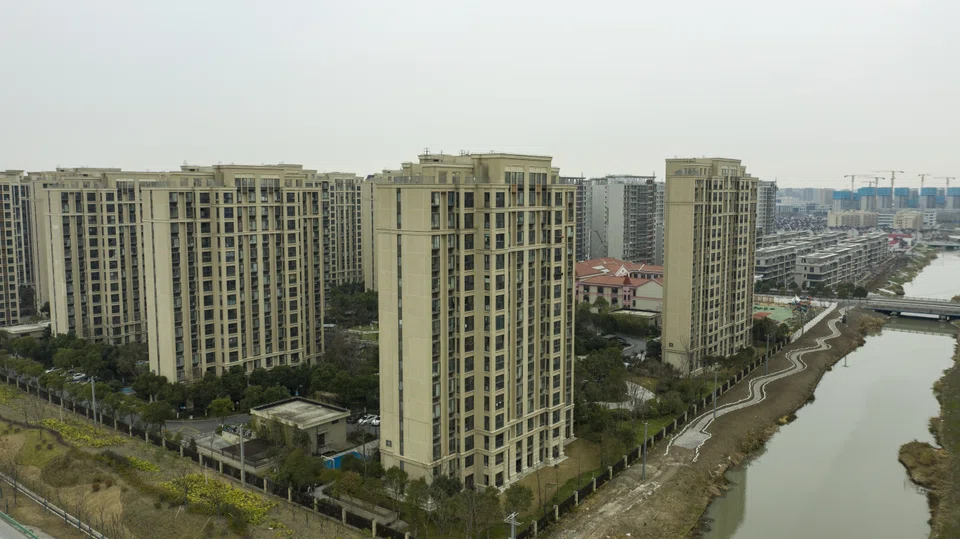
CHINA’S real estate sector appears to be teetering. Debt-laden developers such as China Evergrande Group have been grappling with liquidity problems as financing dries up.
With lockdowns, home buyer confidence is rattled and agents are unable to get potential buyers to visit show flats and close deals. Construction of projects stall, with project completions delayed.
New home sales in 23 major cities tracked by China Real Estate Information fell 33 per cent by area during the 5-day national holiday in May compared with a year earlier. Combined sales of homes by the top 100 developers has halved in the first four months of 2022.
Many developers are starved of cash inflows from new sales, while facing refinancing issues from maturing loans and bonds.
Singapore-listed performed credibly in 2021, with net profit up 2 per cent year-on-year (yoy) to 2.66 billion yuan (S$0.55 billion). But the group, which is active in property development and investment in China, sounded cautious on its China business when responding to queries received from shareholders ahead of its annual general meeting (AGM) in late April. The group said there are challenges ahead in view of possible disruptions in supply chain and market sentiment due to the Covid-19 situation, adding that it will manage its business cautiously.
, which owns outlet malls in China, saw distribution per unit rise 3.6 per cent yoy in Q1 2022. But outlet sales fell 3.6 per cent yoy in the first quarter, and the trust’s manager noted that weaker buying sentiments due to the outbreak of Covid-19 resulted in lower sales in April and early May.
Should Singapore-based players slow down on China expansion plans given the woes plaguing the Chinese real estate sector?
Driven by urbanisation and robust economic growth, China’s real estate industry has been developing rapidly for the past few decades.
Perhaps, China’s ongoing efforts to curb speculation in its housing market will lead to a more sustainable market in the long run. Also, the Chinese authorities may look to ease their policy stance on the housing market.
Opportunistic acquisitions
In recent years, many Chinese groups have acted aggressively in land bids, making it tough for foreign parties to acquire sites. But some Chinese players are now retreating from making new investments and busy selling assets to strengthen balance sheets.
Perhaps, it is opportune for Singapore players to take advantage of the financial weakness of some Chinese players to buy development sites and investment properties.
Responding to shareholder queries submitted ahead of its AGM in late April, (CLI) said it remains long-term positive on China, premised on China’s ‘Two Sessions’ policy announcements that call for supportive pro-business and pro-consumption stimulus to steer economic and employment growth, while addressing concerns over the real estate sector and its capital markets.
CLI believes that its China property portfolio’s resilience is helped by being diversified across geographies and asset classes. The group expects that the current headwinds may generate interesting counter-cyclical and opportunistic investment themes.
In a conference call in April on Keppel Corporation’s Q1 2022 business update, Keppel Land’s chief executive officer Louis Lim noted that while the China market is going through quite a bit of uncertainty, the group see opportunities in the market going forward. He said: “the local developers are a little bit more prudent, so that also gives us an opportunity to put equity with them on projects in China”.
In April, CapitaLand Development said it had secured one site each in the Chinese cities of Wuhan and Chengdu for a total of 3.49 billion yuan. The developer is looking to construct 1,581 homes on the two sites, with construction expected to start this year. It wants to create quality and affordable homes, and is targeting first-time home buyers and upgraders.
Wuhan is the capital of Hubei Province and the largest city in central China, with a population of more than 12 million people. Chengdu is the capital of Sichuan Province and home to more than 20 million people.
Tough market
China is the world’s second-largest economy. For many foreign property players, this is not a market to be ignored. However, many Singapore groups may be unable to build scale there. Also, there are tales of travails that have befallen some groups.
In 2019, (CDL) unveiled its transformational investment in China-based Sincere Property Group to accelerate growth in China. By investing in Sincere, CDL would expand its geographical presence from 3 to 20 cities in China and get exposure to a much larger development pipeline.
However, Sincere faced liquidity problems. For financial year 2020, CDL booked a S$1.78 billion impairment for losses attributable to Sincere - effectively writing down 93 per cent of its total investment in Sincere. In 2021, CDL exited its troubled investment in Sincere for a consideration of US$1.
Venturing overseas helps Singapore-based property groups diversify and offers additional growth opportunities, especially as the home market is small, competitive and fragmented.
But, there are major challenges to building a strong team on the ground and achieving scale in an overseas market. In many places, sizable capital investment, in-depth understanding of the local terrain, building of strong relationships with local authorities and other stakeholders, and long-term commitment are needed for the business to succeed.
CapitaLand Development can count on nearly three decades of experience in the China market, where it has developed and operated business parks, integrated developments as well as residential, retail, office and lodging properties.
Going forward, the China property market may continue to be attractive to Singapore-based groups, which have built up expertise there through the years.
While many people in China have met their housing needs, there are large numbers who seek to upgrade to better homes. Tier-one cities such as Beijing, Shanghai, Guangzhou and Shenzhen as well as some provincial capital cities are likely to continue to draw dynamic and ambitious people, who move to these cities to pursue their dreams.
Even as China matures, there is room for select Singapore property groups to grow. Expect more counter-cyclical building up of land bank and asset purchases in China by these groups.
TRENDING NOW
‘The next 40 years’: SingLand CEO Jonathan Eu on remaking Marina Square

SGX gold-linked counters lose their shine as the precious metal hits one-year low
Peter Kwee’s Ridley Park bungalow on the market with S$100 million asking price

Alibaba sued for allegedly hiding ties to suspected spy Alice Huang from Megaspeed

