

Timely for SingLand to unlock value with a Singapore commercial Reit

Leslie Yee
SEVERAL property-related groups posted strong results for the half year ended June. City Developments Limited (CDL) achieved a record net profit of S$1.1 billion for H1 2022, reversing a net loss for H1 2021. CDL is paying a special interim dividend of S$0.12 per ordinary share.
The Straits Trading Company posted a 449 per cent year-on-year rise in H1 net profit to S$673 million. In the wake of its strong H1 results, the group declared a special dividend, distributing either ESR shares or Straits Trading shares to entitled shareholders.
UOL Group and its subsidiary Singapore Land Group (SingLand) saw year-on-year net profit rise 306 per cent to S$371 million and 290 per cent to S$360 million respectively. But both groups did not declare an interim dividend, which is in line with their practice of not declaring interim dividends.
Based on last year’s dividend and share price as at Aug 17, 2022, UOL and SingLand traded at dividend yield of 2 per cent and 1.4 per cent respectively. Such yield looks unappealing versus Singapore dollar fixed deposit rates of over 2 per cent for tenures of 18-24 months. However, shareholders of UOL and SingLand may want to temper hopes of receiving a much higher dividend for 2022 as profit for both groups was helped by fair-value gains.
A more pressing matter for UOL and SingLand is addressing their large discount to net asset value (NAV). Based on their share prices as at Aug 17, 2022, UOL and SingLand traded at discounts to end-June NAV of 39 per cent and 55 per cent respectively.
There is perhaps greater urgency for SingLand to unlock value for shareholders than UOL. Also, unlocking value at SingLand can be a precursor to unlocking value at UOL. Fortunately, SingLand has assets from which substantial value can be unlocked.
SingLand Commercial Reit
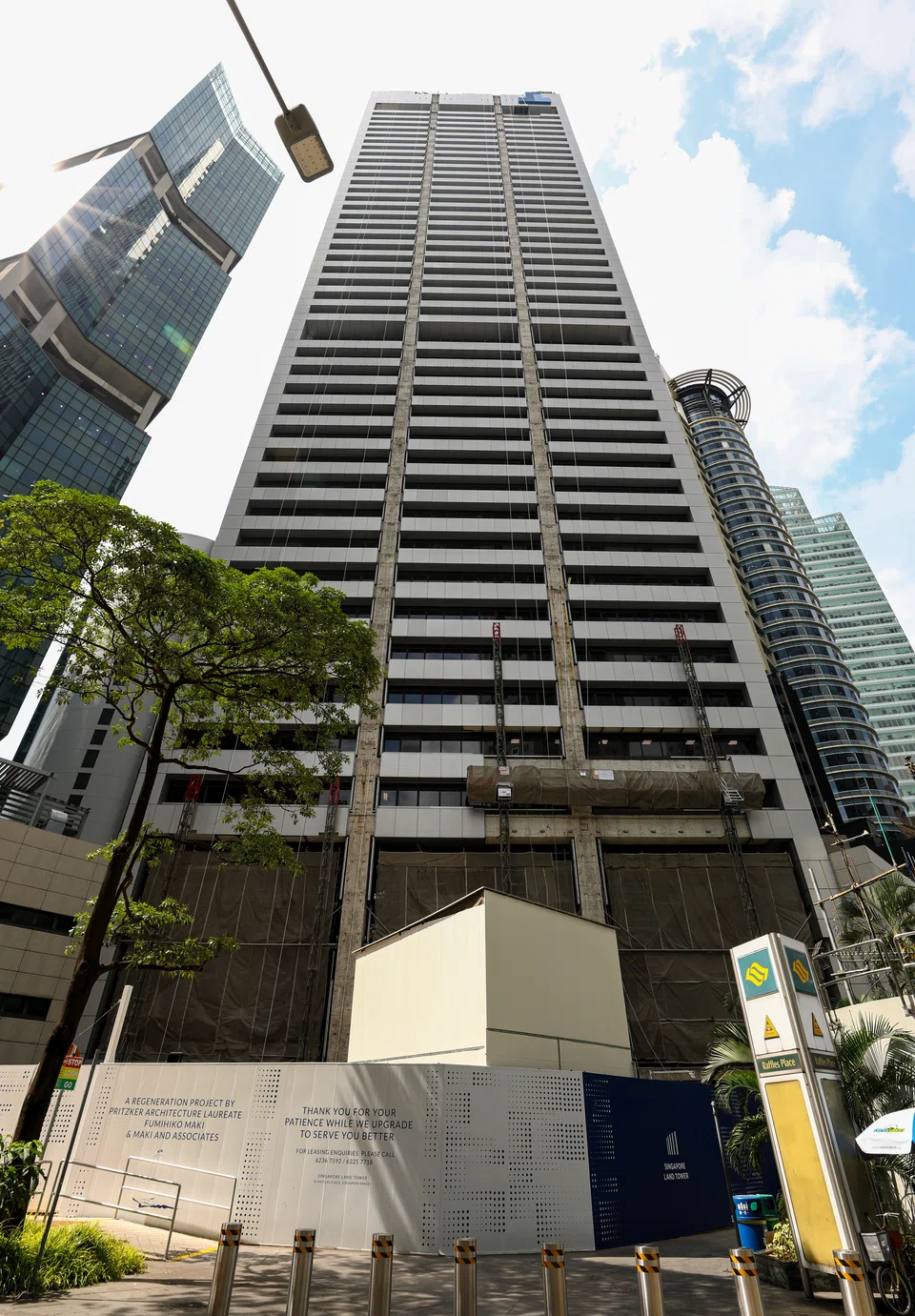
Investment properties, worth around S$6.6 billion, accounted for about 70 per cent of SingLand’s total assets as at end-June. An investor buying SingLand’s shares today is implicitly getting a share of prime office-centric buildings such as Singapore Land Tower, The Gateway, UIC Building and Clifford Centre at less than half-price.
The catch is that if one snares a physical property at a big discount to valuation, chances are one can sell the said asset for a good profit, whereas an investor who buys SingLand’s shares at substantially below NAV may see the shares persistently trade well below NAV. SingLand’s shares may be a value trap if there is no catalyst for the shares to re-rate.
On the local bourse, real estate investment trusts (Reits), which have regulations governing distribution payout, gearing level and scope of activities, typically trade at superior book value multiples versus asset-heavy property development and investment groups.
SingLand’s prime Singapore commercial property portfolio has enough scale to form a Reit. And the timing for SingLand to launch a Singapore-only office-centric Reit is opportune.
With the Republic’s post-pandemic reopening, workers have been returning to the Central Business District (CBD). Leasing demand for CBD Grade A office space is strong and broad-based, coming from tech firms, asset managers, insurance providers, legal firms and energy businesses. CBRE Research expects Core CBD (Grade A) office rents to grow 8.3 per cent for 2022, versus 3.8 per cent for 2021.
Recent new Reit listings have been led by trusts with overseas assets. The market here may welcome an initial public offering (IPO) of a Reit that owns Singapore assets, which local investors are familiar with, and assets in property segments with good prospects.
Privatising SingLand
UOL, where banker Wee Cho Yaw is a major shareholder, owns over 50 per cent of SingLand, while Filipino conglomerate JG Summit Holdings, led by the Gokongwei family, holds a deemed interest of about 37 per cent. SingLand’s free float is around 12.6 per cent, according to its latest annual report.
Perhaps a restructuring of SingLand can see the group’s Singapore commercial assets held by a listed Reit. If SingLand can list its commercial Reit at around NAV via an IPO, UOL and JG Summit may be happy to see their interests in the underlying assets diluted. UOL and JG Summit can form a joint venture to manage the said Reit.
Other assets of SingLand, such as hotels and overseas investment properties, can be retained by the group or sold. UOL can then privatise SingLand, which may be left largely holding stakes in properties under development. As it is, SingLand is UOL’s junior partner in several Singapore property development projects, including that of AMO Residence, which sold almost all its units by the first day of its launch in July.
Almost a year back, Jonathan Eu, who is a grandson of Wee, became chief executive officer of SingLand. Eu is leading a major asset enhancement initiative to upgrade and modernise the group’s flagship Singapore Land Tower in Raffles Place, with completion scheduled in 2023, as part of SingLand’s portfolio rejuvenation.
Rejuvenating assets by introducing green features among others is critical for SingLand to ensure that its assets meet the needs of today’s users. Concurrent with efforts to improve the quality of the buildings should be a strategic review by the board of directors of SingLand to unlock value for shareholders.
Property investors are willing to pay top dollar to buy chunky CBD office assets in safe-haven Singapore. Surely, the share market severely underprices SingLand’s commercial assets - this should be rectified urgently.
The writer holds shares in SingLand and UOL
TRENDING NOW

Knight Frank’s Tan Tee Khoon leaves firm, Nicholas Keong takes over auction business
Keppel Energy, Sembcorp Utilities and Tuas Power to supply biomethane in pilot project

GovTech retrenches another 38 staff in second round of layoffs
Take-up of new private homes dives 45% in Q3 as prices accelerate with 1.4% rise

