Top Global is case study why firms should be made to sell their investment properties before going private

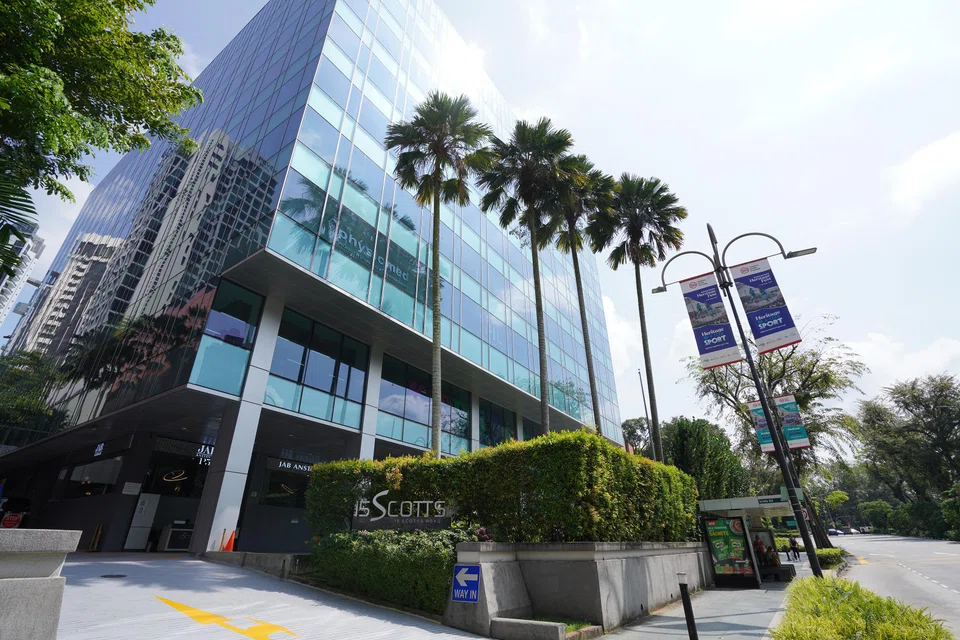
TOP Global has been busy selling strata units at 15 Scotts Road (previously called Thong Teck Building) post its delisting from the Singapore Exchange in August 2021.
Most recently, it has put up for sale two strata ground floor retail units, with a combined strata area of around 6,437 square feet (sq ft), at 15 Scotts Road – a District 9 freehold nine-storey commercial building located near the Tanglin Club.
Marketing agent Cushman & Wakefield said that the indicative price is S$38.8 million for the two units, or around S$6,000 per square foot (psf). The current tenants are a luxury home interior decor brand and a premium spa facility.
Interest could be high. Following new measures to cool the residential property market, the appetite for freehold strata office and retail spaces in prime locations is expected to be strong.
A foreigner who is not a permanent resident (PR) now pays a 60 per cent Additional Buyer’s Stamp Duty (ABSD) to buy a home here. The said foreigner pays no ABSD when buying non-residential properties.
For a non-PR foreigner, the difference in total stamp duties payable for buying a non-residential property and a residential property worth S$38.8 million amounts to S$23.6 million.
Moreover, there is scarcity value in centrally located strata commercial spaces. In March 2022, the Urban Redevelopment Authority restricted the strata subdivision of commercial components of developments in the Central Area – including Scotts Road.
Low-ball privatisation
Top Global was previously a listed entity. The group was successfully privatised by an investment company owned by Sukmawati Widjaja, who is the sister of tycoon Oei Hong Leong and daughter of the late Eka Tjipta Widjaja.
Sukmawati and her son Hano Maeloa owned nearly 87 per cent of Top Global at the time of the offer announcement. Sukmawati’s bid of S$0.39 per share in cash was deemed not fair but reasonable by the independent financial advisor Stirling Coleman Capital.
The reasons for the bid being seen as not fair included the offer price representing a discount to end-2020 net asset value (NAV) of about 47 per cent, and a discount to revalued NAV (RNAV) of about 68 per cent. The difference between RNAV and NAV largely came from development properties in Indonesia.
Grounds for the bid being deemed reasonable included the offer price being above various historical trading prices and poor trading volume of the shares.
I think regulations should be tightened to stop privatisations of property-linked groups from succeeding unless offers are made at around NAV.
Doing right
As a business leader with acumen, Sukmawati played by the rules of the game when she privatised Top Global.
But in the spirit of good governance and corporate social responsibility, should business leaders do more than merely play by the rules of the game?
Top Global held 23 strata office and retail units at 15 Scotts Road, worth about S$169 million as at end-2020.
Post-privatisation, the group sold eight strata office lots occupying about 8,643 sq ft to multiple buyers for around S$32 million in total, or just under S$3,700 psf in September 2021.
The Business Times understands from market sources that other sales by Top Global included office space on the third, sixth and eighth floors for a total of almost S$55 million, between February and December 2022.
A Cushman & Wakefield spokesperson said that Top Global is left today with three units at 15 Scotts Road – the two ground floor units being put up for sale and one strata unit on the second floor.
Perhaps Top Global should have unlocked value for all shareholders by selling units at 15 Scotts Road and other investment properties before going private.
Property groups are popular targets of privatisation attempts by major shareholders. For example, the Ong family, who are controlling shareholders of construction and property company Lian Beng Group , are in the midst of trying to privatise the group, with an offer that is significantly below NAV.
That property groups get privatised is unsurprising, given that many such groups trade way below book value.
Property groups should, however, be privatised in a fairer way. Sell the investment properties first and return the proceeds raised to shareholders. The remaining property development business, which may involve projects with long gestation periods and may generate lumpy earnings, can subsequently be taken private.
In future, independent directors of listed property groups that receive low-ball privatisation bids should insist that investment properties are put up for sale first.
Many societies are fraying because of rising inequality. Some people are losing faith in capitalism due to the generation of vastly unequal outcomes and perceptions of wealthy people unfairly gaming the system.
The business elite should learn to exercise restraint, to ensure the sustainability of capitalism. Regardless of what the rules are, treat workers, suppliers, customers and minority investors fairly. In short, business leaders must walk the talk on good governance.
Boards of undervalued asset-heavy listed property groups need to urgently do the right thing by working to unlock value for the benefit of all shareholders.