

Tourist arrival rebound points to better year for hospitality Reits
Pace of growth, if sustained, could help trusts ward off downward pressure on earnings

Nisha Ramchandani
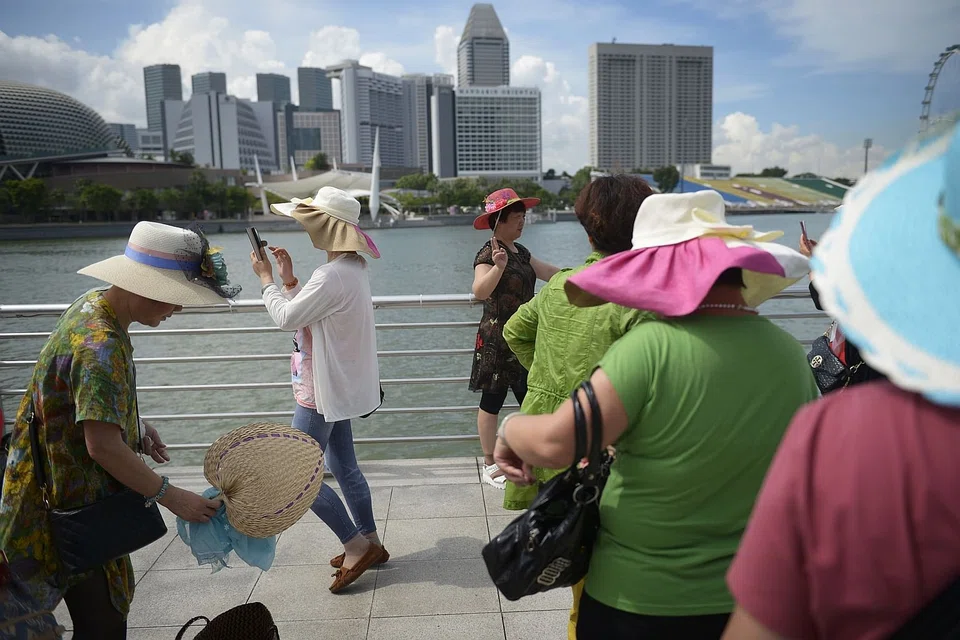
THINGS are looking a bit more optimistic this year for Singapore's hospitality real estate investment trusts (Reits) even with additional room supply coming onstream, as a resurgence in visitor arrivals this year could help stave off downward pressure on earnings.
According to preliminary data from the Singapore Tourism Board (STB), visitor arrivals to Singapore have rebounded this year, rising around 14 per cent year-on-year in the first four months to 5.53 million. This has been fuelled in part by a surge in arrivals from key source markets China (up 53 per cent) and Indonesia (up nearly 10 per cent). If growth keeps up at this pace, it suggests that arrivals will surpass the STB's own fairly cautious projections. In March, the tourism board had forecast visitor arrivals would expand by 0-3 per cent to between 15.2 million and 15.7 million this year, citing an uncertain global economy. For the whole of 2016, STB is forecasting 0-2 per cent growth in tourism receipts, at S$22 billion to S$22.4 billion.
In contrast, for 2015, arrivals edged up just 0.9 per cent to 15.2 million due to factors such as a strong Singapore dollar and a gloomy economic outlook. Meanwhile, spending by visitors slumped 6.8 per cent to S$22 billion, weighed down by a drop in business travellers.
Interestingly, China appears to have overtaken Indonesia to become the biggest source market of tourists this year - at least for the January to April period - with over 1.01 million visitors. The corresponding figure for Indonesia stands at nearly 919,240. One of the possible reasons for this is that the STB has been boosting efforts to tap the Chinese market by tying up with online travel services like Alitrip.
"This positive trends in visitor arrivals - if sustained - could offset the potential earnings pressure from an estimated 11 per cent increase in Singapore hotel rooms between 2016 and 2018," said Fitch Ratings in a recent report on Singapore hospitality Reits. The ratings agency said that earnings for these Reits should stabilise this year as a result.
Profit lift
Meanwhile, Reits such as Ascott Residence Trust, OUE Hospitality Trust (OUE HT) and CDL Hospitality Trusts (CDL HT) which have invested in new assets and/or refurbished existing assets should also see a lift to earnings, Fitch added.
This year should likely bring the benefit of a more robust MICE (meetings, incentives, conventions and exhibitions) calendar. "Even years typically tend to have a stronger line-up than 'odd' years, with biennial events such as the Singapore Airshow returning to the city-state. This could boost the number of business travellers, who on average spend more than leisure travellers."
Reits such as CDL HT, OUE HT and Far East Hospitality Trust with strong exposure to Singapore are likely to benefit from the uptick in the local tourism scene, Fitch said. Similarly, DBS Group Research picked CDL HT and OUE HT as favourites due to an anticipated 5 per cent growth in Singapore's tourist arrivals to 16 million this year.
Zooming in on the hotel sector, industry-wide average occupancy rate for the first four months of this year has edged up slightly by 1.4 percentage points to 84.6 per cent, STB data shows. While average room rate (ARR) has eased slightly by dipping around 2 per cent to around S$239, revenue per available room is nearly flat - or 0.8 per cent lower - at S$202. Based on RevPAR, mid-tier and upscale hotels appear to be the two categories posting growth, at 3 per cent and 2 per cent respectively.
OCBC Investment Research, which is neutral on the sector, flagged in a recent report: "We believe tourists are choosing to stay for shorter periods of time, and/or that an increased amount of transit traffic is passing through immigration."
"Nonetheless, the figures reported seem to indicate a decent Q2 and we expect that mid-tier players continued to pursue a strategy of higher occupancy and lower ARR for the quarter," the report added.
Where overseas exposure is concerned, certain markets are expected to perform well. For instance, cities such as Sydney and Melbourne have limited supply of hotel rooms, so demand in those cities is expected to hold up. Similarly, hotels in China reported RevPAR growth in the first quarter of this year, a trend which could potentially continue into the second half of the year. Meanwhile, the new Disneyland in Shanghai could boost domestic travel to the city.
On the other hand, markets such as Brisbane and Perth, for instance, are feeling the impact of softer spend from the mining sector as well as additional room supply coming onstream. Exposure to Britain could also be a worry, in the wake of Brexit, while travel to the Maldives is softer as the depreciation of the rouble is keeping Russian tourists at bay. But for Reits which receive fixed income from hotels, the downside to earnings will be muted, analysts have said.
Downside risks
Of course, there are other downside risks too, given headwinds in the global economy, which could end up dampening both leisure and business travel demand. Competition is stiff for the local tourism industry as regional neighbours are vying for a bigger slice of the tourism pie.
Should the rebound in visitor arrivals to Singapore sputter out in the second half of the year, this could hit earnings, especially as new supply is added to the existing inventory of 60,900 hotel rooms at the end of last year). But for now, the double-digit rise in tourist arrivals is lending the local tourism industry some lost shine and this suggests that the hospitality Reits are at least facing better prospects than they were a year ago.
TRENDING NOW

Indonesia’s coal tycoon Low Tuck Kwong replaced as Bayan Resources president-director

Nvidia reinstates Jensen Huang as CEO; Trump says move poses no national security risk

Six workers file employment claims against Crystal Jade Food Manufacturing

AI agents and stablecoins a ‘perfect match’ for payments, says MetaComp’s Tin Pei Ling

