

Trump is still in; but Trumpism may be out
Even the harshest critics of Trump would agree that he is not an anti-Semite or a racist
BEFORE leaving Washington for three weeks of overseas travel and vacation, I emailed my editor at BT that "nothing really happens in Washington in August". Politically, it's a dead month. After all, Congress is in recess and lawmakers travel back home to their districts.
Federal government workers, media types and politicos are on vacation and those left behind can get a seat on the subway or Metro. And, hey, even President Donald Trump vacated the White House (which is being renovated) and left town to play golf in a resort in New Jersey. So take care, and let's meet again after Labor Day weekend next month.
Like what could really get wrong while I am away? Like how about a war with North Korea which has threatened to launch missiles against the US-controlled island of Guam with the American president promising to retaliate with "fire and fury"? This could all ignite a nuclear war and destroy the entire world before I'll get back to Washington. Bummer!
And then poof, out of the blue, the whole world was watching the violent clashes in Charlottesville, Virginia. If you were travelling on a time machine back from the 1860s, you could imagine that the nation was still in the midst of the Civil War between the North and the South.
In fact, the violence in the state of Virginia, where the capital of the Southern Confederacy was located, was sparked by an earlier decision to take down the statue of Robert E Lee, the renowned military general and leader of the seceding South, who is still revered by many Virginians. Many of those objecting to the move were not racists, white nationalists or Nazis but southerners who wanted to preserve a symbol of their tradition and history.
That in turn could have opened a civilised debate, with those supporting the removal of the statute contending that while Gen Lee may have been a symbol of American heroism, a monument honouring a man who served the secessionist and slave-owning state was a moral affront to many citizens, including African-Americans, and should be taken down.
That was certainly the view of many of the counter-protesters, including members of civil rights organisations, who showed up in Charlottesville. But there they were joined by members of more radical groups such as Black Lives Matter and anti-fascist or Antifa groups consisting of communists, socialists and anarchists who advocate violent political action.
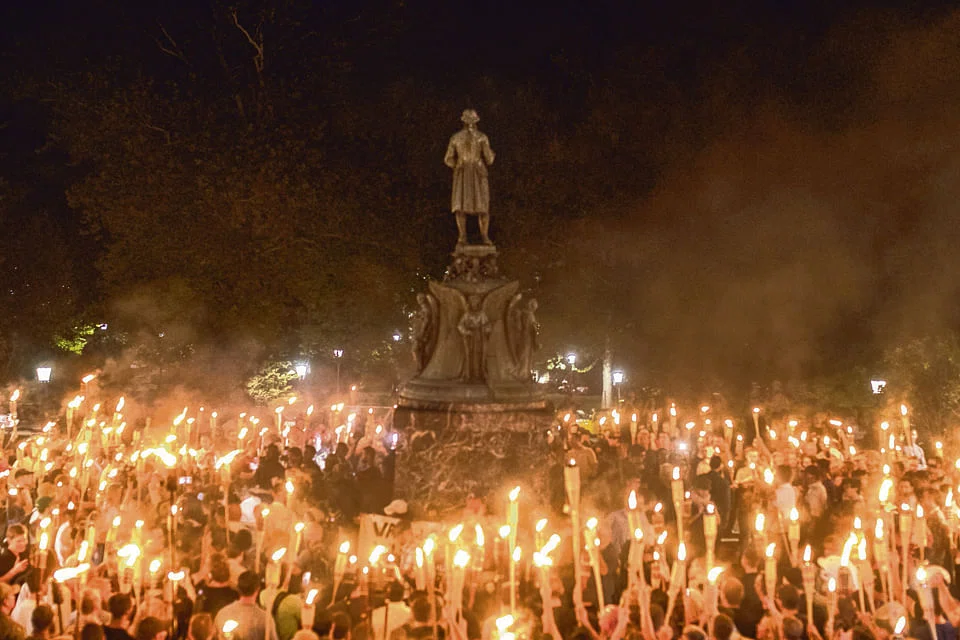
Confronting them were hundreds of marchers representing the Ku Klux Klan (KKK), white supremacist and neo-Nazi organisations. They carried Nazi flags and torchlights, chanting fascist slogans such as "blood and soil" and "Jews will not replace us" while hurling verbal abuse and beating their opponents, although they later blamed the other side for starting the violence.
During the mayhem that ensued, one of the right-wing demonstrators drove his car into a group of left-wing protesters, injuring several of them and killing one young woman.
Now if you were sitting in a bar watching all of this on television and cursing the Nazi demonstrators and someone sitting next to you by the name of, say, Donald Trump, commenting, "Hey, man, but those communists on the other side were also violent" and "there were some good people on both sides", you may have ended up having an argument and calling him some names.
A conservative talking head on Fox television news by the name of Donald T could have argued that many of those objecting to the removal of Gen Lee's statue were not Nazis, while a newspaper columnist by the name of D Trump could have written that the white supremacist and neo-Nazi groups, very much like the Antifa demonstrators, represent a very tiny minority of a few thousand people with no political influence and should basically be ignored.
But if you are Donald Trump, the president of the United States, you don't have the luxury of responding to the Charlottesville violence by presenting a complex on-one-hand/on-the-other-hand/on-the-third-hand arguments in the form of stream-of-consciousness run-amok babble, which is basically what Mr Trump did during his initial response to the events. Instead, in the aftermath of the scenes of marchers holding Nazi flags and wearing white outfits of the KKK, you should have condemned the hate and bigotry that these groups represented.
After all, American presidents led the nation to war to defeat the forces that supported these forces of evil. Which Mr Trump finally did in prepared remarks 48 hours later, only to revert to drawing moral equivalency between the white nationalist protests and the counter demonstrators on Wednesday, during off-the-cuff remarks in Trump Tower following an event in New York City.
Mr Trump's conduct and response drew rage and fury from his many bashers on the political left and the Democratic Party and the Mainstream Media which seemed to suggest that he was trying to pander to his right-wing supporters and that he himself may been sympathetic to their political causes. But the White House occupant has also been criticised by members of the GOP establishment, including leading Republican lawmakers and former presidential candidates, concerned that their political party would now be associated with proponents of racism and anti-Semitism on the political right.
Yet even the harshest critics of Mr Trump would agree that the former real estate magnate from New York City who has spent his life working and socialising with Jews and African-Americans, and whose daughter married an observant Jew and converted to Judaism, isn't an anti-Semite or a racist.
But then much of the populist, anti-immigration and anti-globalist agenda - or Trumpism - that helped elect the Donald to the presidency reflected some nationalist, protectionist and nativist sentiments that tend to be associated with fringe groups on the xenophobic political right.
Helping Candidate and later President Trump to draw the outlines of the nationalist platform that came to be known as Trumpism has been Steve Brannon, the controversial former editor of Breibart, an online news site that promotes anti-free trade and anti-immigration themes. Since Mr Trump entered office and appointed Mr Bannon as his top White House strategist, the dominant political narrative in Washington went something like this:
Mr Bannon has been trying to press the president to embrace policies, especially on international trade and immigration, that reflect his nationalist positions. But his influence has been counterbalanced by members of a "globalist" clique that included his son-in-law Jared Kushner and his daughter, Ivanka, joined by several Wall Street veterans, led by his top economic adviser, Gary Cohn, which explains why the White House has yet to launch a costly trade war against China.
The influence of the so-called "globalists" has been enhanced thanks to the pressure of the retired generals who occupy the major national security positions in the administration and who have stirred Mr Trump's foreign policy in a more internationalist direction. So when one of these generals, John Kelly, was appointed as the new White House Chief-of-Staff, Washington insiders predicted that Mr Bannon and his nationalist buddies would be losing power.
And when the White House announced at the end of the crazy political week that Mr Bannon was out, it seemed to be a sign that the balance of power at the White House was shifting in the direction of the clique dominated by the Trump-Kushner Dynasties, Wall Street and the Generals, suggesting that this round may have ended with the triumph of the globalists. But then there are probably going to be many more rounds to come after yours truly returns to Washington.
TRENDING NOW

Singapore’s central gas buyer affirms Indonesia’s role as ‘important partner’ amid export review warning

Why the biggest business decision about AI isn’t which model to choose

Is Manila Asia’s new dining hot spot?

KKR founders among investors buying 42% of Peter Lim’s Valencia; club valued at US$1.4 billion

